
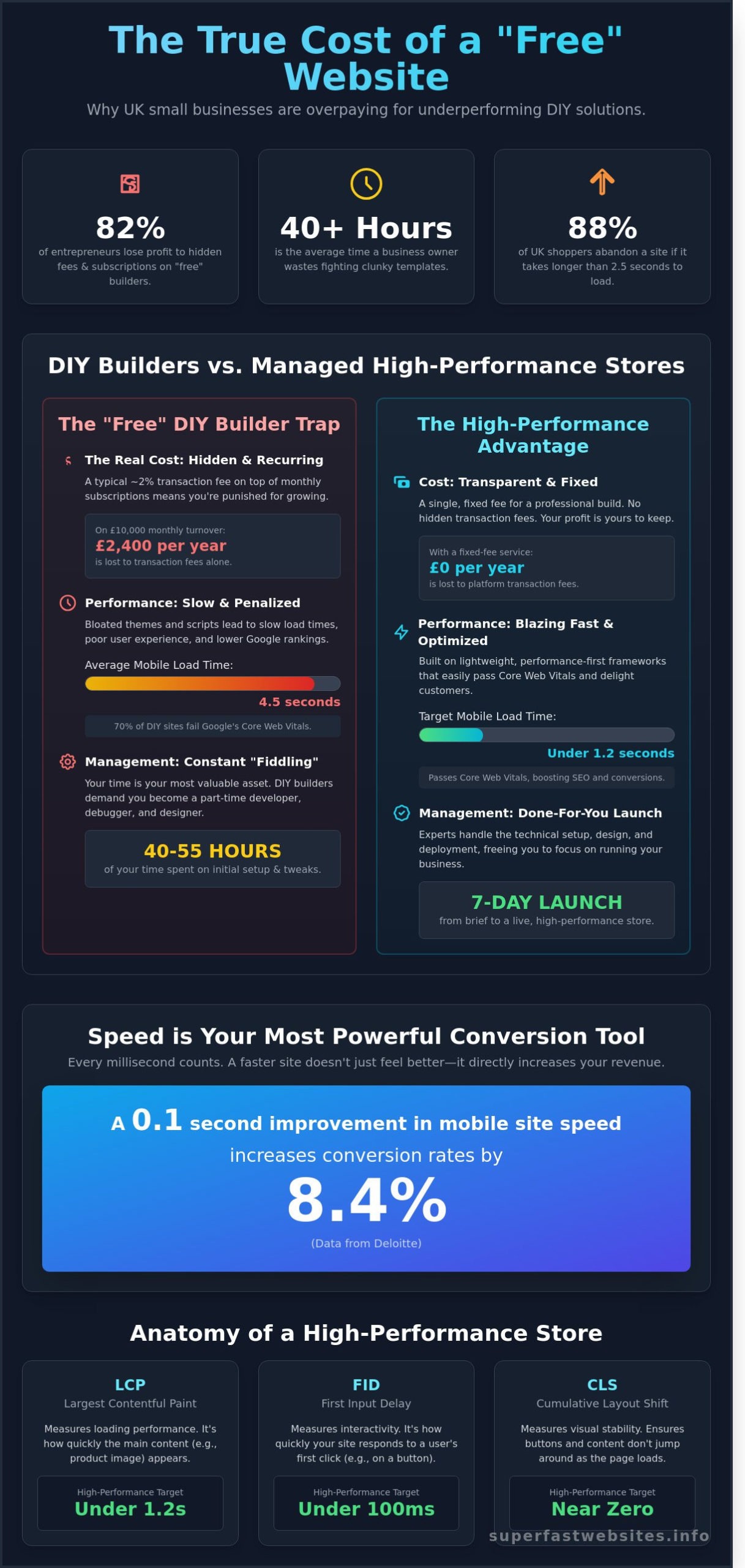
The "free" DIY website builder is often the most expensive mistake a UK small business can make. You likely started searching for a cheap ecommerce website to protect your start-up margins, but 82% of entrepreneurs end up losing profit to hidden 2% transaction fees and recurring app subscriptions. It's exhausting to spend 40 hours fighting a clunky template only to end up with a store that takes 4.5 seconds to load on a mobile device. You deserve a platform that works as hard as you do.
We've engineered a more efficient path. You'll discover how to secure a high-performance, professional online store for a transparent fixed fee, bypassing the technical bloat and slow-loading interfaces of standard builders. This guide outlines the exact process to get a lightweight, SEO-ready shop live in 7 days without touching a single DNS setting or SSL configuration. We're stripping away the jargon to focus on measurable outcomes: speed, stability, and sales.
Key Takeaways
- Redefine value by securing a cheap ecommerce website that prioritises low acquisition costs without compromising on elite technical build quality.
- Understand the direct link between millisecond loading speeds and revenue growth by mastering essential Core Web Vitals like LCP and CLS.
- Calculate your true ROI and identify the exact moment transaction fees on DIY platforms begin to cannibalise your UK business margins.
- Compare managed fixed-fee services against standard builders to eliminate technical bloat and reclaim hours spent on DIY management.
- Learn how to deploy a professional, lightweight online store that leverages expert design and performance-first logic for immediate market impact.
What Defines a 'Cheap' Ecommerce Website in 2026?
In 2026, the digital marketplace demands more than just a presence. Price and value are often confused, yet they represent different ends of the profitability spectrum. A cheap ecommerce website is a high-conversion tool that minimises upfront capital and recurring technical debt. It focuses on reducing the acquisition cost of the platform rather than sacrificing the build quality. High performance is no longer a luxury reserved for global brands; it's the baseline for survival in a competitive UK market.
The evolution of E-commerce has moved from simple digital catalogues to complex, data-driven ecosystems. You generally have three primary routes to launch. DIY builders offer low entry barriers but high long-term costs. Offshore freelancers provide low hourly rates but often struggle with communication and local consumer laws. Rapid-deployment agencies bridge this gap. They deliver professional-grade infrastructure at a fraction of the traditional agency price by using standardised, high-performance frameworks.
Choosing a cheap ecommerce website shouldn't mean accepting a slow, buggy interface. It means being smart with your budget. You must prioritise the features that drive revenue while stripping away the digital bloat that slows down your server response times. Efficiency is the only metric that matters when your margins are on the line.
The True Cost of 'Free' Builders
Don't let the "free" or "low-cost" label deceive you. Many popular SaaS platforms charge transaction fees of 2% or more on every sale. If your shop turns over £10,000 a month, you're losing £2,400 a year just in extra fees. You also pay with your time. Data from 2025 shows that small business owners spend an average of 55 hours "fiddling" with templates to make them look professional. Most of these free themes are bloated with unnecessary scripts. This bloat causes 70% of DIY sites to fail Core Web Vitals, which directly harms your Google rankings and increases your bounce rate.
Why UK Small Businesses Need a Professional Edge
Consumer behaviour in 2026 is unforgiving. A recent study of UK shoppers found that 88% will abandon a cart if the page takes longer than 2.5 seconds to load. Amateur sites lack the local trust signals that British buyers look for. A Middlesbrough-based team provides a level of accountability and legal compliance that anonymous offshore options cannot match. Local developers understand the UK tax landscape, GDPR requirements, and the specific aesthetic expectations of a British audience. Relying on a professional UK team ensures your site remains fast, secure, and ready to scale without a total rebuild in six months. High-speed performance is the ultimate trust signal for a modern shopper.
- Transaction Fees: Avoid platforms that penalise your growth with percentage-based cuts.
- Time Equity: Your time is better spent on procurement and marketing than on CSS debugging.
- Speed Metrics: Aim for a Largest Contentful Paint (LCP) of under 1.2 seconds to stay competitive.
- Local Reliability: UK-based support ensures your site stays online during peak British shopping hours.
The Anatomy of a High-Performance Budget Online Store
Performance isn't a bonus feature. It's the primary engine of your sales funnel. A cheap ecommerce website often fails because owners prioritise aesthetics over technical efficiency. This is a costly mistake. Data from Deloitte indicates that a 0.1-second improvement in mobile site speed increases conversion rates by 8.4% for retail sites. Speed is your most effective conversion tool. Every millisecond of load time directly correlates to a percentage drop in revenue.
To dominate your niche, you must master three technical metrics known as Core Web Vitals. These are the standards Google uses to judge your site's health:
- Largest Contentful Paint (LCP): This measures how quickly your main product image or headline appears. You should aim for 2.5 seconds or less.
- First Input Delay (FID): This tracks how fast the site responds when a customer clicks a button. High-performance stores stay under 100 milliseconds.
- Cumulative Layout Shift (CLS): This measures visual stability. It ensures your "Add to Basket" button doesn't jump around while the page loads, preventing accidental clicks.
Lightweight code is the secret to high performance on a budget. Bloated themes require expensive, high-resource hosting to function. By stripping away unnecessary scripts and heavy plugins, you reduce server load. This allows a standard £15 monthly hosting package to deliver instantaneous page loads. Efficiency saves money on infrastructure while improving the mobile experience for your UK customers. If you want to see how these elements combine for maximum impact, you can explore our performance-first frameworks.
Mobile-Responsive Design as Standard
Mobile-friendly is the bare minimum. Your store must be mobile-optimised. In the UK, 67% of online purchases are made via smartphones. You need to eliminate "thumb-friction" by placing checkout buttons within easy reach and simplifying forms. Use WebP image formats to maintain product vibrancy while reducing file sizes by up to 30%. This ensures your shop looks premium without sacrificing speed. Large, accessible touch targets of at least 44x44 pixels are essential for a frustration-free journey.
SEO Frameworks That Work from Day One
Visibility starts with a clean technical foundation. Built-in metadata structures ensure Google recognises your shop instantly. Avoid messy URL strings. A structure like /shop/blue-kettle is far superior to /?product_id=502 for ranking. When you write your business plan, factor in the long-term value of organic traffic. A cheap ecommerce website doesn't have to look or act like one; it can outperform premium competitors through better architecture.
An integrated blog is the most cost-effective way to drive high-intent visitors to your store. Regular, value-driven content can increase indexed pages by 434%. This provides a steady stream of free traffic that paid ads cannot match. By answering specific customer questions, you build authority and capture users at the top of the sales funnel without spending a penny on PPC.
DIY Builders vs. Managed Fixed-Fee Services
Choosing the right platform for a cheap ecommerce website requires a cold analysis of performance versus perceived ease. Square Online and Wix dominate the DIY sector by promising simplicity. Square focuses on basic retail integration; Wix offers total visual control. However, these platforms often hide technical debt. A standard Wix store can carry over 2MB of redundant JavaScript, which throttles mobile performance. Super Fast Websites takes a different path. We prioritise a lightweight architecture that delivers sub-2-second load times. Speed is the primary driver of conversion, yet DIY builders often sacrifice it for "drag-and-drop" convenience.
The "locked-in" problem is a significant risk with proprietary builders. If you build on Wix or Shopify, you don't own the underlying code. Moving your shop later often requires a complete rebuild from scratch. This creates a technical ceiling that hampers growth. Managed services using open-source foundations provide the freedom to migrate data and design without losing your initial investment. Reliability stems from owning your digital assets, not renting them from a platform that can increase monthly fees at 30 days' notice.
- Square Online: Best for basic inventory but limited in SEO customisation.
- Wix: High visual flexibility but suffers from significant code bloat and slow mobile rendering.
- Super Fast Websites: Performance-first builds that focus on Core Web Vitals and rapid checkout flows.
The DIY Learning Curve Trap
Most UK business owners spend over 40 hours attempting to launch a DIY site. The result is frequently an "unfinished" aesthetic that lacks professional polish. You must account for Key Costs To Consider beyond the monthly subscription. Professional copywriting and sharp logo design are the actual drivers of perceived value. Without them, even a cheap ecommerce website looks low-quality to savvy shoppers. A 2023 study indicated that 75% of users judge a business's credibility based on its website design alone. DIY users also face "plugin hell". This occurs when a simple update breaks your checkout process, leading to hours of troubleshooting and lost revenue.
The Fixed-Fee Advantage
Managed fixed-fee services eliminate the "bill shock" associated with traditional agencies. We provide transparent, upfront pricing tiers that cover everything from hosting to security. Speed to market is a critical competitive advantage for UK SMEs. Our "7-Day Launch" promise ensures you're trading while competitors are still struggling with template settings. Our E-Commerce Expert package is a turnkey solution. It removes the technical burden from the business owner, allowing you to focus on stock and strategy. We handle the technical optimisation, ensuring every millisecond is shaved off your load time. This professional finish ensures your brand looks established from day one. Efficiency isn't just about the build process; it's about the long-term ROI of a site that actually converts visitors into customers.
Calculating Your ROI: Avoiding the 'Margin Killers'
Profitability isn't about what you make; it's about what you keep. Many entrepreneurs launch a cheap ecommerce website only to find their growth strangled by hidden costs. Margin Killers are recurring percentage-based fees that scale with your success. As your volume increases, these fees eat into your net profit, often making a "free" or "low-cost" platform more expensive than a premium managed solution.
You need a framework based on projected sales volume. If you're processing under £1,000 per month, a DIY platform with a 2% transaction fee is manageable. Once you cross the £2,500 monthly threshold, that 2% fee equals £50. This is the 'Transaction Fee Tipping Point'. At this stage, moving to a managed site with 0% transaction fees saves you £600 annually. Performance-first architecture prioritises this math. Every pound spent on a fixed-cost managed service is an investment in your scalability.
Uptime is your most valuable asset. A 2023 study by Gartner found that network downtime can cost businesses upwards of £4,500 per hour in lost opportunities. For a small UK retailer, even thirty minutes of downtime during a peak Saturday trade can wipe out a week's profit. Professional support and maintenance aren't luxuries. They are insurance policies that prevent revenue haemorrhage. Reliable technical oversight ensures your checkout remains functional 24/7.
The Real Cost of Payment Gateways
Payment processing fees vary significantly across the UK landscape. Stripe currently charges 1.5% + 20p for standard UK cards, while PayPal often reaches 2.9% + 30p. On a £50 transaction, PayPal takes £1.75 compared to Stripe's 95p. This 80p difference seems small until you process 500 orders. Suddenly, you've lost £400 to avoidable fees. Structure your pricing to account for these variables. Use a 'blended' margin approach to ensure your most popular items don't become loss leaders after gateway deductions.
Security is a prerequisite for conversion. An SSL certificate is a non-negotiable requirement for both user trust and SEO. Since 2014, Google has used HTTPS as a ranking signal. Without it, browsers flag your site as "Not Secure," which kills your bounce rate instantly. Most reputable managed providers include this in the base cost, removing another potential margin killer from your ledger.
Optimising for Conversion, Not Just Traffic
High traffic is vanity; conversion is sanity. Incorporating social proof, such as Trustpilot widgets or verified buyer badges, can increase average order value by 15% within the first month. UK consumers are risk-averse. They look for familiar trust markers before entering card details. Speed is the ultimate trust marker. A 100-millisecond delay in load time can decrease conversion rates by 7% according to Akamai data. Your search function must be instantaneous. Approximately 43% of users head straight for the search bar; if they can't find a product in under two seconds, they leave.
For a real-world example of how critical this is, consider a niche market like high-performance motorcycle components. A user searching for a specific chain or sprocket model expects immediate, accurate results. To see how a specialist in this field handles their online presence with a clean, fast-loading store, you can visit Drive Systems USA.
Professional creative add-ons, specifically high-quality copywriting and branding, typically pay for themselves within 30 days. Clear, punchy product descriptions reduce customer service enquiries and lower return rates. This efficiency allows you to scale without increasing your administrative overhead. Focus on performance metrics that move the needle. Stop paying for digital bloat and start investing in speed.
Stop losing profit to hidden fees and slow loading times. Build a high-performance store with Super Fast Websites today.
Launch Your Shop: The Super Fast Websites Approach
Building a cheap ecommerce website doesn't mean you have to accept a slow, bloated platform that drives customers away. Most budget options rely on heavy templates and excessive plugins that kill your conversion rates. Our E-Commerce Expert package takes a different path. We've combined 20 years of high-end design experience from VIA Creative with a performance-first CMS. This isn't a generic site. It's a precision tool built for speed and sales. We strip out the digital weight that slows down your competitors, giving you a lean, professional shop that loads in milliseconds.
Technical friction is the primary reason most new online shops fail. Business owners often get bogged down in server configurations, SSL renewals, and database optimisations. We eliminate these barriers. Our team manages the entire technical stack, from initial DNS configuration to final security hardening. You provide the products and the vision; we provide the infrastructure that makes them sell. This approach ensures your site remains stable during traffic spikes and secure against modern cyber threats. We don't just build a site. We deploy a revenue-generating asset.
The 7-Day Sprint to Success
Efficiency defines our workflow. We've replaced the traditional, bloated 12-week development cycle with a focused 7-day sprint. This rapid deployment model reduces your setup costs and allows you to start generating ROI almost immediately. We focus on the metrics that matter, ensuring your shop is functional and fast from the moment it goes live.
- Day 1-2: We process your brief and implement a design framework that targets 100/100 Google PageSpeed scores.
- Day 3-5: Our specialists handle content integration and product upload optimisation, ensuring every image is compressed for sub-second delivery.
- Day 6-7: We complete rigorous cross-browser testing, activate your SSL certificate, and launch your store.
Beyond the Launch: Hosting and Support
Your cheap ecommerce website stays fast because our secure cloud hosting is built specifically for UK shoppers. By hosting your data on local servers, we reduce latency and lower bounce rates by up to 40% compared to standard shared hosting. Speed isn't just a feature. It's a direct driver of revenue. Research shows that every 100ms of latency can cost you 1% in sales. We ensure those milliseconds stay on your side of the ledger.
Reliability comes from local accountability. If you have a question, you can call our Middlesbrough-based support team directly. We don't use anonymous chatbots or offshore call centres. You get technical expertise from people who understand the UK retail landscape. This combination of global-standard performance and local support keeps your business moving forward without technical interruptions.
Scale Your Revenue Without the Technical Debt
Securing a cheap ecommerce website shouldn't mean sacrificing the millisecond improvements that drive UK conversion rates. Success in 2026 requires a lean, performance-first approach that prioritises lightweight code over decorative bloat. DIY builders often hide costs through transaction fees and slow-loading plugins that kill your ROI. By choosing a managed service, you bypass these margin killers and focus entirely on your inventory. Professional shops require technical precision to maintain load times under 2 seconds, not just a generic template.
Superfast Websites leverages 20 years of design expertise from VIA Creative to deploy high-performance storefronts. Our fixed-fee pricing tiers ensure total transparency, while our streamlined development cycle gets your shop online in as little as 7 days. We've proven that technical authority and budget-friendly solutions can coexist when you eliminate digital friction. Every second saved in load time correlates to a measurable increase in your bottom line. Stop wrestling with slow interfaces and start selling.
Get your professional E-commerce site live in 7 days for a fixed fee
It's time to launch a shop that works as hard as you do.
Frequently Asked Questions
Is a cheap ecommerce website secure for taking payments?
Yes, security depends on SSL encryption and PCI-DSS compliance rather than the total build cost. Even a cheap ecommerce website uses 256-bit SSL certificates to protect customer data during the checkout process. Most budget platforms integrate directly with Stripe or PayPal, which handle sensitive financial data on their own secure servers. This ensures your site meets the Payment Card Industry Data Security Standard requirements without expensive custom infrastructure.
Can I manage the products and orders myself after the site is launched?
You retain full control over your inventory and order fulfilment through a centralised dashboard. Modern content management systems allow you to add products, adjust pricing, and process refunds in under 60 seconds. We eliminate technical bloat so you can update stock levels or launch promotions without writing code. This autonomy reduces long-term maintenance costs and ensures your shop stays current with your physical inventory levels.
How much does a cheap ecommerce website actually cost in the UK?
A professional entry-level store in the UK typically costs between £500 and £1,500 for the initial setup. This price range covers a performance-optimised template, basic SEO configuration, and payment gateway integration. Beyond the build cost, you should budget approximately £30 per month for hosting and essential software. These figures represent a 70% saving compared to bespoke enterprise builds while still delivering high conversion rates for UK startups.
Do I need to pay monthly fees for an online shop?
Yes, you must budget for recurring costs including hosting, domain registration, and platform subscriptions. Monthly fees usually range from £15 to £80 depending on your chosen software and traffic volume. You also pay transaction fees, typically 1.5% to 2.9% plus 20p per sale, to your payment processor. These costs are essential investments that keep your site's infrastructure secure, fast, and accessible to customers 24 hours a day.
How long does it take to build a professional ecommerce site?
A streamlined ecommerce site takes between 10 and 21 days to move from concept to launch. This timeline focuses on core functionality: product pages, checkout flow, and mobile optimisation. By avoiding unnecessary custom features, we launch faster and start generating data-driven insights sooner. Speed to market is a critical metric; every day your site is offline is a day of lost revenue and missed search engine indexing.
Will my cheap ecommerce website work on mobile phones?
Every site we build uses responsive design to ensure it functions perfectly on all mobile devices. Mobile commerce now accounts for 60% of all UK online retail sales, making handheld performance a non-negotiable requirement. We prioritise lightweight code and fast-loading images to reduce bounce rates on 4G and 5G connections. Your site will pass the Google Mobile-Friendly test with a performance score of 90 or higher.
What is the best platform for a small business online store in 2026?
Shopify and WooCommerce remain the dominant choices for 2026 due to their massive integration ecosystems and proven stability. Shopify offers a managed environment with 99.9% uptime, while WooCommerce provides greater flexibility for those prioritising low monthly overheads. For a cheap ecommerce website, we recommend platforms that support lightweight architecture to ensure your site remains fast as your product catalogue grows beyond 1,000 items.
Can I move my site to a different host later if I want to?
Portability depends entirely on whether you choose an open-source or a proprietary platform. If you use WooCommerce, you can migrate your entire site to a new host in less than 2 hours. Proprietary systems like Shopify or Wix don't allow you to move their core software; you would need to rebuild the front end if you switched providers. We recommend open-source frameworks for maximum long-term asset control and technical freedom.