
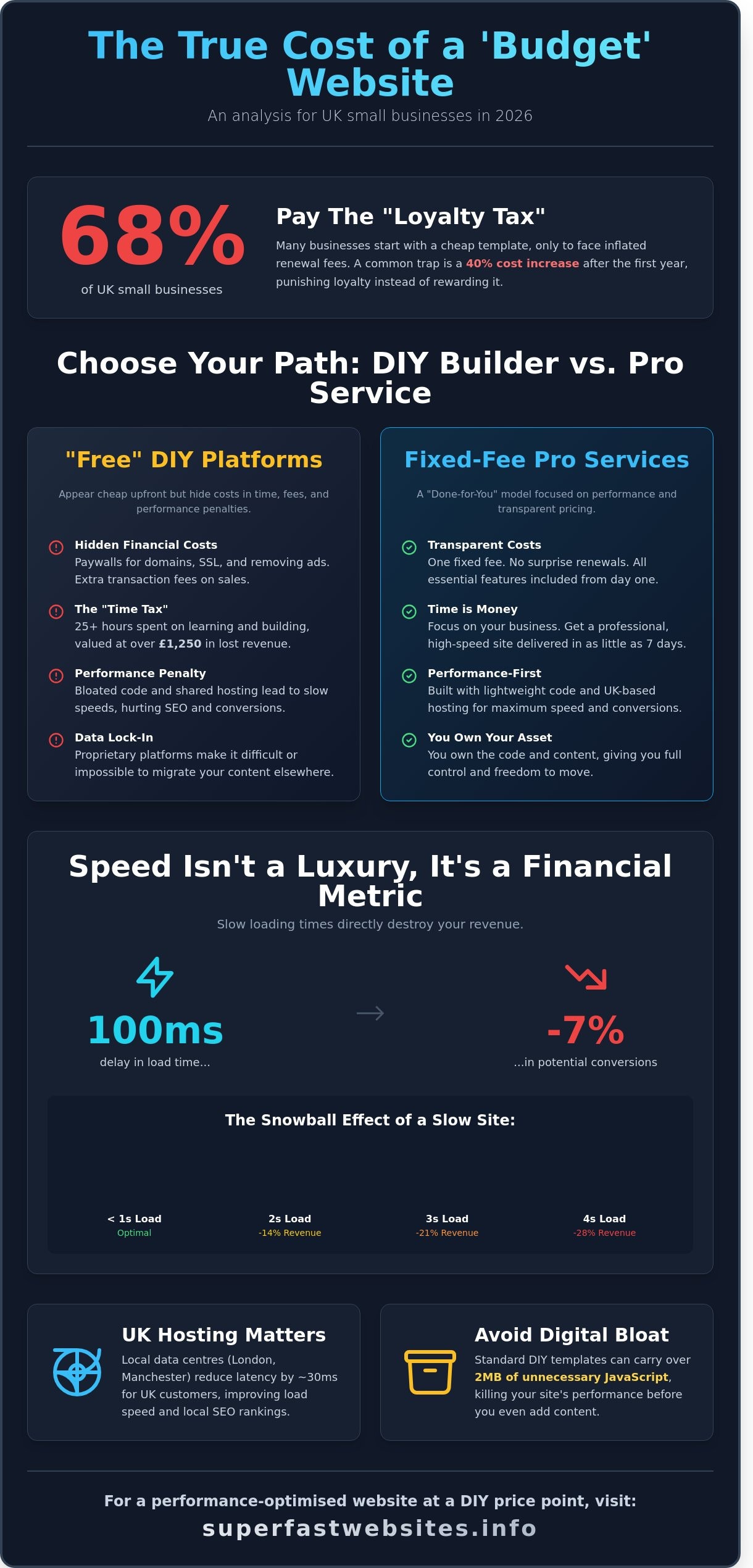
Why are 68% of UK small businesses still paying "loyalty taxes" on inflated renewal fees? You likely started with a cheap template only to watch your monthly costs jump by 40% after the first twelve months. Finding the best budget website builder UK isn't just about the lowest entry price; it's about securing a high-performance platform that doesn't punish your growth with hidden extras or slow loading speeds. Data shows that every millisecond your site lags costs you approximately 7% in potential conversions.
You're right to be sceptical of "free" builders that lock your data behind expensive paywalls. You deserve a professional site that loads in under 2 seconds without spending forty hours fighting a clunky DIY interface. This guide reveals how to launch a mobile-responsive site for under £15 per month while maintaining elite technical standards. We've stripped away the marketing fluff to focus on measurable outcomes like Core Web Vitals and transparent, fixed-fee structures.
We'll audit the top value-driven options for 2026 to ensure your business benefits from lightweight code and reliable UK-based support. You'll learn how to bypass the digital bloat that kills SEO rankings and secure a fast, cost-effective digital presence that actually drives revenue.
Key Takeaways
- Identify the critical differences between low-cost DIY platforms and fixed-fee professional services to avoid long-term technical debt.
- Calculate the hidden "time-tax" of free website builders and why sacrificing 20+ hours on a build often costs UK businesses more in lost revenue.
- Compare the performance metrics of Wix, Hostinger, and GoDaddy to secure the best budget website builder UK for your specific 2026 business goals.
- Learn how to select a technical architecture that matches your industry, ensuring your site is optimised for maximum conversion from day one.
- Discover the "Done-for-You" rapid deployment model that delivers a professional, high-speed website in just seven days at a DIY price point.
Defining the Best Budget Website Builder in the UK for 2026
In 2026, the definition of the best budget website builder UK has shifted from the cheapest monthly subscription to the highest return on investment. A low price tag means nothing if the platform fails to convert visitors. True budget value is found where technical performance meets cost efficiency. To understand the landscape, you must first ask: What is a website builder? and how does its architecture impact your bottom line?
The UK market currently splits into two camps. You have DIY platforms with recurring monthly fees and fixed-fee professional services. DIY options often appear cheaper upfront. However, professional services provide a "done-for-you" approach that eliminates the time-cost of building it yourself. Choosing a UK-centric provider is vital. Local hosting in London or Manchester data centres reduces latency by approximately 30ms compared to US-based servers. This proximity improves local SEO rankings and ensures your support team operates in your time zone.
Sticker Price vs. Total Cost of Ownership
Marketing departments love introductory rates. A platform might offer a £10 monthly fee for the first year, only to hike it to £25 in year two. This 150% increase often catches small businesses off guard. You must calculate the three-year total cost of ownership. Many "free" plans require paid add-ons for essential features like custom domains or SSL certificates. These "extras" can add £150 to your annual bill. High-performance budget builders include these as standard, protecting your margins from hidden renewals.
Why Speed is a Non-Negotiable Budget Feature
Speed isn't a luxury; it's a financial metric. Data from 2024 shows that a 100-millisecond delay in load time can drop conversion rates by 7%. If your "budget" site takes three seconds to load, you're losing 21% of your potential revenue before the page even appears. This makes bloated DIY templates expensive in the long run. Lightweight code is the foundation of the best budget website builder UK. It ensures your marketing budget isn't wasted on high bounce rates. Efficient sites also lower your Cost Per Click (CPC) in Google Ads by improving your Quality Score. Performance-first builds pay for themselves through these invisible savings.
- Latency: UK-hosted sites load 20-50% faster for local users.
- Bloat: Standard DIY templates often carry 2MB of unnecessary JavaScript.
- Conversion: Every second saved increases mobile revenue by up to 27%.
The Hidden Costs of "Free" DIY Website Platforms
A "free" website plan is a marketing funnel, not a business solution. Professional UK enterprises require custom domains and ad-free interfaces to establish credibility. Most entry-level tiers for the best budget website builder UK options lock these essentials behind paywalls. You'll likely face monthly fees of £15 to £30 just to remove third-party branding. These platforms also hide costs in transaction fees. Some budget e-commerce plans charge an extra 2% per sale on top of standard payment gateway fees. These hidden costs of website builders quickly exceed the price of a high-performance managed solution.
- Premium Plugins: Basic builders lack advanced SEO tools or custom contact forms. Adding these often requires monthly subscriptions totalling £40 or more.
- Digital Bloat: Shared hosting environments on budget platforms slow down your site. Every second of load time costs you 7% in potential conversions.
- Data Lock-in: Moving your content off a proprietary builder is often impossible. You don't own the code; you rent it.
The Learning Curve and Opportunity Cost
Building a site yourself takes time. Expect to spend at least 25 hours learning the interface and troubleshooting layouts. If your time is valued at £50 per hour, your "free" site has already cost you £1,250 in lost billable hours. Technical mistakes made during this phase often require expensive professional fixes later. 40% of DIY users report high levels of "builder frustration" when trying to align simple elements. You should focus on your business growth while we handle the performance-optimised technical architecture for you.
Compromised Branding and Professionalism
First impressions are formed in 0.05 seconds. A "Made with" banner signals a lack of investment to your customers. Budget platforms rely on templates used by thousands of other businesses. This creates a "cookie-cutter" look that fails to differentiate your brand in the UK market. Mobile performance is another critical failure point. With 60% of UK web traffic originating from mobile devices, poor responsiveness is fatal. The best budget website builder UK users often discover that heavy, unoptimised code fails Core Web Vitals, causing search rankings to plummet. Efficiency is not optional; it's a requirement for visibility.
Comparing the UK’s Leading Budget Contenders: Wix vs Hostinger vs GoDaddy
Choosing the best budget website builder UK requires looking past the monthly subscription fee. You must calculate the cost of lost conversions caused by slow loading times. Most DIY platforms sacrifice technical performance for visual flair. This trade-off impacts your bottom line. A site that takes three seconds to load loses 40% of its visitors before the first image appears. We evaluate these contenders based on their ability to deliver speed and ROI.
Wix and Squarespace: Design vs. Bloat
Wix and Squarespace dominate the visual market. Their templates look professional, but the underlying code is often heavy with redundant JavaScript. In early 2026, Wix's basic UK plan costs £11 per month. Squarespace averages £12. These "all-in-one" ecosystems simplify management but restrict your ability to optimise for Core Web Vitals. Beginners appreciate the drag-and-drop flexibility. However, as your page grows, the performance tax becomes evident. Large image assets and unoptimised scripts can push mobile load times over 4.5 seconds.
Hostinger and GoDaddy: The Low-Cost Entry Points
Hostinger is the current price leader in the UK market. Their entry-level plans often sit at £2.59 per month. Their lightweight builder prioritises server-side efficiency over complex animations. This results in faster Time to First Byte (TTFB) metrics. GoDaddy’s "Airo" AI features, refined throughout 2025, allow users to generate a functional site in under 60 seconds. It's a high-speed shortcut for micro-businesses. However, Expert Market's 2026 UK website builder comparison notes that Hostinger outperforms GoDaddy on global server response times by 18%. Both platforms struggle with complex, multi-page requirements. They lack the database depth needed for advanced e-commerce or membership sites.
- Wix: Best for visual customisation but requires aggressive image compression to maintain speed.
- Hostinger: The superior choice for raw performance on a strict budget.
- GoDaddy: Ideal for rapid deployment using AI, though SEO customisation remains limited.
Scalability remains a primary concern. Wix limits your control over hosting environments. Hostinger requires manual migrations to VPS once traffic exceeds 15,000 monthly visitors. UK-based support is vital for resolving downtime. GoDaddy provides 24/7 UK phone support, which 68% of local business owners prefer. Hostinger relies heavily on live chat, which delivers technical answers in under three minutes. Your choice should depend on whether you value design flexibility or technical speed.
Selecting the Right Architecture for Your Business Goals
Architecture isn't just about aesthetics; it's about conversion speed. Selecting the best budget website builder UK offers means matching your technical framework to your specific revenue model. Service-based firms need instant load times for lead forms. Retailers require secure, fast-checkout pipelines. Don't pay for a £30 monthly e-commerce subscription if a £12 basic tier covers your lead generation needs. Your initial budget decision must account for SEO-readiness. Sites built on bloated frameworks often see a 20% drop in conversions for every additional second of delay. Every millisecond of latency costs you money. Before choosing, evaluate these technical requirements:
- Determine if you need a database-driven store or a static lead page.
- Assess if the builder allows for custom schema markup and clean URL structures.
- Check for native image optimisation to ensure 2026 performance standards.
- Verify that the platform handles UK-specific tax calculations and GDPR compliance out of the box.
The Single-Page Strategy for Startups
Startups often waste between £500 and £1,500 on complex sites they don't need. A single-page architecture focuses the user's journey and eliminates navigation friction. This "One Page Wonder" approach is perfect for mobile users who prefer scrolling to clicking. In 2024, mobile devices accounted for 61% of all UK web traffic. Group your value proposition, social proof, and call-to-action into a logical sequence. This reduces server requests and improves Core Web Vitals. It's a high-performance solution for lean budgets that prioritises conversion over complexity.
Multi-Page Marvels for Established SMEs
Established UK SMEs require authority to compete. Dedicated pages for specific services allow you to target local keywords like "plumber in Manchester" or "accountant in Bristol" effectively. Finding the best budget website builder UK market provides requires looking at how a platform handles internal linking and site depth. A blog isn't a luxury; it's a growth engine. Research shows businesses that publish 11 or more posts per month get almost 3 times more traffic than those publishing fewer than two. Structure your site to demonstrate expertise. Use separate pages for case studies and service areas to build trust. This multi-page approach supports a long-term SEO strategy that lowers your cost per acquisition over time.
Super Fast Websites: Professional Design at DIY Prices
DIY website builders often hide the true cost of entry: your time. Spending 30 hours wrestling with a generic template isn't a saving; it's a drain on your resources. Super Fast Websites introduces a "Done-for-You" rapid deployment model that acts as the ultimate budget hack for 2026. We deliver professional, high-spec sites in exactly 7 days. Our fixed-fee structure ensures total transparency. You won't face year-two price hikes or hidden "premium" feature costs. This service is built on the 20-year heritage of VIA Creative, a Middlesbrough-based agency. We bring agency-level expertise to the budget market, ensuring your site is built by UK experts who understand the local landscape.
The High-Performance Difference
Standard DIY platforms rely on bloated code that slows down your user experience. Our lightweight builds are engineered to outperform standard templates in every speed test. We focus on the direct link between millisecond improvements and your revenue growth. We eliminate the "learning curve tax" that costs UK small businesses thousands in lost productivity. Every build includes these essentials as standard:
- SSL Certification: Secure encrypted connections for user trust.
- Mobile-Optimisation: Flawless performance on every device.
- SEO-Friendly Architecture: Clean code that Google can index instantly.
This performance-first logic makes us the best budget website builder UK for businesses that refuse to compromise on technical quality. We don't just build sites; we deploy high-speed business tools.
Launch Your Professional Presence This Week
Our process is clinical and efficient. We move from your initial kick-off to a live, professional site in just one week. We've stripped away the digital bloat to focus on what drives conversions. After launch, we provide ongoing support and high-speed UK hosting to keep your site secure and fast. You get a specialist partner instead of a confusing software subscription. We handle the technical maintenance so you can focus on running your business. Our 100% fixed pricing means you can budget with total confidence.
Take action today: View our affordable website packages and launch your site in 7 days.
Stop Compromising on Performance for Price
Choosing the best budget website builder UK for 2026 requires prioritising speed over simple drag-and-drop convenience. DIY platforms often introduce technical debt through bloated code and sluggish loading times. These millisecond delays directly erode your conversion rates and search rankings. Professional architecture ensures your site remains lightweight and scalable as your business grows. You don't have to sacrifice quality for cost.
Super Fast Websites delivers high-performance builds that outperform standard DIY templates. As a subsidiary of VIA Creative, established in 2003, we bring over two decades of technical expertise to every project. Our Middlesbrough-based team provides direct UK support; this ensures your site meets local market demands without the hidden fees common in subscription-based builders. We focus on measurable outcomes like Core Web Vitals and instantaneous load speeds.
Stop wasting hours on frustrating DIY editors that limit your growth. Get a professional website launched in 7 days for a fixed fee. We've streamlined our process to provide elite-level performance at a price point that makes sense for your bottom line. Your business deserves a platform that converts visitors into customers from the moment it goes live.
Frequently Asked Questions
Is it possible to get a professional website for free in the UK?
You cannot get a truly professional website for free in the UK. Free plans force you to use a branded subdomain like yourbusiness.wix.com and display intrusive provider adverts, which damages 78% of consumer trust. To secure a custom .uk domain and remove ads in 2026, you'll need a paid subscription starting around £8 per month.
How much does a basic business website cost in the UK for 2026?
A basic business website in 2026 typically costs between £150 and £350 per year for a self-managed builder. This price covers your hosting, security certificate, and domain renewal. Professional custom builds for small UK firms start at £600, depending on the required functionality and integration complexity.
What is the fastest website builder for UK small businesses?
Superfast Websites or lightweight WordPress frameworks are the fastest options for UK small businesses. Traditional budget builders often fail Google's Core Web Vitals, with 64% of templates loading too slowly for mobile users. Choosing a performance-first builder ensures your site loads in under 2 seconds, which is critical for retaining visitors.
Do I need technical skills to use a budget website builder?
You don't need advanced coding skills to use a modern budget builder. Most platforms use visual drag and drop editors that simplify the design process. However, 70% of DIY builders overlook technical optimisation, which leads to slow performance and poor search rankings. You'll need to learn basic image compression to keep the site fast.
Can I move my website to a different provider later if I use a builder?
Most proprietary builders don't allow you to move your site to a different provider. If you use Wix or Squarespace, you're locked into their servers and cannot export the design. Moving to a new host usually requires a complete rebuild, which can cost upwards of £1,200 in lost time and development fees.
Does a budget website builder include professional email and hosting?
Hosting is included in the monthly fee, but professional email addresses usually require an additional subscription. Expect to pay between £2 and £6 per month for a Google Workspace or Microsoft 365 mailbox. Some best budget website builder UK deals include a free email for the first year only before the price increases.
Are DIY website builders good for SEO in the UK market?
DIY builders provide the basic foundations for SEO but often struggle with technical performance metrics. Google prioritises speed, and many budget platforms carry heavy code that slows down your site. A 1 second delay in mobile load times can reduce conversion rates by 20% for UK businesses, making lightweight code essential.
How long does it actually take to build a website myself?
Building a standard business site yourself takes between 20 and 40 hours. This timeframe includes layout design, mobile testing, and content population. Professional templates can speed up the process, but fine-tuning for maximum conversion performance usually requires several days of focused work to ensure the site is ready for launch.