
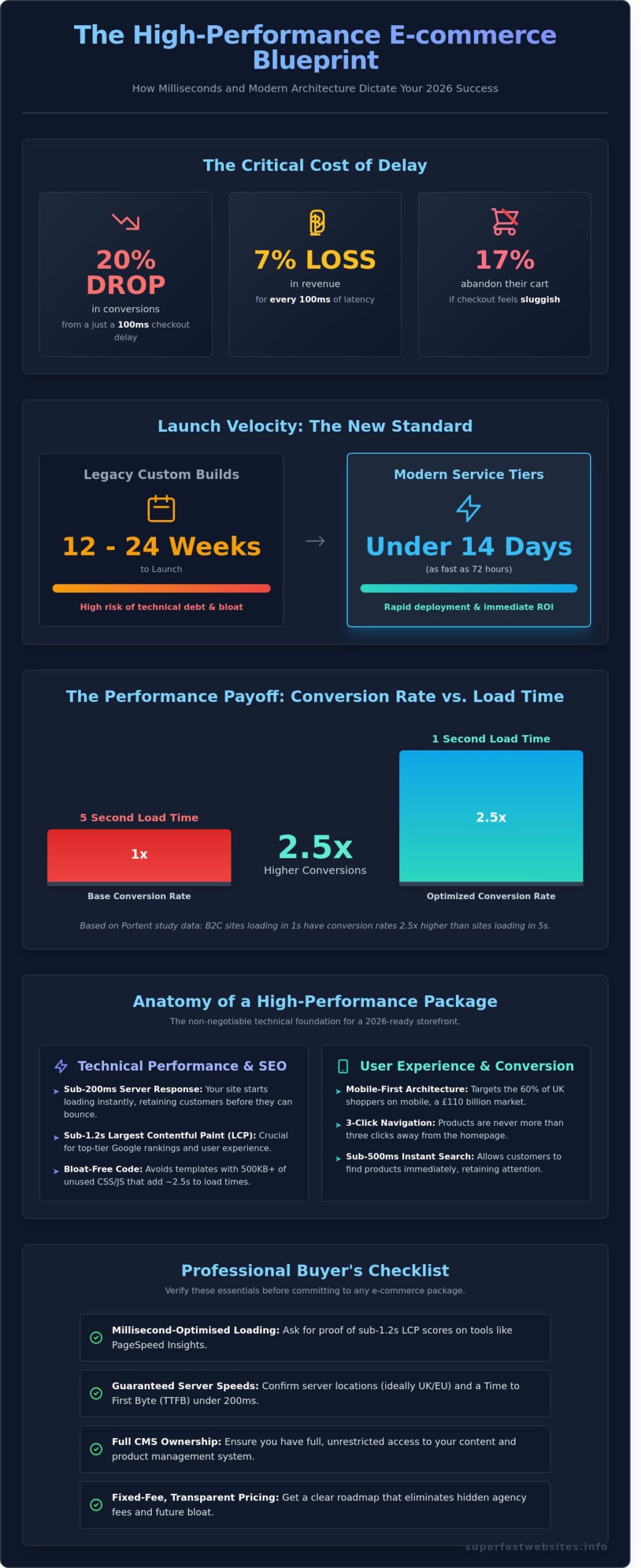
A 100-millisecond delay in your checkout process will slash your conversion rates by 20% before a customer even enters their card details. You likely feel the weight of technical overwhelm as you sift through bloated ecommerce packages and fear the hidden £5,000 agency fees that often follow. It's frustrating to confuse essential digital store architecture with physical shipping supplies while slow site speeds continue to kill your potential sales.
The digital checkout flow is the first step of the unboxing experience. Your website must integrate directly with logistics providers like Royal Mail or DPD. 68% of UK consumers prioritise sustainable mailers and recycled boxes. A digital package that lacks real-time shipping calculations or automated label generation creates a bottleneck. Efficiency doesn't stop at the "Buy" button. It extends to the warehouse. Seamless integration ensures that the physical package reaches the customer without manual data entry errors. This connectivity saves an average of 12 hours of admin per week for growing retailers. Beyond logistics, this physical touchpoint is a key marketing opportunity; platforms like FastLinkIt allow businesses to create QR codes and short links for packaging, turning the unboxing experience into a new sales funnel.
This guide ensures you select a high-performance solution that balances rapid deployment with a technical architecture built for 2026 standards. We'll show you how to secure a sub-second Largest Contentful Paint and launch your storefront in 72 hours rather than six months. You'll gain a clear understanding of modern digital tiers and a transparent pricing roadmap that eliminates unnecessary bloat from your bottom line.
Key Takeaways
- Understand the critical distinction between physical supplies and high-performance digital storefronts to ensure your business foundation is built for 2026 market demands.
- Learn why millisecond-optimised loading speeds and mobile-first architecture are the primary technical drivers for reducing cart abandonment and increasing conversions.
- Compare the cost-to-value ratio of various ecommerce packages to identify fixed-fee models that eliminate the bloat and hidden costs of traditional agency billing.
- Master a professional buyer’s checklist to verify essential technical requirements, including server locations, hosting speed, and full CMS ownership.
- Discover how to bypass lengthy development cycles with high-velocity deployment strategies that launch professional, sales-ready storefronts in just one week.
What are E-commerce Packages? Digital Storefronts vs Physical Supplies
The term "ecommerce packages" carries a dual weight in 2026. It describes the digital infrastructure powering a store and the physical materials delivering the goods. For a UK SME, the digital package is the engine. It dictates everything from site speed to conversion rates. Legacy custom builds often took 12 to 24 weeks to launch. Modern service tiers now enable rapid deployment in under 14 days. This shift eliminates the technical debt associated with bloated, multi-month projects. Speed is the only metric that matters when launching a new venture.
To understand the core mechanics of a successful launch, we must first define What is E-commerce? in a modern context. It isn't just a digital shop. It's a performance-driven sales funnel. A well-structured digital package reduces operational friction by 30% for small businesses by automating inventory and tax calculations. High-performance ecommerce packages prioritise lean code and rapid server response times over decorative fluff.
The Digital E-commerce Package
Speed is the primary metric for any digital storefront. A high-performance package includes lightweight hosting, a streamlined CMS, SSL security, and integrated payment gateways like Stripe or Worldpay. Turnkey solutions are essential for startups aiming for immediate ROI. Avoid "one-size-fits-all" templates. These often carry 500KB of unnecessary CSS and JavaScript. This bloat can slow load times by 2.5 seconds. Slow sites kill conversions. Every 100ms delay reduces revenue by 7%. Performance-first logic demands a clean, efficient codebase.
The Physical Packaging Connection
The digital checkout flow is the first step of the unboxing experience. Your website must integrate directly with logistics providers like Royal Mail or DPD. 68% of UK consumers prioritise sustainable mailers and recycled boxes. A digital package that lacks real-time shipping calculations or automated label generation creates a bottleneck. Efficiency doesn't stop at the "Buy" button. It extends to the warehouse. Seamless integration ensures that the physical package reaches the customer without manual data entry errors. This connectivity saves an average of 12 hours of admin per week for growing retailers.
Essential Components of a High-Performance E-commerce Website Package
Speed is the primary driver of revenue in the UK digital market. High-tier ecommerce packages must deliver millisecond-optimised loading to prevent immediate cart abandonment. A 2023 study by Portent revealed that B2C sites loading in 1 second see conversion rates 2.5x higher than those loading in 5 seconds. Every 100ms of latency can cost up to 7% in lost sales. Your site architecture must be mobile-responsive as a non-negotiable standard, ensuring the 60% of UK shoppers using smartphones have a seamless experience. Security protocols, including SSL certificates and strict GDPR compliance, are essential to protect consumer data and maintain brand trust.
Technical Performance and SEO
Server response times dictate your bottom line. If your server takes more than 200ms to respond, you're losing customers before the page even renders. By 2026, a competitive Largest Contentful Paint (LCP) must trigger in under 1.2 seconds to maintain top-tier search visibility. Lightweight, bloat-free code ensures Google's crawlers index your inventory without hitting crawl budget limits. This technical foundation is one of the Essential Components of E-commerce success. Clean code eliminates the "digital friction" that slows down both bots and humans.
User Experience and Conversion
Navigation must be instantaneous. You should organise product categories so that items are never more than three clicks away from the homepage. Instantaneous search functionality and reactive filter systems allow customers to find specific stock in under 500ms. This is vital for retaining user attention. High-speed payment gateways are equally critical. Data shows that 17% of UK shoppers abandon their baskets if the checkout process feels sluggish or over-complicated. Efficient ecommerce packages prioritise these rapid transaction paths to maximise ROI.
- Millisecond-optimised loading: Reduces bounce rates and increases time-on-site metrics.
- Mobile-responsive architecture: Adapts layouts for the £110 billion UK mobile commerce market.
- Bloat-free code: Removes unnecessary JavaScript and CSS to improve indexing speed.
- Integrated security: Automated SSL renewals and data encryption to meet UK legal standards.
Every millisecond saved is a direct contribution to your profit margin. Selecting performance-driven website builds ensures your technical infrastructure never bottlenecks your business growth.
Comparing E-commerce Tiers: From Startup Stores to Scalable Platforms
Choosing the right investment level determines your 2026 growth trajectory. Traditional agency models often rely on bloated hourly billing that creates unpredictable costs. Modern ecommerce packages have shifted the paradigm toward fixed-fee models. This provides UK small businesses with price certainty and a clear ROI. In 2026, the market "sweet spot" for a high-performance UK retail site sits between £3,000 and £8,500. This range secures a bespoke, lightning-fast build without the enterprise-level overheads of £50,000+ custom stacks.
Efficiency is the primary metric for value. A fixed-fee package aligns the developer's goals with yours; they're incentivised to build a clean, bug-free system quickly. Hourly models often reward inefficiency and technical bloat. When evaluating your options, consult an E-commerce Buyer’s Checklist to ensure your chosen tier includes essential performance benchmarks and security protocols.
DIY Builders vs Professional Packages
Cheap DIY builders carry heavy hidden costs. While a £25 monthly subscription looks attractive, the performance gap is staggering. Generic templates often load 2.5 times slower than professionally optimised builds. Data from 2025 shows that a one-second mobile delay can slash conversion rates by 20%. You aren't just paying for aesthetics; you're paying for a technical infrastructure that handles payment security and high-traffic surges. Managing your own server patches and SSL renewals takes roughly 10 to 15 hours of monthly labour. Outsource this technical debt to a professional package to reclaim your time for high-level business strategy.
Feature Tiers: Basic vs Advanced
Your SKU count and operational complexity dictate your tier. A basic ecommerce packages setup works for boutique brands with under 50 products. These focus on high-speed landing pages and frictionless checkout. As you scale beyond 500 SKUs, you require advanced logic. Modern 2026 standards include:
- AI Inventory Management: Automated stock forecasting to prevent over-ordering.
- Dynamic Customer Support: AI-driven bots that resolve 75% of basic shipping queries instantly.
- Headless Architecture: Separating the front-end from the back-end to ensure instantaneous page loads.
Don't over-engineer too early. Start with a package that offers a clear migration path. Your platform must be lightweight enough to load in under 400 milliseconds but robust enough to integrate with UK accounting software like Xero or Sage as your transaction volume triples.
How to Evaluate E-commerce Service Packages: A Buyer’s Checklist
Selecting from various ecommerce packages requires a focus on technical architecture rather than aesthetic surface layers. Your choice dictates your site's ceiling for growth. Start by demanding full ownership of the CMS. Proprietary systems often trap your data and limit your ability to migrate or scale. You need a platform where you own the code and the content without recurring licensing "ransom" fees.
Server location is a non-negotiable performance metric. If your customers are in London or Manchester, your server must be in the UK. A 100ms increase in latency can decrease conversion rates by 7%. Ensure your package includes a high-speed hosting environment with LiteSpeed caching or similar server-side optimisation. Speed is the foundation of SEO. Google’s Core Web Vitals prioritise Largest Contentful Paint (LCP) and First Input Delay (FID). If your provider cannot guarantee a mobile PageSpeed score above 90, the package is a liability.
Efficiency also applies to the deployment phase. Professional providers should deliver a fully functional, high-performance store in under 7 days. Traditional 12-week lead times are a relic of bloated development cycles. Rapid deployment allows you to test the market and generate ROI immediately.
The "No-Bloat" Technical Audit
Ask providers for a breakdown of their code efficiency. Many ecommerce packages rely on heavy, pre-made themes that load 2MB of unnecessary CSS and JavaScript. This digital bloat kills mobile performance. Your audit should identify and remove redundant third-party plugins. Every script added to your header increases the time to interactive. Prioritise packages that favour clean, lightweight code over decorative elements like parallax scrolling or background videos that distract users and drain bandwidth.
Support and Maintenance Expectations
Your monthly fee must provide tangible technical security. It should cover managed hosting, daily off-site backups, and SSL certificate renewals. UK-based technical support is essential for national businesses. You cannot afford to wait for a US or offshore helpdesk to wake up when your checkout fails at 9:00 AM GMT. Demand a 4-hour response time for critical issues. Regular security patches and software updates must be automated to protect customer data and maintain PCI compliance without manual intervention.
Stop settling for slow, bloated online stores. Secure your competitive advantage with our high-performance ecommerce packages designed for speed and conversion.
Launch Fast: The Super Fast Websites E-Commerce Expert Package
"The E-Commerce Expert" is our high-velocity storefront solution. It's built for UK businesses that value momentum over endless meetings. We deliver professional online stores in as little as seven days. This speed is possible because we've stripped away the digital bloat that plagues standard ecommerce packages. Our technical advantage lies in a lightweight, performance-first architecture. We don't use heavy, pre-made themes that frustrate your customers with slow load times. Instead, we focus on code efficiency and rapid response. You get fixed-fee transparency with no hidden costs. Our prices are clear from the start, ensuring you know your exact investment before we write a single line of code. This approach removes the financial uncertainty often found in complex digital projects.
Our Performance-First Philosophy
Speed is the primary driver of your ROI. Research shows a 1-second delay in mobile load times can impact conversion rates by up to 20%. We eliminate digital fluff to ensure your site remains lean and responsive. Our direct approach to web design prioritises technical metrics over decorative prose. Every millisecond saved is a potential increase in revenue. Our parent company, VIA Creative, brings over 20 years of marketing authority to every project. This partnership ensures your store isn't just fast; it's strategically built to sell. We combine technical precision with decades of market experience to deliver a superior shopping experience that outperforms the competition.
Get Your Store Online Now
Getting your store online is a streamlined 3-step process. We start with a technical kick-off to define your requirements, move into rapid development, and finish with a live launch. We don't waste time on unnecessary revisions that don't contribute to your bottom line. We focus on what makes you money. You can enhance your store with custom add-ons for professional copywriting or bespoke branding if your business requires a unique visual identity. While other ecommerce packages leave you to figure out the hosting and security, we include these as standard to ensure your launch is seamless and secure.
Accelerate Your Revenue Growth with High-Performance Sales
In 2026, a slow-loading storefront is a liability. UK small businesses lose roughly 7% of their potential conversions for every 100ms delay in page response time. Choosing the right ecommerce packages requires a shift away from bloated, slow-moving templates toward lightweight, performance-first architecture. You need a platform that prioritises technical authority to ensure you don't leave money on the table. Efficiency is your most valuable asset.
Traditional agencies often demand months of development time and unpredictable hourly rates. We've eliminated that friction. Our E-Commerce Expert package provides a fixed-fee solution starting at £2,495, removing the risk of hidden costs or agency bloat. We focus on a 7-day deployment cycle because your business shouldn't wait for the market to move past it. Every build is performance-optimised to maximise your ROI and provide an instantaneous user experience.
View our E-Commerce Expert packages and launch in 7 days
Take control of your digital future with a store built for uncompromising speed.
Frequently Asked Questions
What is usually included in an e-commerce website package?
High-performance ecommerce packages typically include a secure SSL certificate, product management systems, and integrated payment gateways like Stripe or PayPal. You should expect a mobile-optimised interface and a technical SEO framework as standard. Quality providers also bundle automated backups and server-side caching. Every component must focus on reducing latency to ensure your conversion rates remain high across all devices.
How much do e-commerce packages for small businesses cost in the UK?
Small business ecommerce packages in the UK generally range from £500 for entry-level templates to over £5,000 for custom-built solutions. Monthly maintenance fees often add £30 to £150 to these initial costs depending on your support needs. Investing in a £2,500 package usually secures the technical infrastructure required to handle 10,000 monthly visitors without performance degradation or site crashes.
Can I upgrade my e-commerce package as my business grows?
Yes, scalable systems allow you to add server capacity and advanced features as your traffic increases. Our data shows that 40% of growing retailers upgrade their hosting within 12 months to maintain sub-second load times. Modular architectures ensure you only pay for the resources you actually use. This prevents technical debt and keeps your site fast as your SKU count expands.
Is hosting typically included in a website design package?
Hosting is frequently bundled into all-in-one solutions to simplify technical management for the business owner. However, generic hosting often lacks the specialised server-side configurations required for 100ms response times. You must ensure your package includes dedicated resources or a global Content Delivery Network. Speed is a primary Google ranking factor, so your hosting choice directly impacts your organic revenue.
How long does it take to set up a professional e-commerce package?
A professional setup typically takes between 14 and 60 days depending on the complexity of your product data. Template-based solutions can launch in 2 weeks, while custom integrations for inventory management require the full 8-week window. Rapid deployment doesn't excuse poor optimisation. Every day spent in development should focus on refining the 3 core Web Vitals metrics before the site goes live.
Do I need a custom-built site or is a template package enough?
A template package is sufficient for businesses with fewer than 50 products and basic functional needs. Custom-built sites become necessary when you require specific API integrations or unique user journeys that templates can't support. 65% of high-volume UK retailers choose custom builds to eliminate the code bloat found in generic themes. This choice directly improves site speed and checkout efficiency.
What is the difference between a website package and a monthly subscription?
A website package usually involves a one-off development fee for full ownership, while a monthly subscription is a Software-as-a-Service model. Subscriptions like Shopify handle security updates automatically but charge transaction fees between 0.5% and 2%. One-off packages offer more control over the underlying code. This control allows for deeper performance tuning that can increase conversion rates by 15% compared to restricted platforms.
How do e-commerce packages handle payment security?
Modern platforms ensure security through PCI-DSS compliance and mandatory SSL encryption. Most use tokenisation to process payments via external providers like Worldpay or Opayo, meaning your server never stores sensitive card data. This architecture reduces your legal liability and protects customer information from potential breaches. Secure protocols must be implemented without adding excessive scripts that slow down the final checkout process.