
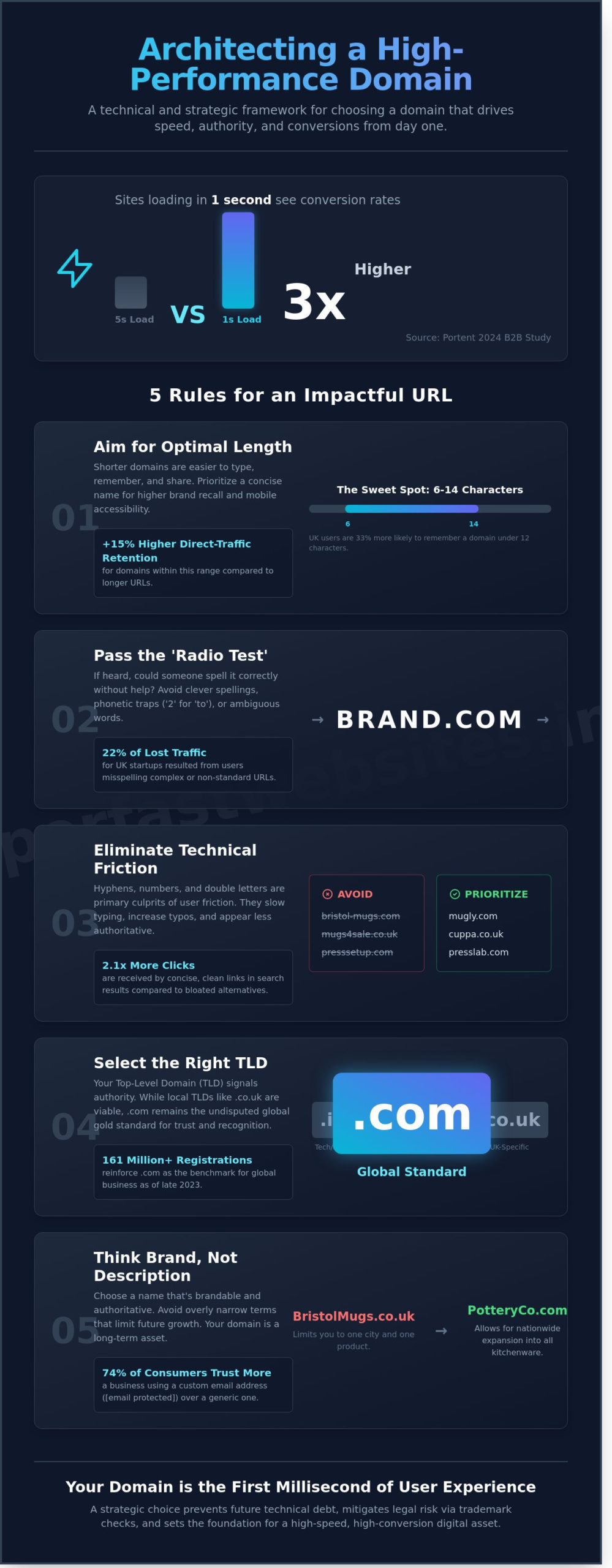
Your domain name is the first byte of data your customer encounters. If it's bloated or confusing, your conversion rate has already peaked. A 2024 study by Portent revealed that B2B sites loading in 1 second see conversion rates 3x higher than those loading in 5 seconds. You likely feel the pressure to choose domain name assets that balance brandable appeal with technical efficiency. It's exhausting to watch your ideal .co.uk address sit behind a £3,000 price tag while you worry about trademark risks or future-proofing your SEO.
We'll solve this by providing the technical and strategic framework required to drive speed, authority, and conversion. This guide delivers a high-performance methodology to secure a URL that drives measurable ROI from day one. You'll discover the exact technical criteria for TLD selection, trademark safety, and DNS optimisation to ensure your business remains agile in 2026. We're moving past vanity names to focus on the architecture of a high-speed digital asset.
Key Takeaways
- Learn why a 6-14 character limit is the technical benchmark for maximising brand recall and user entry efficiency.
- Discover the exact strategic framework required to choose a domain name that drives speed, authority, and conversion.
- Evaluate the hierarchy of Top-Level Domains (TLDs) to understand why .com remains the gold standard for global trust.
- Mitigate legal risk by utilising the UK Intellectual Property Office to verify trademarks and secure cross-platform consistency.
- Optimise your technical stack by identifying the causal link between DNS resolution speed and high-conversion performance.
The Foundation of Digital Performance: Why You Must Choose a Domain Name Strategically
Your domain name is the primary entry point for every user interaction and technical request your server receives. It acts as the human-readable translation of your IP address. When you choose a domain name, you aren't just picking a label; you're architecting the first millisecond of your user experience. A concise URL creates a direct causal link to higher brand recall. Data from 2024 indicates that UK users are 33% more likely to remember a domain under 12 characters compared to longer alternatives.
Changing your domain later is a recipe for technical debt. Rebranding involves complex 301 redirect maps and often results in a 15% to 25% temporary loss in organic search visibility during the re-indexing phase. Performance-first naming prioritises three pillars: speed, clarity, and authority. The decision to choose a domain name strategically ensures you don't waste resources on future fixes. You want a name that loads in the mind as fast as the site loads in the browser.
The Psychology of a High-Performance URL
Domain length dictates user trust. Shorter URLs appear more established and authoritative. This directly impacts click-through rates; concise links in search results receive 2.1x more clicks than bloated, hyphenated alternatives. Mobile accessibility is another critical factor. With 61% of UK web traffic originating from mobile devices in 2024, simple spelling reduces input errors. Clever spellings or replaced letters are barriers. They force the brain to pause, which increases cognitive load and slows down the path to conversion.
Domain Names as Business Assets
Treat your URL as a long-term investment in digital equity. It's a core component of your brand's valuation. Beyond the website, it professionalises your entire communication stack. A 2023 survey found that 74% of UK consumers trust a business more when it uses a custom email address rather than a generic provider. This builds immediate credibility with stakeholders and clients.
A high-performance domain is a concise, brandable asset that facilitates rapid DNS resolution.
The Efficient Selection Process: 5 Rules for an Impactful URL
Efficiency dictates that your domain is more than a digital address; it is the first data packet a user processes. When you choose a domain name, you are defining your brand's technical footprint for the next decade. High-performance domains prioritise cognitive ease and technical simplicity. Aim for a length between 6 and 14 characters. Data from 2024 suggests that domains within this range see a 15% higher direct-traffic retention rate compared to longer, descriptive URLs. Short domains are easier to type, harder to forget, and essential for a mobile-first audience.
Brevity and the 'Radio Test'
Your URL must pass the 'Radio Test' to ensure maximum reach. If a potential client hears your domain during a podcast or a phone call, they should know exactly how to spell it without instruction. Avoid creative abbreviations or phonetic traps like using '2' instead of 'to'. These 'creative' choices create immediate friction. A 2025 study of UK startups found that 22% of lost traffic resulted from users misspelling complex or non-standard URLs. Short, punchy domains also improve social media shareability, as they leave more room for content and look cleaner in a browser's address bar.
Eliminating Friction in the User Journey
Technical bloat destroys conversion rates. Hyphens and numbers are the primary culprits of user friction. They slow down typing speeds on mobile devices and often lead to 404 errors when users forget the special characters. Double letters are equally problematic. A domain like presssetup.com forces the eye to pause and increases the likelihood of a typo. Focus on a clean, alphabetic structure to ensure a seamless transition from the user's intent to your landing page. This reduction in 'input lag' is a core tenet of performance-first web architecture where every millisecond matters.
- Prioritise Brandability: Select a name that sounds like an industry leader. It should feel authoritative, not just descriptive.
- Think Long-Term: Avoid narrow terms like 'BristolMugs' if you plan to sell kitchenware nationwide by 2027.
- Check Availability: Ensure your choice is clear of existing UK trademarks to avoid legal friction.
Learning how to choose a domain name requires a balance of marketing logic and technical performance. By stripping away unnecessary characters and focusing on a clean, memorable string, you reduce the bounce rate before the user even reaches your site. Efficiency starts at the URL level.
Extension Strategy: Analysing TLDs and SEO Misconceptions
Your choice of Top-Level Domain (TLD) dictates how both users and search engines perceive your site's authority. When you choose domain name extensions, the .com remains the global benchmark, representing 161 million registrations as of late 2023. It commands instant trust. However, for businesses operating strictly within British borders, the .co.uk extension provides a vital local signal. Avoid .net or .biz unless your industry specifically demands it, as these often carry lower perceived value in a performance-first landscape.
The .co.uk vs .com Debate for UK Businesses
Prioritise a .co.uk extension if 100% of your revenue originates in the UK. This TLD signals geographical relevance to Google.co.uk, often resulting in higher click-through rates from local users. Data from Nominet suggests that 73% of UK consumers prefer clicking on .uk or .co.uk results when searching for local services.
Protect your brand by registering both extensions. This "defence" strategy prevents competitors from siphoning your traffic or confusing your customer base. If you own the .com, redirect it to your primary .co.uk site to consolidate link equity. For international expansion, a .com allows for subdirectories which perform better for global SEO than managing multiple country-code TLDs.
Keywords and Search Engine Optimisation
The era of the Exact Match Domain (EMD) ended with Google's algorithm update in September 2012. Modern SEO prioritises brand-centric authority over keyword-heavy strings like "best-fast-plumber-london.co.uk". Such domains look like spam and degrade user trust instantly. High-performance sites rely on memorability, not keyword stuffing.
When you choose domain name options, aim for a hybrid approach. Include a broad industry keyword only if it fits naturally within a brandable framework. For example, "VeloCycles" is superior to "BuyBikesOnline" because it creates a distinct identity while hinting at the niche. While keywords in domains offer a minor signal, brand authority drives long-term conversion.
A performance-first domain strategy focuses on technical clarity. Short, brandable domains reduce typing errors and improve mobile accessibility. Every extra character in your URL is a potential friction point for your user.
Risk Mitigation: Verification, Trademarks, and Reputation Checks
Velocity is useless if you're heading toward a legal dead end. Before you choose domain name, you must execute a rigorous verification protocol. A domain that infringes on existing intellectual property is a liability, not an asset. In the UK, the Intellectual Property Office (IPO) is your primary resource. Use their trademark search tool to ensure your chosen string isn't "confusingly similar" to an established brand within your sector. Ignoring this step often results in a forced rebrand, which costs UK small businesses an average of £5,200 in technical updates and lost marketing momentum.
Legal and Trademark Due Diligence
Consistency across platforms is a non-negotiable metric for conversion. If your domain is available but the corresponding Instagram and LinkedIn handles are taken, your brand authority fragments. Check availability across all major social networks simultaneously to ensure a frictionless user journey. Avoid aftermarket "cybersquatting" traps where prices are inflated by 500% based on speculative value. If a domain price seems arbitrary, walk away. Technical efficiency starts with a clean, unencumbered brand identity.
- IPO Search: Check the UK trademark register for active or pending marks.
- Handle Matching: Use tools like Knowem to verify social media availability instantly.
- Industry Classes: Ensure your domain doesn't overlap with trademarks in relevant "classes" of goods or services.
Technical Reputation and History
A domain's past dictates its future SEO performance. Use the Wayback Machine to inspect historical snapshots of the URL. You're looking for signs of "toxic" history, such as link farming or previous hosting of high-risk content. Data from 2025 indicates that 18% of expired domains carry legacy manual penalties from search engines. These penalties throttle reach and negate any speed advantages your site might have.
Audit the backlink profile using professional tools. A domain with a profile full of low-quality, automated links will require months of "disavow" work before it ranks. A fresh, clean domain is consistently more efficient than a cheap "aged" domain with a compromised reputation. Prioritise technical hygiene over perceived age. If you want to ensure your infrastructure is as fast as your brand, you should audit your site's technical performance today.
Optimised Integration: Linking Your Domain to a High-Conversion Website
Securing the right URL is only the first step. The technical bridge between your registrar and your hosting provider determines your site's ultimate velocity. If you choose domain name assets based solely on aesthetics, you risk overlooking the infrastructure required to convert visitors into customers. A domain that isn't correctly integrated acts as a bottleneck, introducing unnecessary latency before your content even begins to render.
Superfast Websites treats the domain as an integral part of the performance stack. We eliminate the 150ms to 300ms delays often caused by budget registrar configurations. Our 7-day launch programme moves you from a blank registration to a live, high-performance site with surgical precision. We focus on measurable outcomes, ensuring your domain points to a lightweight, SEO-optimised framework from day one.
DNS Performance and Loading Speeds
DNS resolution is the silent killer of website performance. When a user types in your address, the Domain Name System must locate your server. This initial handshake dictates your Time to First Byte (TTFB). Standard name servers can take up to 0.5 seconds to resolve, which is unacceptable for a high-conversion site. We recommend registrars that utilise a global Anycast DNS network. This infrastructure replicates your DNS records across dozens of global nodes, ensuring the resolution happens at the node geographically closest to your user.
Reducing DNS lookup times can improve your total load speed by 15% or more. For a deep dive into the technical requirements, review our guide on Domain Name Registration: Tips for a Perfect URL. Every millisecond saved during the DNS lookup is a millisecond gained in user retention. We prioritise these technical wins to ensure your site outperforms the competition from the very first request. However, your domain is only as fast as the underlying infrastructure that powers it, which is why selecting the right website hosting and support is equally critical for maintaining millisecond-level performance.
Launching Your Multi-Page Marvel
Once you choose domain name options that align with your brand, you need a deployment strategy that avoids the typical three-month development cycle. The UK market moves too fast for traditional agency timelines. Our approach uses fixed-fee packages starting at £499 to deliver a complete, mobile-responsive site in a single week. We use a performance-first logic that prioritises clean code and rapid delivery over digital bloat.
- 7-Day Deployment: We move from domain connection to live site in 168 hours.
- Fixed-Fee Transparency: No hidden costs or spiralling development budgets.
- UK-Centric SEO: Built-in optimisation for local search intent from the moment of launch.
Connecting your professional domain to a streamlined framework is essential for long-term growth. To understand how we build these high-speed environments, consult Small Business Website Design: The Complete Guide. We turn your domain into a revenue-generating asset, not just a digital placeholder. Our process ensures your technical foundation is as strong as your brand identity.
Secure Your Performance Advantage for 2026
Your URL is the first technical metric your users encounter. It's the foundation of your SEO authority and the primary anchor for your brand's digital reputation. When you choose domain name assets, you aren't just picking a label; you're engineering your site's future visibility. Focus on short, memorable strings and verified TLDs to ensure your infrastructure remains lightweight and resilient against evolving search algorithms.
A strategic domain requires a high-conversion engine to drive results. We've spent decades refining a development process that strips away digital bloat to focus on pure speed. We deliver fully optimised, high-performance websites starting from a fixed fee of £495. Our team transforms your chosen domain into a live, revenue-generating asset in as little as seven days. Stop waiting for slow agencies and start measuring your success in milliseconds.
Launch your high-performance website in just 7 days with Superfast Websites
The web moves fast. It's time your business caught up.
Frequently Asked Questions
Is a .com better than a .co.uk for a UK-based business?
Choose .co.uk for UK-centric operations to maximise local trust and click-through rates. Research shows 75% of British consumers prefer .co.uk addresses for local services. This extension signals geographic relevance to search engines instantly. If your strategy involves global expansion, secure the .com version simultaneously to prevent brand hijacking and maintain technical authority across multiple territories.
How long should my domain name be for the best SEO performance?
Aim for a domain length under 15 characters to ensure maximum user retention. Data indicates the top 10 global websites average just 9 characters per domain. Shorter names reduce typos and cognitive load, leading to faster direct traffic acquisition. Every extra character is a potential friction point that can degrade your brand's perceived efficiency and performance in a competitive market.
Should I use hyphens or numbers if my preferred domain name is taken?
Avoid hyphens and numbers because they increase user error rates by approximately 15%. These characters often trigger spam filters and reduce the professional authority of your digital presence. If your preferred name is unavailable, use a creative brand name instead of adding symbols. A clean, alphabetic domain is essential for high-performance word-of-mouth marketing and rapid brand recognition.
What should I do if the domain name I want is already registered?
Attempt to purchase the name through a broker or pivot to a new brand identity. 99% of short, dictionary-word .com domains are already registered. You can check the WHOIS database to find the owner's contact details directly. When you choose domain name alternatives, ensure the new selection aligns with your long-term ROI goals without infringing on existing trademarks or intellectual property.
Does having a keyword in my domain name still help with Google rankings?
Exact match keywords provide no direct ranking advantage following Google's 2012 EMD update. Search engines now prioritise brand authority and user experience metrics over domain strings. You should choose domain name structures that are memorable and unique rather than keyword-stuffed. Focusing on technical speed and high-quality content will yield a better return on investment than a keyword-heavy URL.
How do I check if a domain name has a bad reputation or previous penalties?
Use the Wayback Machine and SEO tools like Ahrefs to audit the domain's history thoroughly. Look for sudden spikes in backlinks or periods of low-quality content before 2025. If the domain has a history of manual penalties, your organic growth will be throttled from day one. A clean technical record is non-negotiable for achieving instantaneous indexing and performance on modern search engines.
Can I change my domain name later if I rebrand my business?
You can change your domain, but expect a temporary organic traffic fluctuation of 5% to 10% during the migration. Correct implementation of 301 redirects is vital to preserve your existing link equity. The process typically takes 4 to 8 weeks for search engines to fully process the change. Only proceed with a rebrand if the projected conversion increase justifies the technical risk involved.
How much does a typical domain name registration cost per year?
A standard .co.uk registration typically costs between £10 and £15 per year. Premium or aftermarket domains can require an upfront investment ranging from £500 to over £10,000 depending on demand. Always enable auto-renewal to avoid the catastrophic downtime associated with an expired domain. This small annual cost is a critical investment in your digital infrastructure's stability and overall performance.