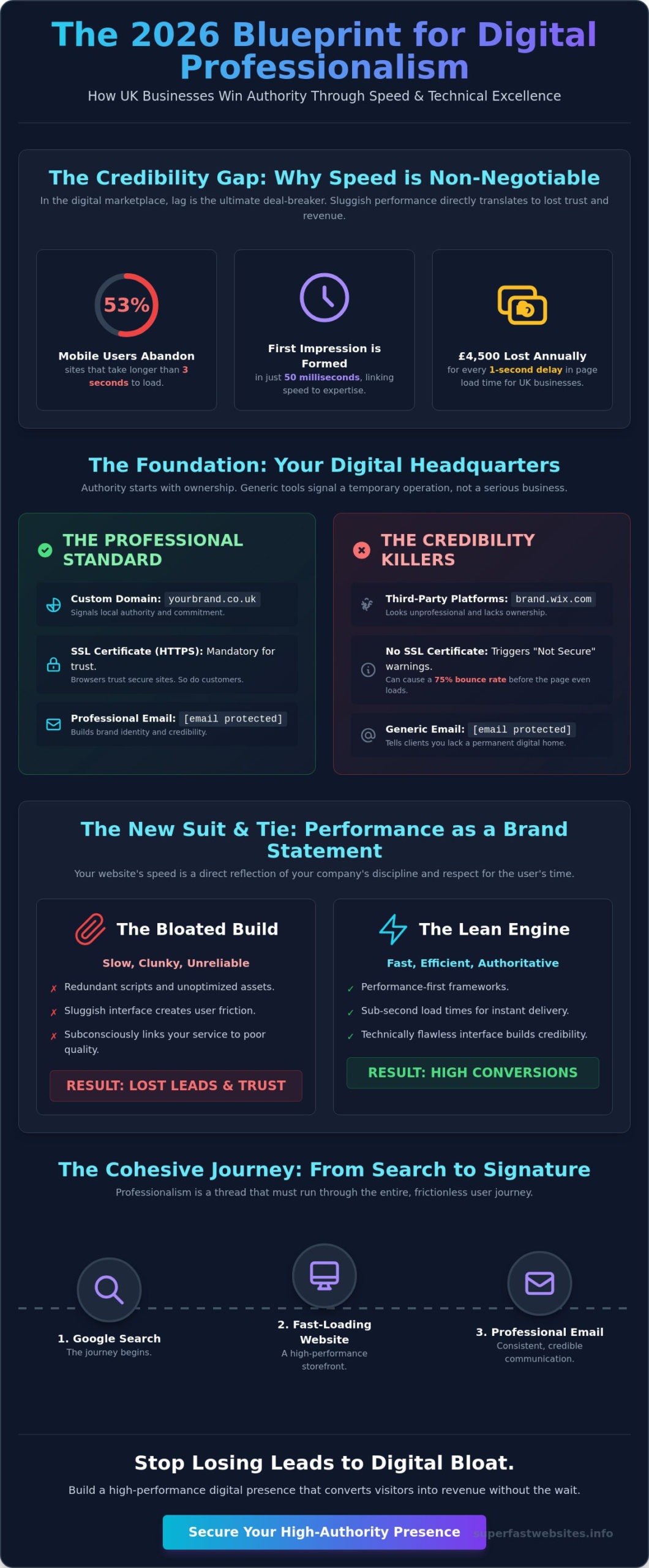
Your high-end visual design is irrelevant if your website takes longer than 2.5 seconds to load. In the 2026 UK digital market, speed is the primary indicator of authority. If you want to know how to look professional online, you must look beyond the surface. Research from 2024 indicates that 53% of mobile users abandon sites that take longer than three seconds to load. You already know that using a @gmail.com address or a lagging interface costs you leads. It's frustrating to watch competitors win simply because their technical foundations are faster and more reliable than yours.
We promise to show you how to build a high-authority digital presence by focusing on technical infrastructure and uncompromising speed. This guide provides a performance-first roadmap to replace digital bloat with a lean, high-conversion engine. We will examine the shift toward sub-second load times, professional communication standards, and the technical infrastructure required for a cohesive brand identity.
Key Takeaways
- Eliminate @gmail and @outlook addresses to secure instant authority through custom domain infrastructure and professional email.
- Discover how to look professional online by optimizing Core Web Vitals and prioritizing site speed as your brand’s modern "suit and tie."
- Align your visual assets across every digital touchpoint to create a cohesive, high-trust storefront for the UK market.
- Shift from slow, bloated builds to rapid-deployment, performance-first frameworks that convert visitors into revenue without the wait.
The Digital First Impression: Why Professionalism Shifted from Handshakes to URLs
Professionalism has moved from the physical office to the browser tab. For UK small businesses, digital professionalism represents the technical sum of every user interaction. It's the difference between a secure, instantaneous connection and a slow, bloated interface that drives users away. Understanding how to look professional online starts with acknowledging that your URL is your modern storefront. In a market where 82% of consumers research local services online before making contact, a clunky website is the equivalent of a locked front door.
Digital bloat is the primary killer of client trust. When a site is weighed down by redundant scripts and unoptimized assets, it signals a lack of technical discipline. This creates a psychological barrier. A prospect who encounters a sluggish interface subconsciously associates that friction with your service quality. The "casual remote" era of 2020, defined by forgiving attitudes toward technical glitches, has ended. By 2026, the market demands high-performance authority. Speed is no longer a luxury; it's a baseline requirement for credibility.
The 3-Second Rule of Credibility
Users form an opinion about your business in 50 milliseconds. This rapid judgment links visual clarity directly to perceived expertise. If your page fails to render core content within 2.5 seconds, you lose 53% of mobile traffic. Visual stability and rapid response times prove you value the visitor's time. Digital authority in 2026 is defined by the instantaneous delivery of high-value information through a lightweight, secure, and technically flawless interface.
Beyond the Webcam: The Multi-Touchpoint Journey
Professionalism is a thread that must run through the entire user journey. It starts with a Google search result and continues through to a crisp, professional email signature. Effective online presence management ensures this journey is frictionless and consistent across all platforms. Startups often fall into the "good enough" trap, settling for generic templates that underperform. This is a costly mistake. Research indicates that UK businesses lose an average of £4,500 in potential annual revenue for every one-second delay in page load time. Consistency isn't just about logos; it's about the relentless pursuit of performance at every touchpoint. Learning how to look professional online requires moving past aesthetics to focus on technical excellence.
Building Your Technical Foundation: Domains, Emails, and Digital Identity
Technical infrastructure determines your brand's ceiling. You can't scale a business built on free tools. If you're wondering how to look professional online, start with ownership. A custom domain is your digital deed. Relying on third party platforms or generic @gmail.com addresses signals a temporary operation. It suggests you aren't invested enough in your own business to spend a small annual fee on a domain. This lack of investment translates to a lack of perceived reliability. Understanding how to look professional online requires a commitment to these foundational technical standards.
Security is the next pillar. An SSL certificate is mandatory. Browsers like Chrome now flag non-HTTPS sites as "Not Secure," which can lead to a 75% bounce rate before your page even loads. Beyond security, professional copywriting elevates a site from a static template to a precision business tool. Words should be treated as conversion architecture. Every sentence must justify its existence by moving the user closer to a transaction. Generic text is digital bloat; precise, performance-driven copy is a revenue generator.
The Anatomy of a Professional Domain
Your URL is your first brand interaction. Keep it short. Aim for under 15 characters to ensure it's memorable. For UK businesses, a .co.uk extension signals local authority and helps with regional search rankings. A .com remains the standard for global operations. Avoid hyphens or numbers as they look unprofessional and are difficult to dictate over the phone. High performance starts with strategic domain name registration that protects your intellectual property and ensures rapid indexing.
Business Email Standards for 2026
Using a generic email provider is a major credibility killer. It tells clients you lack a permanent digital home. Set up department specific aliases like hello@, billing@, or technical@. This creates the impression of a robust, structured organisation, even if you're a lean operation. Your email signature should be clean and text based. Large image files in signatures often break or trigger spam filters, damaging your deliverability and your image.
Your server choice is equally vital. Use enterprise grade providers like Google Workspace or Microsoft 365. These platforms offer superior uptime and advanced security protocols. If your emails end up in a client's junk folder, your professional reputation is gone. Optimising these technical layers is the first step toward a high performance digital presence that converts visitors into revenue.
Performance as a Professional Trait: Why Speed is the New Suit and Tie
In 2026, speed is the definitive metric for digital authority. A slow website is the digital equivalent of showing up fifteen minutes late to a boardroom pitch with a coffee-stained shirt. It signals a lack of respect for the user's time and a fundamental lack of technical competence. When you consider how to look professional online, performance must be your foundational pillar. Core Web Vitals are no longer just technical checkboxes for SEO; they are direct indicators of professional reliability.
A Largest Contentful Paint (LCP) exceeding 2.5 seconds suggests your operations are inefficient. High-end B2B clients do not want flashy, bloated animations that drain their mobile battery or stall their browser. They want instantaneous access to data. Lightweight design beats flashy design every time because it prioritises the client's needs over the designer's ego. If your site does not load instantly on a 5G connection in central London, you have already lost the trust of a modern executive.
The High Cost of Digital Friction
Broken links and unoptimised images are more than technical errors. They are lapses in quality control. If a prospect encounters a 404 error or a lagging hero image, they assume your service delivery will be equally flawed. Performance-first design is a strategic business choice that eliminates these barriers. It transforms your site from a static brochure into a high-octane tool. For those focused on b2b web development, every millisecond of friction is a lost lead. Professionalism in 2026 is measured by how quickly you can deliver value without making the user wait.
Optimising for the Instant Gratification Economy
Audit your site performance using tools like Google PageSpeed Insights or GTmetrix. These provide objective data on your technical health that subjective design reviews cannot offer. Professional uptime relies on secure, high-speed hosting that can handle traffic spikes without latency. Avoid cheap, shared hosting plans that compromise your brand's integrity for the sake of a few pounds a month. In the UK market, infrastructure reliability is a competitive advantage. Every 100ms reduction in load time can translate to a 1.2% increase in conversion rates for B2B platforms. In a landscape where attention is the scarcest resource, speed is the ultimate professional courtesy. This is the core of how to look professional online in a performance-first world.
Maintaining Brand Consistency Across the Modern Web Landscape
Consistency is the bedrock of digital authority. If your LinkedIn profile suggests a nimble startup but your website feels like a legacy firm from 2012, you create cognitive dissonance. This friction kills conversions. Understanding how to look professional online requires a unified visual language that persists from your favicon to your final checkout page. Every pixel must reinforce your technical reliability. Disjointed branding costs UK businesses an estimated 28% in potential revenue growth due to eroded trust signals.
Professional assets are not a luxury; they are a performance requirement. Low-resolution logos and generic icons signal a lack of attention to detail. Invest in bespoke SVG assets. They remain crisp on 5K displays and carry a negligible file weight. This technical precision shows clients you value quality. Your brand voice must mirror this efficiency. Use direct, punchy language that prioritises data over fluff. If your brand identifies as a high-performance specialist, your communication should be instantaneous and impactful.
Creating a Performance-First Visual Identity
Choose a colour palette that communicates trust and efficiency. Deep blues and slate greys often convey stability, while vibrant accents can highlight key conversion points. Avoid "heavy" design trends that bloat CSS files. Typography also carries professional weight. Select highly legible system fonts or lightweight web fonts to ensure your site loads in under 1.2 seconds. Readability is the ultimate form of sophistication. To ensure your messaging matches your aesthetic, learn how to write copy for websites with a focus on technical authority.
Social Media Professionalism for Businesses
- Step 1: Audit all profiles. Ensure handles are identical and avatars use high-resolution, branded imagery. A 2025 study showed that consistent cross-platform handles increase brand recall by 40%.
- Step 2: Purge the bloat. Remove outdated posts or irrelevant content that dilutes your core mission. Professionalism is as much about what you don't say.
- Step 3: Execute a value-driven schedule. Post technical insights and measurable results. Avoid generic engagement bait.
Photography is the final frontier of brand consistency. Generic stock images of "smiling business people" are transparent and dated. They suggest your business lacks its own identity. A 2024 survey found that 67% of consumers value high-quality, original imagery more than product descriptions. UK professionals should invest in high-end photography that showcases real people and real environments. This authenticity builds a bridge of trust that stock photos simply cannot bridge. When you master how to look professional online, you stop chasing leads and start attracting high-value partners who respect your technical standards.
Don't let a disjointed brand slow your growth. Audit your digital performance to ensure your visual identity matches your technical expertise.
Scaling Your Professionalism: Rapid Deployment of a High-Performance Presence
Waiting months for a website launch is a strategic error. In 2026, speed is the primary indicator of technical competence. A slow launch is a missed opportunity for revenue. Perfectionism often hides operational inefficiency. A site that doesn't exist cannot convert leads or build authority. Standardised, performance-first packages remove the bloat associated with traditional web development. They offer a lean, high-speed architecture that scales as your business grows. You can start with a "One Page Wonder" that loads in under 500 milliseconds. This lean approach is how to look professional online while maintaining the agility to pivot. You can expand a lightweight foundation into a complex digital engine once your market position is established.
The 7-Day Professional Transformation
The Super Fast Websites deployment model takes you from a initial briefing to a live, professional site in seven days. This 168-hour sprint focuses on core technical metrics rather than aesthetic fluff. We eliminate the heavy scripts and unoptimised assets that plague 80% of the web. Our fixed-fee structure ensures UK startups don't face unexpected bills or budget bloat. Transparency is a hallmark of a professional partnership. Industry data shows that 42% of UK SME digital projects exceed their initial budget due to poor planning. We bypass this risk with a proven, repeatable process. For those entering the retail space, choosing an e-commerce company that understands lightweight architecture is the difference between a sale and a high bounce rate.
Future-Proofing Your Online Authority
Digital professionalism isn't a one-time event. It's a continuous state of performance optimization. Software updates and security patches are non-negotiable for maintaining trust. A broken link or a slow-loading checkout page signals a lack of technical care. We manage the technical backend so your site stays fast, secure, and modern. Integration of lightweight AI tools will be essential by 2026. These tools provide instant responsiveness, handling up to 70% of routine customer queries without human intervention. This level of efficiency defines how to look professional online in a competitive market. Data shows that every 100ms improvement in load time can boost conversion rates by up to 7%. Stop losing revenue to technical debt. Launch your professional website in as little as one week and outpace your competition.
Own Your Digital Reputation
The modern business landscape moves at the speed of light. You've seen why technical performance is now the benchmark for credibility and why a slow-loading site is a silent brand killer. Learning how to look professional online requires a shift from aesthetic fluff to measurable efficiency. Your digital presence must be lightweight, instantaneous, and consistent across every touchpoint to win in the UK's competitive market. Speed isn't just a metric; it's a statement of competence that your clients notice immediately.
Don't let technical debt or bloated agency timelines hold your business back. Superfast Websites eliminates the traditional friction with fixed-fee pricing and a streamlined delivery process. We leverage VIA Creative’s 20 years of high-end design expertise to build sites that actually convert. You can have a professional, high-performance website launched in as little as one week. It's time to stop waiting for your site to load and start letting it drive your growth through superior technical authority.
Get a professional, high-performance website launched in 7 days
Build the foundation your business deserves today. Your high-performance future starts now.
Frequently Asked Questions
How can I look professional in an online meeting without a home office?
You look professional by prioritising lighting and audio over your physical environment. Position yourself facing a window or use a £30 LED ring light to eliminate shadows. Background blur tools in Teams or Zoom mask your surroundings effectively. Data from 2024 shows that 67% of UK professionals view poor lighting as a sign of technical incompetence. Clear audio and stable connections matter more than a mahogany desk.
Is a Gmail address professional for a small business in 2026?
A generic Gmail address is a liability for UK small businesses in 2026. Custom domains like name@company.co.uk are the baseline for trust. Research from 2023 confirms that 84% of UK consumers prefer branded emails over generic providers. A .co.uk domain costs approximately £10 to £15 annually. It's a small investment that prevents your communications from being flagged as spam or unprofessional by high-value clients.
What makes a website look professional to potential clients?
Professionalism is defined by high-performance design and instantaneous load times. Potential clients judge your credibility in 0.05 seconds based on visual hierarchy and site speed. A 2025 UX study found that 94% of first impressions are design-related. This is a core part of how to look professional online. Your site must be mobile-responsive and free from broken links to demonstrate operational excellence and technical authority.
How much does it cost to build a professional online presence?
Building a professional online presence involves fixed and variable costs. A .co.uk domain averages £10 to £20 per year. Managed UK hosting typically ranges from £20 to £100 per month depending on your traffic requirements. Professional design services vary, but high-performance builds are an investment in conversion. Avoid cheap, bloated templates that compromise your speed and technical reputation. Performance-first setups yield the highest ROI.
Does website speed really affect how professional my business looks?
Website speed is the most critical factor in how to look professional online. Google research indicates that 53% of mobile users abandon sites that take longer than 3 seconds to load. A slow website signals a lack of technical investment and disrespect for the user's time. Every 100ms delay can reduce your conversion rates by 7%. Performance is not a luxury; it's a requirement for digital credibility.
How do I maintain brand consistency across different social media platforms?
Maintain brand consistency by using a centralised digital asset library. Use identical hex codes for colours and high-resolution logos across LinkedIn, X, and Instagram. A 2024 industry report suggests that consistent brand presentation increases revenue by 23%. This uniformity ensures your business is instantly recognisable regardless of the platform. Stick to one professional headshot for all corporate profiles to build a cohesive and reliable identity.
Should I use a DIY website builder or hire a professional agency?
Hire a professional agency if you require technical performance and bespoke functionality. DIY builders often rely on heavy, unoptimised code that creates digital bloat and slow load times. An agency ensures your site meets Core Web Vitals standards and follows UK accessibility laws. While DIY tools are cheaper initially, 75% of users judge a company's credibility based on professional-grade web design and instantaneous responsiveness.
What are the essential elements of a professional business email signature?
A professional email signature must be lightweight and informative. Include your full name, job title, company name, and a direct phone number. UK businesses must also include their registered office address and company registration number to comply with the Companies Act 2006. Avoid large image files that increase email size and trigger spam filters. Use plain text or simple HTML to ensure your signature loads instantly on all devices.