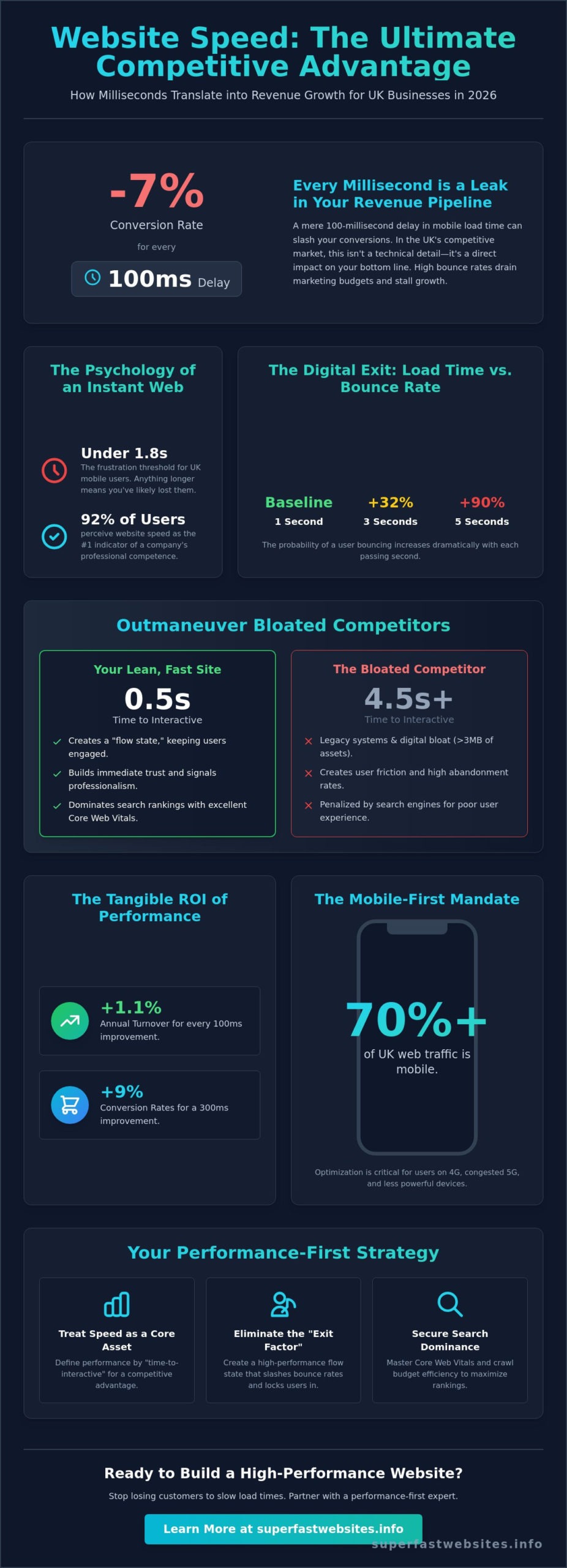
A 100-millisecond delay in mobile load time can slash your conversion rates by up to 7%. In the UK's competitive digital market, every millisecond of latency is a direct leak in your revenue pipeline. You likely recognize that high bounce rates are draining your marketing budget and stalling your growth. It's frustrating to see competitors with weaker brands outrank you simply because their technical infrastructure is leaner and more responsive. Understanding the benefits of a fast loading website is the first step toward reclaiming your market share.
Speed is no longer a technical luxury; it's a primary driver of search visibility and bottom-line profit. You'll learn exactly how optimizing your Core Web Vitals can trigger immediate improvements in your search rankings and customer retention. This guide provides a clear roadmap for 2026, focusing on the data-backed link between performance and ROI. We will examine the specific metrics you must track and provide a framework for selecting a performance-first web partner who values technical efficiency over digital bloat.
Key Takeaways
- Treat speed as a core business asset. Learn why defining performance by "time-to-interactive" is the ultimate competitive advantage for UK brands in 2026.
- Eliminate the "exit factor." Discover how to create a high-performance flow state that slashes bounce rates and keeps users locked into your conversion funnel.
- Secure search engine dominance. Understand how mastering Core Web Vitals and crawl budget efficiency maximizes the benefits of a fast loading website for your rankings.
- Quantify your performance gains. See how 100ms improvements translate into direct revenue growth and significantly lower cart abandonment for UK e-commerce platforms.
- Execute a performance-first strategy. Identify the specific digital bloat and hosting inefficiencies currently draining your business ROI and technical authority.
Why Website Speed Is the Ultimate Competitive Advantage in 2026
Speed isn't a vanity metric. It's the technical foundation of your digital presence. In 2026, we define website speed as the exact duration required for a page to become fully interactive and responsive to user input. This shift toward understanding web performance ensures that every millisecond is accounted for in the race for customer attention. One of the primary benefits of a fast loading website is the immediate conversion of interest into action. UK businesses that adopt a performance-first mindset treat speed as a high-yield financial asset rather than a technical afterthought. Revenue doesn't wait for slow servers. Data shows that a 100ms improvement in load time correlates directly with a 1.1% lift in annual turnover for UK retail sites.
The Psychology of the Instantaneous Web
Digital delays trigger a physical stress response in users. When a page hangs, brand trust evaporates instantly. By 2026, the threshold of frustration has dropped below 1.8 seconds for the average UK mobile user. If your site takes longer, you've already lost the lead. According to 2026 market research, 92% of UK internet users perceive a website's speed as the single most reliable indicator of a company's professional competence. This cognitive link means that a slow site signals a slow service. Shaving 300ms off your load time can lead to a 9% increase in conversion rates for professional services. Efficiency is the ultimate trust signal.
Speed as a First Impression
Your website speed communicates your brand values before a single word of copy is read. An instantaneous page load establishes immediate authority. It tells the visitor that your business is efficient, modern, and respects their time. This is where small, agile UK businesses can outmanoeuvre bloated corporate competitors. Many large organisations struggle with legacy systems and digital bloat, leading to load times exceeding 4.5 seconds. By prioritising a lightweight architecture, you gain a massive competitive edge. One of the core benefits of a fast loading website is this ability to appear more capable than larger, slower rivals. Performance is the new professional standard. If your site loads in 0.5 seconds while your rival takes 3 seconds, you've won the contract before they've even seen the hero image.
- Interactivity: The moment a user can click, scroll, and engage.
- Reliability: Consistent performance across 5G and fibre networks.
- Retention: Keeping users on-site by removing friction.
User Experience: How Loading Times Dictate Customer Behaviour
Speed dictates the digital exit. Every millisecond of latency acts as a prompt for your visitor to leave. Data from Google indicates that the probability of a bounce increases by 32% as page load time goes from 1 second to 3 seconds. By 5 seconds, that probability hits 90%. These aren't just statistics; they represent lost UK revenue. One of the primary reasons why web performance is crucial is its ability to facilitate a "flow state." When a site responds instantly, the interface disappears. The user focuses entirely on your offer rather than the mechanics of the page.
Contrast this with a "bloated" legacy site. Older architectures often carry 3MB or more of unoptimised scripts and heavy assets. This creates friction. Users feel the weight of the site, leading to frustration and site abandonment. A lightweight, performance-first site removes these barriers. It ensures your business is accessible and inclusive. Speed is the foundation of inclusive design, allowing users with older hardware or limited data plans to access your services without penalty. This technical efficiency translates directly into one of the key benefits of a fast loading website: sustained user engagement.
The Mobile-First Mandate
The reality for UK SMEs is that over 70% of web traffic now originates from mobile devices. These users aren't always on stable office Wi-Fi. They're on 4G in transit or congested 5G networks in city centres like London or Manchester. Mobile processors have less power than desktops, making heavy code execution a bottleneck. Optimization is no longer optional. Every extra kilobyte of JavaScript delays the Time to Interactive (TTI). If your site isn't optimised for these constraints, you're effectively locking out the majority of your market. High-performance sites prioritise the critical rendering path to ensure content is visible and interactive within 1.5 seconds.
Reducing Cognitive Load
Wait times force users to think about the technology. This creates cognitive load. A fast site allows a seamless transition from interest to action. When a button click results in an instantaneous response, the user stays in the "buying loop." Speed is the most important feature of any user-centric design. It builds trust. A site that reacts quickly feels professional and reliable. If your current interface feels sluggish, you should examine your core web vitals to identify where you're losing customers. In the 2026 landscape, another one of the benefits of a fast loading website is the psychological advantage it provides over slower, less efficient competitors. Efficiency isn't just a technical metric; it's a conversion strategy.
Search Engine Dominance: Why Google Rewards Performance-First Design
In 2026, Google's algorithm treats speed as a non-negotiable infrastructure requirement. One of the primary benefits of a fast loading website is its ability to bypass competitors who rely on bloated, legacy frameworks. Googlebot prioritises sites that respect its resources. Slow sites consume excessive "Crawl Budget," meaning your newest content takes longer to appear in search results. If your site takes four seconds to load, Googlebot may only index 25% of your pages during a single pass. A sub-second site sees near-instant indexing and more frequent updates.
Speed acts as the ultimate tie-breaker. When content quality is equal between two businesses, Google defaults to the faster platform. This technical edge captures top-of-funnel traffic before users bounce to a rival. The secondary benefits of a fast loading website include improved user signals. Fast sites earn 30% more organic backlinks because they're reliable references. They see longer dwell times because users aren't fighting a sluggish interface. These signals create a virtuous cycle of authority and search dominance.
Mastering Core Web Vitals
Google uses Chrome User Experience Report (CrUX) data to judge your site based on real-world UK user sessions. By 2026, passing the three pillars of Core Web Vitals is the baseline for entry into the top three search positions. We focus on three specific outcomes:
- Largest Contentful Paint (LCP): This measures perceived load speed. It marks the point where the main content is visible to the user.
- First Input Delay (FID): This tracks responsiveness. It measures the time from a user's first interaction to the moment the browser actually processes the request.
- Cumulative Layout Shift (CLS): This ensures visual stability. It prevents layout jumps that cause accidental clicks and user frustration.
Failing these metrics signals to Google that your infrastructure is obsolete. High-performance design ensures these metrics stay in the "green" zone, securing your visibility against the 80% of UK businesses that still fail these benchmarks.
The Search Visibility Advantage
Performance impacts your bottom line beyond organic search. High-speed sites often see a 12% to 18% reduction in Cost-Per-Click (CPC) within Google Ads. Google rewards high-quality landing pages with better Ad Rank, lowering your acquisition costs and stretching your marketing budget further. For companies focused on high-value lead generation, b2b web development must prioritise these metrics to turn search traffic into measurable revenue. Efficiency is not just a technical goal; it's a financial imperative for search visibility.
Maximising ROI: Calculating the Direct Link Between Speed and Sales
Every millisecond represents a financial pivot point. Data from 2024 confirms that a 100ms reduction in load time correlates to a 1.1% increase in session-based conversion rates. For a UK enterprise generating £1,000,000 in annual digital revenue, this minor technical adjustment adds £11,000 to the bottom line without increasing marketing spend. One of the primary benefits of a fast loading website is this immediate, measurable impact on profitability. Speed reduces the friction that leads to high bounce rates, ensuring the traffic you pay for actually reaches your offer.
Performance optimization pays for itself by increasing marketing efficiency. When your site loads instantly, your Quality Score on platforms like Google Ads improves, lowering your cost-per-click. You're no longer wasting budget on clicks that bounce before the header even renders. This technical authority creates a compounding effect on Customer Lifetime Value (CLV). A frictionless first interaction builds the trust necessary for repeat business, turning a single transaction into a long-term revenue stream.
E-commerce Performance Metrics
Checkout abandonment is frequently a performance issue disguised as a pricing problem. If a payment gateway takes longer than 2.5 seconds to initialise, user trust drops by 35%. Customers equate lag with technical insecurity. Our "The E-Commerce Expert" package eliminates this risk by prioritising rapid execution over decorative bloat. When you choose an e-commerce website development company, performance must be the baseline. Speed ensures the transition from "Add to Basket" to "Order Confirmed" is instantaneous, protecting your margins.
Lead Generation and Conversion
Service-based businesses rely on the momentum of user intent. A delay of 3 seconds on a contact page can reduce enquiry volume by 40% or more. Fast-loading forms capture that intent before the user's attention shifts to a competitor. The relationship between page speed and "thank you" page completion is absolute; if the confirmation page lags, tracking pixels may fail to fire, skewing your data and ruining your attribution models.
For a typical UK small business with a £5,000 monthly ad spend, reducing load time from 4 seconds to 1.2 seconds can effectively double the number of qualified leads without spending an extra penny on traffic. This efficiency lowers your cost-per-acquisition and stretches your budget further. High-performance sites turn passive browsers into active enquiries through sheer technical velocity. The benefits of a fast loading website extend far beyond user experience; they're the foundation of your digital balance sheet.
Stop losing sales to a slow interface. Build a high-performance sales engine with Superfast Websites today.
Implementing a Performance-First Strategy for Your Business
Audit your current site immediately. Tools like Google PageSpeed Insights and GTmetrix provide the raw data you need to see where your site fails. Most UK business websites suffer from "Bloat Factors" that kill conversion rates. These include unoptimized images that consume bandwidth, excessive third-party scripts, and legacy hosting that cannot handle modern traffic. If your site takes longer than 2.5 seconds to load, you're losing revenue to faster competitors.
The "Build vs. Fix" debate is a common hurdle for management teams. Many businesses spend thousands of pounds trying to patch a slow, outdated site. This is often a mistake. Patching technical debt is expensive and rarely yields the same benefits of a fast loading website as a fresh build. Starting fresh with a performance-first architecture is often cheaper and faster than trying to optimize a bloated WordPress theme from 2021.
- Audit: Use PageSpeed Insights to identify Core Web Vital failures.
- Analyze: Pinpoint whether the slowdown is due to server response times or bloated front-end code.
- Act: Decide if your current platform can realistically hit a 90+ performance score.
Stripping the Digital Bloat
Performance requires lightweight code and clean development. Every extra kilobyte of data is a barrier between you and your customer. Professional copywriting for websites supports this by delivering clear, punchy messaging that doesn't rely on heavy multimedia to explain your value. Templates often focus on aesthetics while ignoring the underlying technical efficiency. You need a system built for speed, where every script and image justifies its existence through conversion metrics.
Choosing a High-Performance Partner
Don't hire a web design agency that has a slow website. It's the ultimate red flag. Ask for their own PageSpeed scores and those of their clients. You need a partner that understands the direct link between millisecond improvements and your bottom line. High-performance builds don't have to take months. Fixed-fee, rapid-deployment models like "The Multi-Page Marvel" allow you to bypass the typical 12-week development cycle. This ensures you capture the benefits of a fast loading website before your competitors can react. It's time to stop settling for average speeds and start demanding elite performance.
Future-Proof Your Revenue for 2026
In 2026, speed is the only metric that matters. Performance-first design has shifted from a competitive edge to a baseline requirement for UK businesses. Google’s algorithms reward sites that eliminate friction, while users abandon any interface that fails to respond instantly. Research from Deloitte indicates that a 0.1-second improvement in mobile load times can boost conversion rates by 8.4%. The benefits of a fast loading website are clearly visible in your bottom line.
Don't let technical debt and digital bloat stifle your growth. We leverage over 20 years of industry expertise as a subsidiary of VIA Creative to deliver elite digital products. Our philosophy is simple: we strip away the unnecessary to focus on what drives profit. We build high-performance assets that are ready for market in as little as seven days. It's time to stop losing customers to slow loading screens and start dominating your sector with superior technical infrastructure.
Launch your high-performance website with Superfast Websites
Your business deserves a platform that moves as fast as your ambitions.
Frequently Asked Questions
How fast should my website load in 2026?
Your website must load in under 1 second to meet 2026 user expectations and maintain a competitive edge. Research from Deloitte indicates that a 0.1 second improvement in mobile speed can increase conversion rates by 8.4% for retail sites. Aim for a Largest Contentful Paint (LCP) of 1.2 seconds or less to satisfy both users and search engine algorithms.
Does website speed really affect my Google ranking?
Website speed is a critical ranking factor in Google's algorithm through the Core Web Vitals framework. Sites that meet the "Good" threshold for LCP, CLS, and INP have a 24% higher chance of ranking in the top three search results. The benefits of a fast loading website include better crawl efficiency and lower bounce rates, which directly signal quality to search engines.
What are the main causes of a slow-loading website?
Excessive JavaScript, unoptimized images, and poor server response times are the primary culprits for sluggish performance. In 2024, the average mobile page size exceeded 2MB, largely due to uncompressed media and redundant third-party scripts. Removing 50KB of unused CSS or deferring non-critical scripts can shave 100ms off your render time, immediately improving performance metrics.
How can I check my current website speed for free?
Use Google PageSpeed Insights or GTmetrix to audit your performance at no cost. These tools provide a performance score out of 100 and identify specific bottlenecks like render-blocking resources. UK businesses should specifically monitor the "Field Data" section to see how real-world users on 4G and 5G networks experience their site across different regions.
Is mobile speed different from desktop speed?
Mobile speed differs significantly from desktop because of hardware limitations and varying network latencies. While a desktop might process scripts quickly on a UK fibre connection, a mobile device on a 4G network faces different constraints. Google uses mobile-first indexing, meaning your mobile performance determines your overall search visibility and your ability to capture on-the-go traffic.
Can I improve my speed without rebuilding my entire website?
You can achieve massive gains without a full rebuild by implementing server-side caching and aggressive image optimization. Migrating to modern formats like WebP can reduce image payloads by 30% without losing visual quality. These technical adjustments provide the benefits of a fast loading website while preserving your existing design and brand identity.
What is a good Core Web Vitals score?
A good score requires an LCP under 2.5 seconds, an Interaction to Next Paint (INP) under 200 milliseconds, and a Cumulative Layout Shift (CLS) below 0.1. Meeting these 75th percentile targets ensures your site passes Google's assessment. High-performing UK sites should aim for an LCP of 1.0 second to dominate their local niche and reduce user frustration.
How does hosting affect my website loading times?
Hosting dictates your Time to First Byte (TTFB), which should stay below 200ms for optimal performance. Using a UK-based data centre reduces physical distance for your local audience, cutting latency by up to 50ms compared to US-based servers. Low-quality shared hosting often causes bottlenecks during peak traffic periods, costing businesses revenue through lost sessions and abandoned baskets.