By 2026, every additional second your site takes to load will cost you a 17% drop in conversions, yet most UK agencies still hide their fees behind "bespoke" consultations. This lack of transparency makes it difficult to calculate exactly how much does a small business website cost without enduring a three-week sales cycle. You need a technical breakdown that prioritises lean code over agency bloat.
You're likely tired of opaque pricing and "discovery" phases that delay your launch by months. We agree that the traditional web development model is broken, often delivering slow sites that fail to rank. This guide provides an uncompromising look at 2026 pricing, focusing on performance-to-price ratios and fixed-cost solutions that get you online fast.
We'll explore the true cost of millisecond improvements, the impact of lightweight architecture on your bottom line, and how to secure a site that loads instantly. It's time to stop paying for overhead and start investing in measurable speed.
Key Takeaways
- Learn exactly how much does a small business website cost in the 2026 UK market by shifting focus from outdated page counts to high-performance metrics.
- Understand the critical split between one-time build fees and recurring operational costs to ensure your digital assets remain lightweight and high-converting.
- Discover why "cheap" builds generate technical debt that kills conversions and how 100ms of latency directly impacts your bottom line.
- Compare DIY, bespoke agencies, and fixed-fee models to find the optimal balance between capital investment and rapid market entry.
- Unlock the blueprint for launching a professional, performance-first website in just seven days without the overhead of traditional agency bloat.
Decoding the 2026 Small Business Web Design Pricing Landscape
In 2026, the baseline for a high-performance UK business website starts at £2,000. While a £200 DIY site remains an option for hobbyists, it lacks the technical infrastructure required to compete in a market where speed is the primary ranking factor. Determining how much does a small business website cost no longer depends on the number of pages you order. Page count is an obsolete metric. Modern pricing is driven by engineering requirements, data structure, and the elimination of digital bloat.
Professional web design encompasses a range of technical disciplines that prioritize functional outcomes over purely visual ones. In the current landscape, 92% of users abandon a site that fails to load within two seconds. A £2,000 professional entry-point secures a performance-first architecture designed to convert traffic, whereas a cheap DIY template often creates a ceiling for your business growth. You aren't paying for a digital brochure; you're investing in a high-speed lead generation engine.
The Shift from Visual Design to Technical Performance
By 2026, search engines have pivoted to prioritize millisecond load times over decorative elements. Heavy plugins and oversized scripts are now liabilities that trigger ranking penalties. We use lightweight frameworks to ensure your site remains agile, which reduces long-term maintenance costs by 30% compared to legacy platforms. Technical Debt is the inevitable financial burden of fixing cheap, inefficient code that prevents your website from scaling or ranking. Avoiding this debt from day one is the most effective way to protect your marketing budget.
AI-Readiness: The New 2026 Standard
Your website must now serve two audiences: human users and AI crawlers. Generative Engine Optimization (GEO) is a mandatory component of modern web development. This requires a sophisticated implementation of schema markup and clean data structures to ensure AI agents can accurately interpret and recommend your services. Implementing these AI-ready structures typically increases the initial development fee by 15%, but it's a critical requirement for visibility in 2026. Without this data layer, your business remains invisible to the AI-driven search tools that now handle 60% of local service queries. When calculating how much does a small business website cost, you must factor in this technical readiness to avoid immediate obsolescence.
- Baseline Entry (Professional): £2,000+
- DIY/Template Costs: £200 - £500 (High risk of technical debt)
- Primary Value Driver: Sub-500ms interaction speeds
- Critical Feature: GEO-optimised schema architecture
The Component Breakdown: Upfront vs. Recurring Costs
Calculating how much does a small business website cost requires a clear distinction between capital expenditure and operational overheads. A website isn't a static document; it's a high-performance engine that requires both an initial assembly fee and regular fuel. In the UK market for 2026, business owners must separate "Build Fees" from "Operational Fees" to avoid unexpected cash flow bottlenecks. This clarity allows for better budgeting and ensures the project remains a profitable asset rather than a drain on resources.
Professional assets are the bedrock of this investment. Cutting corners on branding or content creates technical debt that slows down growth. Industry analysis on how much a website costs indicates that while upfront fees can range from £1,500 to over £10,000, the value lies in the asset's ability to convert traffic into revenue. A cheap site that doesn't convert is more expensive than a premium site that produces results. Speed and efficiency are the metrics that matter most in this calculation.
Essential Upfront Investment Costs
Design and development fees cover more than just aesthetics. You're paying for the underlying logic, user experience (UX), and code efficiency. High-performance sites prioritise lightweight architecture to ensure instantaneous load times. This phase also includes the strategic development of copy for websites, which serves as your 24/7 digital sales team. Without data-backed copy, even the fastest site will fail to drive conversions. Startups shouldn't skip professional logo design and brand identity. These elements establish immediate authority and trust with your audience.
Recurring Operational Expenses
Operational costs keep your digital asset secure and online. The most critical recurring element is domain name registration, which acts as your permanent address on the web. Losing this asset can be catastrophic for brand authority. It's a foundational cost that must be protected.
Hosting is where many small businesses fail. Cheap, shared hosting at £5 per month is a false economy. It leads to slow response times and frequent downtime. Performance-first businesses opt for secure cloud environments. These environments provide the stability needed for 99.9% uptime and rapid data delivery. Additionally, SSL certificates are non-negotiable trust signals. They encrypt data and satisfy Google's security requirements. Monthly maintenance subscriptions are also vital. They cover software updates that prevent security breaches, ensuring your site remains a high-performance tool rather than a liability. Understanding how much does a small business website cost means planning for these essentials from the start.
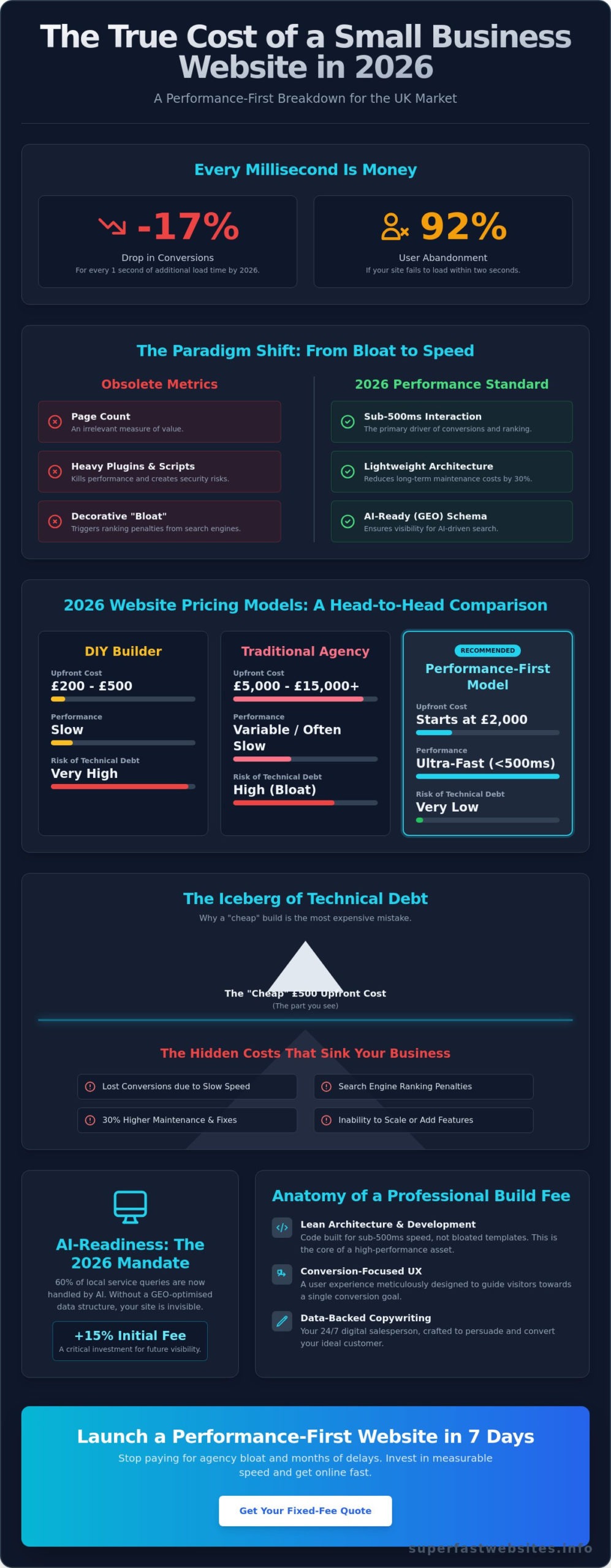
DIY Builders vs. Bespoke Agencies vs. Fixed-Fee Models
Choosing a development path determines your site's technical velocity and your bottom line. You have three primary routes in 2026. Each carries a different weight in terms of technical debt and speed to market. Understanding how much does a small business website cost requires looking past the initial price tag and calculating the total cost of ownership over 24 months.
The Limitations of DIY Website Builders
DIY platforms often lure startups with a £15 monthly subscription. This is a performance trap. These builders rely on bloated, "one-size-fits-all" code libraries that drag down Core Web Vitals. When you Calculate the startup costs for a new venture, the time investment is your most expensive asset. Spending 60 hours fighting a drag-and-drop interface results in a site that fails SEO audits and loads slowly on mobile devices. Use these builders only for micro-side-hustles where search traffic doesn't matter. For any business requiring a lead engine, DIY is a false economy.
Traditional Agencies: Why the £10k Quote Exists
Traditional agencies often present quotes starting at £5,000 to £10,000 for a standard build. This price reflects heavy overheads rather than pure technical output. You're paying for account managers, physical office space, and a 12-week development cycle. While a complex ecommerce website development company may justify this for massive inventories, most small businesses don't need the bloat. A 90-day launch window is too slow for 2026. High-performance b2b web development should focus on conversion and speed, not endless discovery meetings that pad the agency's billable hours.
The Fixed-Fee Efficiency Model
The fixed-fee model is the high-efficiency alternative for 2026. It strips away the agency bloat and focuses on a performance-first architecture. This model bridges the gap for those asking how much does a small business website cost without sacrificing quality. It delivers a professional, lightweight site in a fraction of the time. You get the technical authority of a bespoke build without the "bespoke" price inflation. This approach prioritizes:
- Instant Load Times: Optimized code over decorative fluff.
- Predictable Budgeting: No hidden hourly surprises.
- Rapid Deployment: Sites launch in days, not months.
- SEO Readiness: Technical foundations are built-in, not bolted on.
Efficiency is the only metric that matters. If your website development model doesn't prioritize speed, it's costing you revenue every second a user waits for a page to load.
The Hidden Price of Slow Performance and Technical Debt
A low upfront price is often a down payment on future failure. When calculating how much does a small business website cost, most owners ignore the "Performance Tax." A £500 template might look acceptable on a desktop, but it carries technical debt that drains your bank account through lost leads. Technical debt is the cumulative cost of choosing an easy, cheap solution now instead of a professional one that scales.
Speed is the primary driver of digital ROI. Data from Deloitte indicates that a mere 100ms improvement in mobile load times can boost conversion rates by 8.4%. Conversely, latency kills profit. If your site feels sluggish, you aren't just annoying users; you are actively funding your competitors. Poorly coded themes require expensive "hotfixes" within the first 12 months to address security vulnerabilities or broken plugins. This creates a cycle of reactive spending that far exceeds the cost of a high-performance build.
The "SEO Tax" is another invisible drain. Google’s Core Web Vitals directly influence your search ranking. A slow, bloated site forces you to spend more on paid ads because your organic visibility is non-existent. You end up paying a premium for every lead just to compensate for a sub-optimal foundation.
The Revenue Impact of Site Speed
Performance is a marketing investment, not a technical overhead. If your website takes 5 seconds to load, you will lose 40% of your potential customers before they even see your offer. Modern users demand instantaneous responses. The Conversion Gap is the measurable revenue difference between a site that loads in 1 second and one that forces users to wait for 3. Eliminating this gap is the fastest way to increase your bottom line without increasing your ad budget.
Avoiding the "Rebuild Trap"
Statistics show that 50% of small businesses in the UK rebuild their website within 18 months of launch. This happens because they outgrow DIY platforms or find that their "cheap" build cannot handle basic SEO requirements. Migrating from a closed DIY system to a professional CMS often costs double what a correct initial build would have. To future-proof your business for 2027, you must prioritise a lightweight, scalable architecture from day one. This prevents redundant spending and ensures your technology remains an asset rather than a liability.
Audit your current site performance to see where you are leaking profit.
The Superfast Solution: Professional Results at Fixed Fees
Speed is the ultimate competitive advantage. We developed the "One Page Wonder" and "Multi-Page Marvel" models to eliminate the bloat of traditional agency workflows. These frameworks focus on technical precision and rapid deployment. When asking how much does a small business website cost in 2026, you must look beyond the initial build. You're investing in a 7-day launch cycle that prioritises sub-second load times and immediate market entry. By using standardized high-performance frameworks, we deliver elite technical metrics without the five-figure price tag of bespoke manual coding.
Transparency in Web Design Pricing
Hourly billing is a legacy model that rewards inefficiency. We advocate for fixed-fee tiers because they provide absolute budget certainty for UK entrepreneurs. A professional turnkey package includes everything required for growth: elite design, lightning-fast hosting, and ongoing technical support. Consolidating these services under one roof eliminates the friction of managing multiple vendors. It ensures your entire stack remains optimized for the latest search engine requirements. You pay for outcomes and performance, not for an agency's overhead or slow internal processes.
Getting Started: From Kick-off to 7-Day Launch
Rapid deployment requires a clear roadmap. To prepare for a 7-day launch, businesses should have their core messaging and brand assets ready for integration. Our process leverages the VIA Creative pedigree; this brings decades of high-level design expertise into a streamlined, efficient workflow. This isn't a shortcut. It's an optimization of the entire development lifecycle. We strip away the unnecessary back-and-forth to focus on what drives revenue: speed, clarity, and conversion. View our fixed-fee website packages and launch in 7 days.
- Guaranteed Performance: Does the partner commit to specific Core Web Vitals scores?
- Fixed Pricing: Are there hidden costs for "extra" revisions or basic SEO setup?
- UK-Based Support: Is the technical team available during your business hours?
- Mobile-First Engineering: Is the site built for 2026 mobile hardware?
- Clear ROI: Can they explain how much does a small business website cost in terms of long-term conversion value?
The 2026 digital landscape doesn't tolerate lag. Choosing a partner who views speed as a core philosophy ensures your business remains competitive. Our fixed-fee models provide the technical authority you need to dominate your local UK market without the unpredictable costs of traditional development.
Stop Paying for Technical Debt
The 2026 digital landscape demands more than a static online presence. Performance is now the primary driver of search rankings and conversion rates. Technical debt and bloated code aren't just inconveniences; they're financial liabilities that drain your marketing budget. Choosing the right partner means balancing upfront investment against long-term revenue growth. High-speed infrastructure is the baseline for success in the UK market.
When calculating how much does a small business website cost, you must account for the hidden expense of slow load times. Industry data shows that a one-second delay can slash conversions by 20%. We eliminate this risk by prioritising speed from day one. Superfast Websites, a subsidiary of VIA Creative established in 2003, delivers elite technical infrastructure without the agency price tag. We provide fixed-fee pricing with zero hidden surprises. Every build is mobile-responsive and SEO-optimised as standard.
Stop waiting for slow developers and unpredictable invoices. You can get a high-performance website launched in 7 days for a fixed fee. It's time to build a digital foundation that scales with your business goals.
Frequently Asked Questions
How much does a simple 5-page website cost in the UK in 2026?
A professional 5-page website typically costs between £1,500 and £3,500 in the 2026 UK market. This price reflects the shift toward performance-first development where speed and mobile accessibility are mandatory. When calculating how much does a small business website cost, you're paying for clean code and rapid load times. Cheap £500 alternatives often fail Core Web Vitals, which directly harms your Google ranking and customer trust.
Why is professional web design so much more expensive than a DIY builder?
Professional design focuses on conversion architecture and technical efficiency rather than just aesthetics. DIY builders often inject 2MB of unnecessary bloat into every page, slowing your site down. You're paying for a specialist to strip away this digital waste. High-performance code leads to a 20% higher conversion rate compared to generic templates. Professionals ensure your site is an asset that generates revenue, not a slow liability.
What are the ongoing monthly costs of running a small business website?
Expect to pay between £30 and £150 per month for maintenance and high-performance hosting. Understanding how much does a small business website cost requires looking at these recurring fees. This includes managed hosting for £25, security monitoring for £15, and regular software updates. Skimping on hosting is a mistake. Cheap servers increase latency, and a 1-second delay can reduce your total conversion metrics by 7% instantly.
Can I build a business website for free?
No, because "free" platforms always carry hidden costs that damage your brand. These sites usually display third-party ads and force you onto a slow, shared subdomain. You'll still need to pay roughly £15 per year for a professional .co.uk domain. Free builders lack the optimization tools needed for 2026 SEO standards. If your site takes 3 seconds to load, 40% of your visitors will leave before seeing your offer.
How long does it take to build a small business website?
A high-performance build typically takes 4 to 8 weeks from kickoff to launch. This timeline includes 2 weeks for strategic planning, 3 weeks for development, and 1 week for rigorous speed testing. Rushing the process leads to messy code and broken links. We prioritize a logical, phased approach to ensure every script is optimized. Quality development takes time because every millisecond of performance must be manually refined for maximum impact.
Does the cost of a website include SEO and marketing?
Development costs include technical SEO foundations, but ongoing marketing is a separate investment. Your build price covers site structure, meta tags, and schema markup. Ongoing SEO retainers in the UK usually start at £500 per month for active content and backlink building. Don't confuse a fast, search-ready site with a full-scale digital marketing campaign. A high-performance site provides the necessary foundation, but marketing drives the actual traffic to it.
What is the difference between hosting and a domain name cost?
A domain name is your digital address and costs about £10 to £20 annually. Hosting is the server space where your files live, costing between £200 and £600 per year for business-grade performance. Think of the domain as your business card and hosting as the physical office. Cheap hosting is a bottleneck for growth. We recommend dedicated resources to ensure your site stays online and loads instantaneously during high-traffic periods.
Should I pay for a custom e-commerce site or use a template?
Choose a custom build if you want to achieve sub-200ms server response times. While templates are cheaper initially, they often contain redundant CSS and JavaScript that slow down the checkout process. Custom e-commerce builds allow for a lightweight user journey that increases average order value. Data shows that custom sites scale more effectively as your product range grows. Every extra second of loading time at checkout results in abandoned carts.