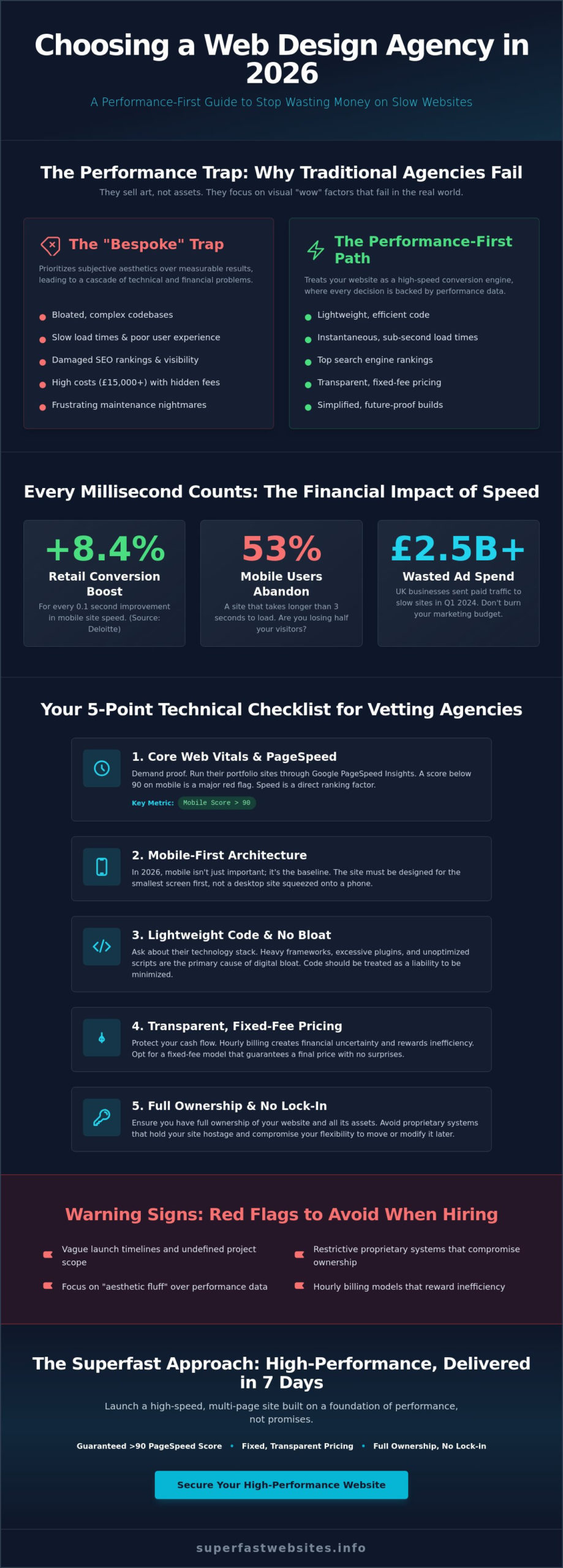
Deloitte research shows that a 0.1-second improvement in mobile load speed boosts retail conversion rates by 8.4%. Despite this data, many UK businesses are still quoted £15,000 or more for bloated websites that frustrate users and damage SEO rankings. You likely agree that the traditional development process is broken. It's often plagued by hidden costs and technical jargon that masks a lack of tangible results. Choosing a web design agency should be a strategic investment in speed and efficiency, not a descent into a financial black hole.
This guide cuts through the industry noise to help you find a performance-first partner. You'll learn how to secure a high-performance site with fixed, transparent pricing and zero surprises. We provide a clear roadmap for 2026. This ensures your next digital project prioritises lightweight code and instantaneous load times, turning your website into a high-speed engine for customer conversion.
Key Takeaways
- Identify why traditional "bespoke" builds often lead to digital bloat and learn to prioritize technical performance over aesthetic fluff.
- Navigate the process of choosing a web design agency by applying five measurable technical criteria that directly impact your bottom line.
- Protect your business cash flow by opting for transparent, fixed-fee pricing models that eliminate the financial uncertainty of hourly billing.
- Spot critical red flags early, including vague launch timelines and restrictive proprietary systems that compromise your ownership and flexibility.
- Discover how a standardized, performance-first philosophy enables the launch of a high-speed, multi-page site in just seven days.
The Performance Trap: Why Traditional Web Design Agencies Often Fail Small Businesses
Traditional agencies sell art, not assets. They focus on visual "wow" factors that look impressive in a boardroom presentation but fail in the real world. When web design prioritizes aesthetics over technical efficiency, your business pays the price in lost leads. These agencies often hide behind the "bespoke" label to justify unnecessary complexity. This custom approach frequently leads to bloated codebases and maintenance nightmares that drain your budget without improving your bottom line.
By 2026, search engine algorithms have evolved to treat speed as a non-negotiable ranking factor. A slow-loading, over-designed site is a massive liability for your SEO. When choosing a web design agency, you must look past the portfolio and look at the PageSpeed scores. If an agency cannot demonstrate a history of sub-second load times, they're building a hurdle for your business, not a bridge to your customers. The shift from creative-first to conversion-first thinking is the only way to survive in a crowded digital marketplace.
The High Cost of Digital Bloat
Digital bloat is the primary enemy of small business growth. It manifests as excessive animations, unoptimized third-party scripts, and heavy frameworks that serve no functional purpose. Statistics show that 53% of mobile users abandon a site if it takes longer than three seconds to load. In the UK market, where mobile commerce continues to dominate, these delays are catastrophic for your conversion rates. Your agency must justify every millisecond of load time with a corresponding increase in user value. If a feature doesn't directly contribute to a sale or a lead, it shouldn't exist on your site.
Prioritizing ROI Over Subjective Aesthetics
A "pretty" site that doesn't convert is a failing investment. High-performance agencies understand that a website is a lead engine, not a vanity project. To identify if an agency understands your goals, ask them about their data-led design process rather than their colour palette choices. They should be able to explain how their technical decisions will impact your specific KPIs. This includes a heavy emphasis on the role of copy for websites during the initial design phase. Effective copy drives action, while "fluff" design merely distracts.
- Technical efficiency must take precedence over visual trends.
- Bespoke builds should simplify the user journey, not complicate the backend.
- Every design choice must be backed by performance metrics and conversion data.
UK businesses spent over £2.5 billion on digital advertising in the first quarter of 2024. Sending that expensive traffic to a bloated, slow-loading site is a waste of capital. When choosing a web design agency, demand a performance-first strategy that treats speed as the ultimate competitive advantage.
5 Technical Criteria for Choosing a High-Performance Web Design Agency
Aesthetics are subjective, but performance is absolute. When choosing a web design agency, looking at a visual portfolio tells you nothing about how a site actually functions under pressure. You need a technical audit. High-performance agencies build for the browser and the search engine, not just the eye. They treat code as a liability that must be minimized, not a canvas for unnecessary flourishes.
Core Web Vitals and Loading Speed
Core Web Vitals are the standardized metrics Google uses to measure the real-world speed, responsiveness, and visual stability of your website. These metrics directly influence your search engine ranking and user retention. Don't take an agency's word for their technical skill. You should run their own website through Google PageSpeed Insights. If their portfolio sites score below 90 on mobile, they lack the technical discipline to build a competitive product for you. Use these free tools to verify their claims:
- Google PageSpeed Insights: Measures Largest Contentful Paint (LCP) and Cumulative Layout Shift (CLS).
- GTmetrix: Provides a waterfall chart to see exactly which assets are slowing down the site.
- WebPageTest: Allows you to test site speed from specific UK server locations.
Mobile-First Responsiveness
Mobile-first architecture is the baseline for 2026. It's no longer about making a desktop site fit on a phone; the agency must design for the smallest screen first to ensure lean asset delivery. Google indexes the mobile version of your site almost exclusively. Test their previous work on physical devices rather than just resizing a browser window. Check that tap targets are at least 48x48 pixels to prevent user frustration. Poor mobile performance destroys your PPC efficiency. If you're paying for clicks through Google Ads, a slow mobile landing page wastes your budget by driving users away before the page even loads.
Security and Clean Code Standards
Code bloat is the primary enemy of speed. Many agencies rely on heavy, pre-built themes that include thousands of lines of unnecessary CSS and JavaScript. This creates a "bloated nightmare" that is difficult to maintain and slow to load. Demand lightweight, standardized frameworks that prioritize clean code. Security must be integrated from day one, including SSL certificates and secure cloud hosting environments. This technical foundation starts before the first line of code is written. You can learn more about the initial technical setup in our guide on domain name registration for UK businesses.
When choosing a web design agency, remember that every 100ms delay in load time can decrease conversion rates by 7%. Speed is the most critical ROI factor in your digital project. If you want to see how your current site stacks up against these 2026 standards, you can audit your performance metrics to identify immediate growth opportunities.
Fixed-Fee vs. Hourly Billing: Navigating the Financial Reality of Web Projects
Hourly billing is a financial trap for the unwary. It creates a direct misalignment of goals between you and the developer. When an agency bills by the hour, inefficiency becomes profitable for them. Every bug, delay, or communication breakdown adds to your final invoice. This "open-ended" structure often leads to budget overruns that exceed 30 percent of the original estimate. For a UK business, this volatility disrupts cash flow and stalls growth.
Fixed-fee models provide the transparency you need. You pay for outcomes, not minutes. This approach forces the agency to be efficient. If they waste time, it costs them, not you. It's the only logical choice for performance-focused projects. Choosing a web design agency that refuses to commit to a fixed price is a red flag. It suggests a lack of confidence in their own internal processes.
Eliminating Scope Creep with Standardized Packages
Standardized packages protect your investment. Tiered pricing models define exactly what you receive for your money. This eliminates the "hidden fee" culture prevalent in the industry. You know the total cost before the project begins. This clarity allows for faster delivery without sacrificing quality. Standardized builds utilize proven frameworks. This means your site benefits from tested, high-performance code rather than experimental, unoptimized scripts. Efficiency is the byproduct of a refined, repeatable process.
Hidden Costs to Watch For
The initial development fee is only the baseline. You must look deeper into the contract. Common add-ons include high-speed hosting, security patches, and CMS training. These can add hundreds of pounds to your annual overhead if not disclosed upfront. Compare one-time project fees against recurring maintenance subscriptions. A professional subscription often provides better value by ensuring your site stays lightweight and secure over time.
The cost of "cheap" DIY builders is deceptively high. While a platform might cost £20 per month, the performance debt is massive. Bloated code and slow shared servers kill your conversion rate. When you hire an ecommerce website development company, you are investing in speed. A site that loads in under 2 seconds can see a significant boost in revenue compared to a sluggish DIY alternative. Performance is not an expense; it's a revenue driver. Prioritize long-term ROI over low entry prices when choosing a web design agency.
- Fixed-Fee: Predictable costs and agency accountability.
- Hourly: Unpredictable budgets and misaligned incentives.
- DIY Builders: Low entry cost but high performance debt.
- Professional Agencies: Higher initial investment with measurable ROI.
Red Flags: What to Avoid When Hiring a Web Design Partner
Choosing a web design agency requires more than reviewing a portfolio of aesthetically pleasing images. You're selecting a technical partner responsible for your primary revenue driver. A mistake here costs more than just the initial fee; it costs months of lost leads and wasted marketing spend. Avoid these critical warning signs before signing any contract.
- Vague Timelines: If a firm cannot provide a concrete launch date, they lack a repeatable process. In 2024, roughly 34% of UK digital projects failed to meet deadlines due to poor initial scoping. Demand a project schedule with clear milestones.
- Proprietary CMS Traps: Never allow an agency to build your site on a closed-source, "in-house" platform. This creates vendor lock-in. You must own your code and be able to migrate your data to any standard hosting environment without rebuilding from scratch.
- Lack of SEO Foundations: Search engine visibility isn't a post-launch luxury. It's a structural requirement. A site built without technical SEO optimisation is a digital paperweight that won't appear in search results.
- Poor Response Times: Communication speed mirrors technical speed. If they take 48 hours to reply to a sales enquiry, they'll take 48 hours to fix a critical server error.
The "Ghosting" Agency Profile
Many agencies prioritise the "hunt" over the "help." Once the deposit is paid, the senior talent disappears, and your project is handed to a junior developer. High-performance teams assign a dedicated technical point of contact from day one. You need direct access to the person building your site, not a middleman who filters your feedback. Rapid response times are a hallmark of elite teams. A 24-hour response window is the industry standard; anything slower indicates a lack of capacity or poor internal organisation.
Over-Complicated Technical Solutions
Complexity is the enemy of performance. Be wary of agencies suggesting "custom-coded" solutions for standard business functions. Bloated, bespoke frameworks often lead to fragile sites that break during basic updates. When choosing a web design agency, look for those who value lightweight, efficient builds. Focus on b2b web development that turns visitors into enquiries through speed and clarity. A site that loads in under 200 milliseconds will always outperform a complex "experience" that takes five seconds to render. When choosing a web design agency, ensure they can prove their technical choices result in measurable ROI.
Don't settle for a slow, fragile website that hurts your bottom line. Partner with Superfast Websites to build a high-performance lead engine today.
The Superfast Approach: Launching Your High-Performance Site in 7 Days
Most UK businesses lose potential revenue because their web development process takes months. We've eliminated that delay. Our standardized Multi-Page Marvel model delivers a lean, high-conversion environment without the traditional wait times. We strip away the digital bloat that kills load speeds, focusing entirely on the technical metrics that drive Google rankings and user engagement. When choosing a web design agency, you must decide if you want a decorative digital brochure or a high-performance sales engine.
Our performance-first philosophy means every line of code must justify its existence. We've removed heavy third-party scripts and legacy frameworks that slow down standard builds. For a UK small business, this efficiency translates directly to a lower bounce rate. Statistics show that 40% of users abandon a site that takes longer than 3 seconds to load. We build sites that load in a fraction of that time, ensuring you don't lose customers before they even see your offer.
Efficiency as a Competitive Advantage
Speed is the ultimate differentiator in the 2026 digital market. A site that launches in 7 days puts you months ahead of your local rivals who are still stuck in "design discovery" phases. We operate as a specialist subsidiary of VIA Creative, bringing over 20 years of high-level marketing expertise to every project. This relationship provides you with enterprise-grade reliability and technical authority. You get a battle-tested system designed by experts who understand that choosing a web design agency is an investment in your bottom line, not just an aesthetic choice.
Your Launch Checklist
A rapid 7-day launch requires precision and preparation. We've simplified the onboarding process to ensure we hit the ground running. Our managed hosting and support subscriptions then take the technical burden off your shoulders, providing proactive security and 99.9% uptime. To prepare for your kick-off, ensure you have the following ready:
- Branding Assets: High-resolution logos, brand colours, and specific font requirements.
- Core Content: Drafts for your services, about page, and contact information.
- Conversion Goals: A clear understanding of what action you want visitors to take.
- Domain Access: Your existing domain credentials to facilitate a seamless transition.
We handle the complex optimization, server-side configurations, and mobile responsiveness. You focus on running your business while we deploy your high-performance asset. It's time to stop waiting and start converting. Launch your Superfast Website today.
Secure Your Competitive Advantage in 2026
Success in the modern digital landscape requires more than just a visual presence. Traditional agencies often overlook the technical debt that cripples small businesses. Google research confirms that 53% of mobile users abandon sites that take longer than three seconds to load. When choosing a web design agency, you must demand technical authority and transparent, fixed-fee pricing. Prioritise a partner that views speed as the primary driver for SEO and revenue growth. Every millisecond saved is a direct investment in your conversion rate.
Don't let your business get left behind by slow-loading competitors. You deserve a platform that's mobile-responsive, SEO-optimised, and engineered for peak performance from day one. Our process eliminates the bloat and delivers a lightweight, high-performance solution that respects your time and your budget. It's time to stop waiting months for a site that might not even perform. You can have a fully functional, lightning-fast site ready to capture leads in a single week.
Get your high-performance website launched in just 7 days with Superfast Websites
Your business moves fast; your website should move faster.
Frequently Asked Questions
How much does a professional web design agency cost in 2026?
In 2026, professional UK web design costs typically range from £5,000 for small business sites to over £50,000 for complex enterprise platforms. Industry data shows UK agencies have increased rates by 15% since 2023 to account for advanced AI integration and performance requirements. You're investing in technical architecture and conversion logic. High-end agencies justify these costs by delivering sub-second load times that correlate with higher revenue. Cheap builds create technical debt.
How long should it take to design and launch a small business website?
A standard high-performance small business website requires between 6 and 12 weeks from kickoff to deployment. This timeline allocates 2 weeks for discovery, 4 weeks for design, and 4 weeks for technical development. Efficiency is critical when choosing a web design agency that prioritizes rapid deployment. Delays often occur during content approval phases. We focus on a streamlined workflow to ensure your site goes live without unnecessary bloat or technical bottlenecks.
What is the difference between a bespoke website and a template-based build?
Bespoke websites use clean, lightweight code built for your specific needs, whereas templates rely on pre-built frameworks that contain up to 40% redundant code. Custom builds offer total flexibility for performance optimization and brand alignment. Templates limit your ability to scale and often suffer from poor PageSpeed scores. Choosing a web design agency that builds bespoke ensures your site isn't weighed down by generic CSS or unnecessary third-party plugins.
Do I need to provide all the content for my new website?
You can provide your own content, but most elite agencies offer technical copywriting to ensure SEO and performance alignment. High-performance sites require copy structured for both users and search algorithms. If you provide content, it must meet strict word count and keyword requirements. Approximately 70% of project delays stem from late content delivery. Professional writers ensure your messaging converts visitors into customers using data-backed strategies that improve your ROI.
Will my website be mobile-friendly and optimized for Google?
Every modern website must pass Google's Core Web Vitals using a mobile-first architecture to maintain search visibility. Mobile traffic now accounts for 62% of UK web usage according to 2025 digital reports. We optimize for Largest Contentful Paint and Cumulative Layout Shift to ensure instant loading on all devices. Optimization isn't an afterthought; it's the foundation of the build. This technical rigour ensures your site ranks higher and provides a seamless experience.
What happens after the website is launched? Do I get ongoing support?
Post-launch support includes monthly security patches, performance monitoring, and technical hosting management to ensure 99.9% uptime. Regular audits are necessary to prevent software decay and maintain peak loading speeds. Your site needs active maintenance to stay secure against evolving cyber threats. Most UK agencies offer fixed-fee maintenance packages. Ongoing support ensures your digital asset continues to deliver a high return on investment while maintaining its technical edge.