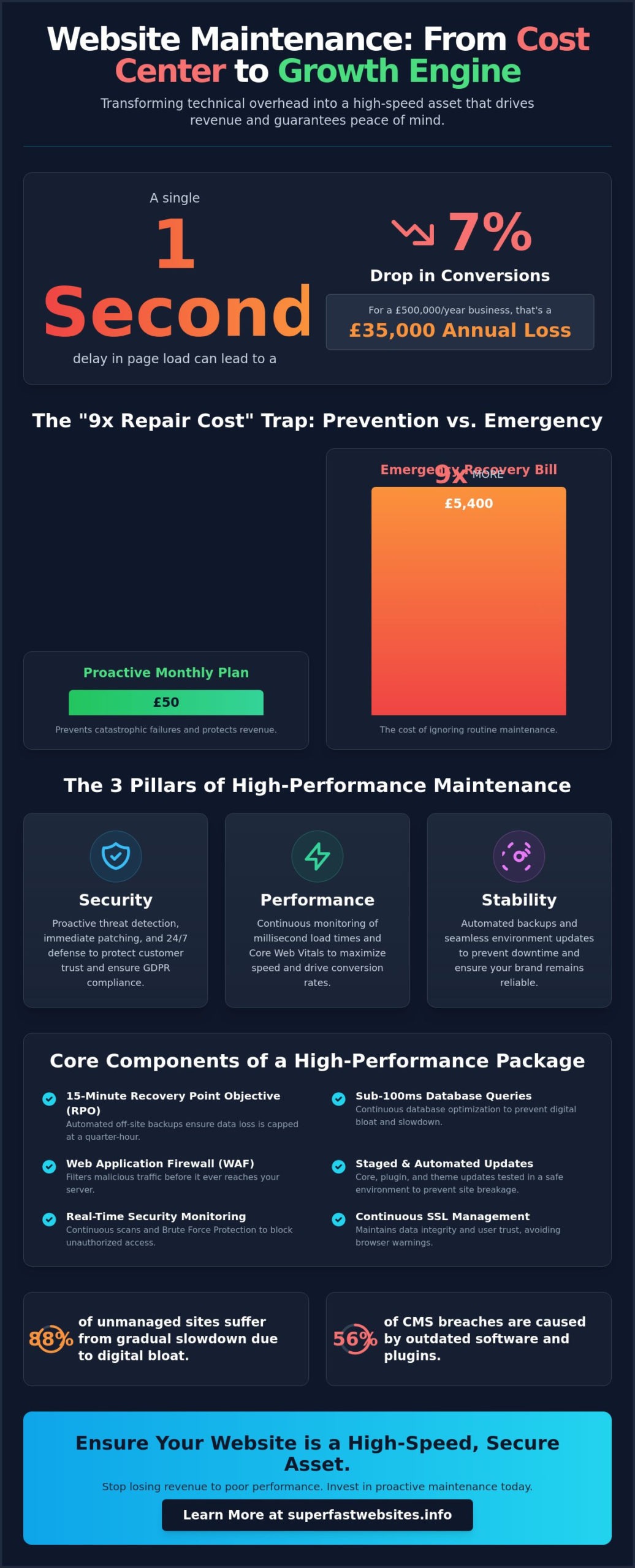
A single second of latency can slash your conversion rates by 7% according to Akamai research. For a UK firm generating £500,000 in annual online sales, that one-second lag is effectively a £35,000 annual tax on your growth. Most website maintenance plans for small business focus on reactive fixes, yet the real value lies in proactive performance optimization that prevents revenue loss before it happens.
You likely view maintenance as a recurring expense, a black box of technical jargon like database optimization and SSL renewals. It's a common frustration to see your budget disappear into updates while your site speed remains stagnant. This article changes that narrative. You'll learn to transform your technical overhead into a performance-first asset that guarantees zero downtime and lightning-fast interactions for every visitor.
This guide outlines the 2026 standard for achieving instantaneous page loads and uncompromising security. We'll break down the exact technical SEO and infrastructure protocols required to give you total peace of mind and a measurable competitive advantage.
Key Takeaways
- Shift your perspective from maintenance as a recurring cost to a performance-first growth engine that prioritises technical health and site speed.
- Evaluate how professional website maintenance plans for small business prevent costly downtime and protect your UK revenue from the technical risks of DIY updates.
- Master the core components of high-performance packages, including automated off-site backups with a rapid 15-minute recovery point objective.
- Learn to audit service providers by demanding transparent performance reporting and real-time security monitoring instead of hidden caps on support hours.
- Understand the direct link between millisecond optimisations and conversion rates to ensure your digital presence remains a lightweight, high-speed asset.
Defining Website Maintenance Plans: Beyond Basic Digital Insurance
A high-performance website is not a static asset. It's a complex software environment that begins to decay the moment it's launched. Effective website maintenance plans for small business move beyond "digital insurance" and focus on proactive technical health. This ensures your site remains fast, secure, and functional every second of the day. You aren't just paying to keep the lights on; you're investing in a revenue-generating tool that stays sharp.
Recent 2024 industry data highlights a "9x repair cost" trap that catches many UK firms off guard. Businesses that ignore Software maintenance pay nine times more to fix a catastrophic failure than they would've spent on monthly upkeep. For a small business in the UK, a £50 monthly proactive plan prevents a £5,400 emergency recovery bill. Proactive care eliminates the need for an expensive in-house technical team. It provides elite-level engineering at a fraction of the cost of a single full-time hire.
The Three Pillars of Modern Maintenance
- Security: We implement proactive threat detection and immediate patching. Vulnerabilities in plugins or themes are closed before they're exploited. This is non-negotiable for GDPR compliance and customer trust.
- Performance: We monitor millisecond load times and Core Web Vitals continuously. Speed is the primary driver of conversion rates in 2026. If your site slows down by 100 milliseconds, your revenue drops. We don't let that happen.
- Stability: Regular backups and environment updates prevent downtime. We ensure your site stays online during server migrations or CMS version jumps. Stability is the foundation of a reliable brand.
Maintenance vs. Managed Hosting: Knowing the Difference
Standard hosting is often insufficient for performance-first websites. Hosting provides the server space; maintenance manages the application. A hosting provider keeps the server running, but they won't fix a broken checkout or optimize a bloated database. Website maintenance plans for small business bridge this gap. They ensure the Content Management System (CMS) is optimized for the specific server environment. While hosting ensures uptime, maintenance ensures the site actually works when a customer arrives. This distinction is critical for maintaining a competitive edge. Hosting is the house, but maintenance is the renovation and upkeep that keeps the property value high.
Core Components of a High-Performance Maintenance Package
Effective website maintenance plans for small business must prioritise technical resilience over basic uptime. A performance-first plan includes automated off-site backups with a 15-minute recovery point objective (RPO). This ensures that data loss is capped at a quarter-hour window, providing a safety net that standard daily backups cannot match. Real-time security monitoring and continuous SSL certificate management maintain data integrity and user trust. Without these, your site risks browser warnings that kill conversion rates instantly. We focus on the underlying infrastructure to ensure your site remains a reliable revenue generator.
Performance tuning is a continuous requirement, not a one-time event. Digital bloat accumulates as databases grow and scripts become outdated. Our approach focuses on database optimisation to ensure query responses remain under 100 milliseconds. This technical rigour prevents the gradual slowdown that plagues 88% of unmanaged sites. For those starting out, this comprehensive guide to website maintenance outlines the fundamental requirements for modern web presence. High-performance maintenance eliminates redundant data rows and overhead, keeping the engine lean and responsive.
Security and Vulnerability Management
Outdated software is the primary entry point for 56% of CMS breaches according to recent cyber security reports. High-performance plans automate core, plugin, and theme updates within a staged environment to prevent site breakage. We implement a Web Application Firewall (WAF) to filter malicious traffic before it reaches your server. Brute Force Protection is a non-negotiable security layer that blocks repeated, automated login attempts to prevent unauthorised access. Maintaining these protocols is essential for businesses that value lightweight, secure digital architecture. Security is not a passive state but an active, 24/7 defence operation.
Proactive Speed and Performance Tuning
The "set it and forget it" mentality leads to 12% performance degradation annually. Recurring maintenance must include image optimisation and script minification to keep page weights low. Every 100-millisecond delay in load time can reduce conversion rates by 7%. We treat speed as a direct revenue driver. By eliminating unnecessary render-blocking resources, we ensure your site remains instantaneous for every visitor. This level of precision is what separates elite website maintenance plans for small business from generic hosting add-ons. We focus on the metrics that matter, turning milliseconds into pounds earned.
The ROI of Maintenance: DIY vs. Professional Managed Plans
DIY maintenance is a common trap for growing firms. It's often viewed as a cost-saving measure, but the hidden expenses are substantial. When a business owner manages their own updates, they aren't just clicking a button. They're gambling with their uptime. A single plugin conflict can trigger the "White Screen of Death" during peak trading hours. If your business generates £400 per hour in revenue, a three-hour outage results in a £1,200 loss. This doesn't include the emergency developer fees required to restore the site, which often exceed £150 per hour for urgent call-outs. Professional website maintenance plans for small business eliminate this volatility by moving updates to a controlled staging environment first.
Managed plans offer a scalable foundation for high-performance b2b web development. As your lead engine grows, the technical demands increase. Manual processes that worked for a five-page brochure site will fail a complex lead generation platform. Expert support ensures that your infrastructure scales alongside your traffic. It transforms a technical liability into a predictable monthly operational expense. You stop paying for "fixes" and start investing in "prevention."
The Risk Assessment of Neglect
Neglect carries a heavy price tag. A case study of a UK-based e-commerce retailer showed that a 4-hour outage caused by an unpatched security vulnerability led to a 22% drop in repeat customer visits over the following month. Trust is fragile. Outdated software is the primary entry point for 80% of successful cyberattacks. This guide for website owners confirms that consistent oversight is the only way to mitigate these risks. Beyond security, Google's 2026 ranking factors penalise sites with high technical debt. If your software is old, your SEO rankings will drop, regardless of your content quality.
Performance as a Competitive Advantage
Speed is a direct driver of revenue. A well-maintained site loads in under 1.2 seconds, while bloated, unoptimised competitor sites often take 4 seconds or more. Data shows that a 100ms improvement in load time can boost conversion rates by up to 8.4%. Professional website maintenance plans for small business focus on continuous optimisation, including database cleaning and script minification. This future-proofs your digital presence for the browser standards of 2026. Instantaneous loading creates a psychological advantage. It signals authority and reliability, ensuring your brand stands out in a crowded market.
How to Evaluate Website Maintenance Plans for Small Business
Choosing the right plan isn't about checking a box; it's about protecting your revenue. Most website maintenance plans for small business focus on "keeping the lights on." In 2026, that isn't enough. If your site is up but loads in four seconds, you're losing 40% of your traffic before the first image renders. You need a partner that treats speed as a non-negotiable metric rather than a secondary feature.
Transparency is your first filter. Avoid vendors that hide behind vague support caps or "inclusive hours" that don't cover critical security patches. A performance-first plan should provide a flat, predictable structure. If a developer can't explain exactly how they handle a PHP version conflict or a database bloat issue without charging extra, walk away. Demand data on speed and security status every month. You shouldn't have to ask if your site is fast; you should see the millisecond improvements in your monthly report.
Evaluate the logic behind the service. Does the provider prioritize "uptime" or "performance"? Uptime is the bare minimum requirement for being online. Performance is the engine that drives Google rankings and user conversions. Milliseconds matter. A site-down scenario in the middle of a UK bank holiday could cost thousands in lost conversions. Your partner should offer a 15-minute triage response time, not a 24-hour ticket queue. Efficiency is the only metric that counts when your revenue is on the line.
The Performance-First Audit Checklist
A maintenance plan is only as good as its technical depth. Use this checklist to vet potential partners:
- Core Web Vitals: Does the plan include monthly assessments of LCP, FID, and CLS?
- Redundancy: Are backups stored on an entirely separate server environment? A backup on the same server is just a second point of failure.
- Content Agility: Is there a streamlined process for updating copy for websites to ensure new text doesn't break your layout or slow down the DOM?
Choosing a Partner, Not Just a Vendor
Technical authority is non-negotiable. You need a team that understands rapid deployment and server-side optimization. For UK businesses, local support is a strategic advantage. It ensures your site's data remains compliant with local regulations and minimizes latency for your primary audience. If you're running a shop, your needs are even more specific. You should consult an ecommerce website development company to ensure your maintenance includes checkout optimization and payment gateway security. Don't settle for a generalist when your business requires a specialist's precision.
Super Fast Websites: Hosting and Support Built for Speed
Speed is the only metric that matters when data shows that a one-second delay in page load time can lead to a 7% reduction in conversions. Our "Hosting & Support" package is engineered for uncompromising efficiency. It's not just a place to park your data; it's a performance engine. By integrating this package with "The Multi-Page Marvel," we provide a seamless, fast-launch experience that puts your business ahead of the competition from day one.
Transparency is a core value at Superfast Websites. We operate on a fixed-fee basis. You won't find surprise bills or hidden overage charges here. You get consistent, high-level performance for a predictable monthly investment. As a subsidiary of VIA Creative, we bring over 20 years of technical authority to every project. This heritage means we've seen every web evolution since 2004, and we've refined our processes to eliminate the digital bloat that slows down modern sites.
Instantaneous Support and Technical Excellence
Generic helpdesks waste your time. Our model provides direct access to specialists who understand performance-first architecture. When you have a question, you talk to an expert, not a script. We don't just fix bugs; we perform continuous optimization cycles. These cycles keep your site lightweight and agile, ensuring that your code remains as clean as the day it launched. We focus on measurable outcomes: speed, security, and stability.
- Speed: We track millisecond improvements because we know they directly impact your bottom line.
- Security: We deploy enterprise-grade patches and monitoring to keep your data safe from evolving threats.
- Stability: Our UK-based infrastructure ensures 99.9% uptime, providing a reliable foundation for your brand.
Get Started with a High-Performance Plan
Onboarding is a streamlined process. Whether you have an existing site that feels sluggish or you're starting a new build, we handle the technical heavy lifting. We audit your current setup, identify the bottlenecks, and migrate you to our optimized environment. Our website maintenance plans for small business are designed for those who refuse to settle for "good enough."
Ambitious UK businesses choose us because we treat speed as a financial asset. A faster site ranks higher on search engines and converts more visitors into customers. Effective website maintenance plans for small business should pay for themselves through improved ROI and reduced bounce rates. Don't let a slow host throttle your growth. Secure your performance-first maintenance plan today and experience the difference that 20 years of expertise makes.
Secure Your Competitive Edge for 2026
In 2026, a slow website is a liability. Your digital presence requires more than basic security patches; it needs a performance-first strategy that converts visitors into customers. Effective website maintenance plans for small business bridge the gap between technical stability and high-speed growth. We leverage 20+ years of technical expertise to ensure your site stays lean, secure, and instantaneous. You get fixed-fee, transparent pricing without the hidden agency bloat that often drains UK marketing budgets. Our team designs websites to launch in as little as 7 days with full support included. Don't let technical debt slow your progress. It's time to treat speed as your primary competitive advantage. Every millisecond saved is a direct contribution to your bottom line. Your business deserves a platform that works as hard as you do. Start building for the future today.
Optimise your site performance with our professional Hosting & Support packages
Frequently Asked Questions
What is included in a standard website maintenance plan for small business?
A standard plan includes core software updates, security patches, automated daily backups, and 24/7 uptime monitoring. High-performance website maintenance plans for small business also prioritize database optimization and image compression to maintain sub-second load times. These services ensure your site remains secure against the 30,000 websites hacked daily according to Forbes data. Regular reporting on Core Web Vitals is now a standard requirement for maintaining 2026 search visibility.
Do I really need a maintenance plan if my website is small?
Yes, because small websites are targeted by automated bots regardless of your traffic volume. Over 43 percent of cyberattacks target small businesses, making professional oversight essential for your digital survival. Neglecting updates leads to technical debt and cumulative performance degradation over time. Even a small site needs to maintain a 99.9 percent uptime rate to ensure local customers can reach you during business hours without friction.
How much do website maintenance plans typically cost in 2026?
UK industry data for 2026 shows that basic website maintenance plans for small business typically range from £50 to £150 per month. Complex e-commerce sites or high-traffic platforms often require premium tiers costing between £200 and £500 monthly. These costs reflect the technical expertise required to manage server-side optimizations and security protocols. Investing a small monthly fee prevents the high costs associated with emergency repairs and lost revenue during a critical outage.
Can I update my own website instead of paying for a plan?
You can manage updates manually, but this often leads to plugin conflicts or broken layouts that take hours to fix. Professional plans use staging environments to test updates before they go live on your production server. This prevents the "white screen of death" and ensures your site stays fast. Most business owners spend 5 to 10 hours monthly on manual maintenance, which is time better spent on revenue-generating activities.
What happens if my website crashes and I don’t have a maintenance plan?
You'll likely face emergency developer fees ranging from £100 to £250 per hour for immediate restoration. Without a plan, you lack recent off-site backups, which means you might lose weeks of content or customer data permanently. Downtime costs UK small businesses an average of £400 per hour in lost opportunities. A maintenance agreement guarantees a response time, typically under 4 hours, to restore your digital presence and protect your brand reputation.
Does website maintenance help with my Google SEO rankings?
Maintenance directly impacts SEO by ensuring your site meets Google's strict PageSpeed Insights thresholds. Sites that load in under 2 seconds see a 15 percent higher conversion rate than slower competitors. Regular maintenance removes broken links and optimizes your site's code structure for better crawling. Google's 2026 algorithm prioritizes technical stability and mobile responsiveness, both of which degrade quickly without consistent professional attention and performance tuning.
How often should website maintenance be performed?
Security monitoring and uptime checks must occur every 60 seconds to ensure immediate response to failures. Software updates and database optimizations are typically performed weekly to ensure peak efficiency and patch new vulnerabilities. We recommend a comprehensive technical audit every 90 days to identify emerging performance bottlenecks. This proactive schedule prevents the 20 percent annual performance decay typically seen in unmanaged WordPress installations.