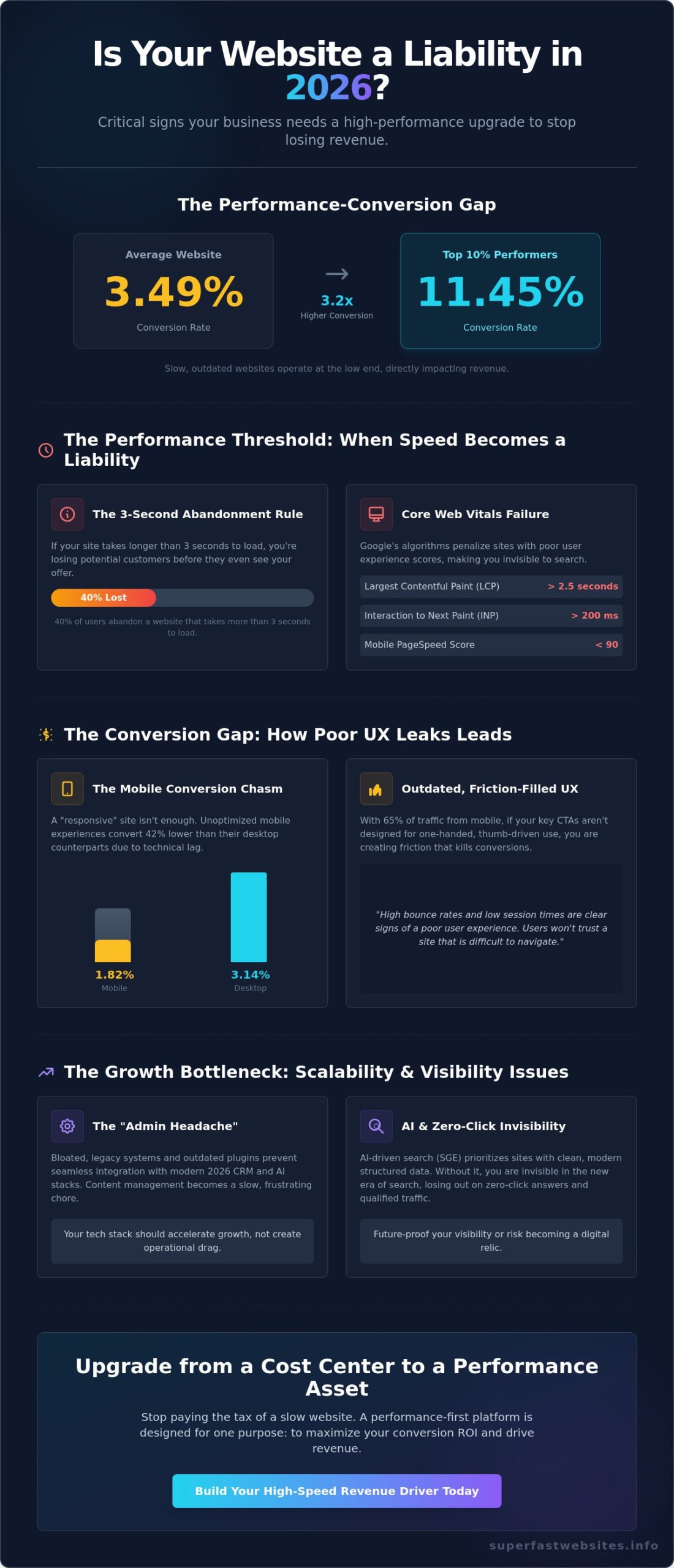
In 2026, a slow website isn't just an annoyance; it's a direct tax on your revenue. If your Largest Contentful Paint (LCP) exceeds 2.5 seconds or your mobile PageSpeed score sits below 90, you're likely losing a share of the 3.49% conversion rate average seen in AI search platforms. You've likely noticed the signs my business needs a new website, from rising bounce rates to the quiet embarrassment of sending a high-value prospect to a URL that feels like a digital relic. It's frustrating to watch your search visibility vanish because technical bloat makes modern optimization impossible.
I'll show you exactly how to identify the red flags sabotaging your growth and how to pivot to a performance-first engine. This guide provides a clear checklist of 15 critical indicators, explains why the top 10% of performers are reaching 11.45% conversion rates, and maps out a streamlined path to a high-performance replacement. We'll break down the technical metrics and strategic shifts required to turn your digital presence from a liability into a high-speed revenue driver.
Key Takeaways
- Benchmark your site against the 3-second rule to eliminate the 40% abandonment rate caused by technical debt.
- Audit your mobile interface for thumb-driven design to fix the UX leaks that are critical signs my business needs a new website.
- Eliminate the "Admin Headache" by upgrading to lightweight systems that integrate seamlessly with 2026 CRM and AI stacks.
- Future-proof your visibility by implementing structured data tailored for AI-driven search and zero-click environments.
- Transition your website from a passive cost center to a performance-first asset designed for maximum conversion ROI.
The Performance Threshold: When Speed Becomes a Business Liability
Technical debt is the silent interest you pay on yesterday’s shortcuts. In 2026, this debt manifests as bloated JavaScript frameworks, unoptimized CSS, and legacy plugins that suffocate your server response times. Speed is no longer a luxury; it is a binary. Your site is either fast enough to convert or slow enough to fail. If your pages take longer than 3 seconds to load, 40% of your audience will abandon the session before seeing a single product. This abandonment isn't just a missed visit. It is a direct transfer of market share to a faster competitor.
One of the most obvious signs my business needs a new website is a performance ceiling that prevents growth. When your current infrastructure cannot handle modern optimization techniques, you are operating with a performance-first handicap. Millisecond improvements correlate directly with revenue lift. For every 100 milliseconds you shave off your load time, conversion rates can jump by up to 1%. Identifying 'bloatware' is the first step toward recovery. Old tracking scripts, redundant social widgets, and heavy, unoptimized code act as anchors on your growth, dragging down your metrics and your bottom line.
Core Web Vitals and Your Bottom Line
Google’s 2026 algorithms are ruthless about user experience metrics. Largest Contentful Paint (LCP) measures how quickly your main content becomes visible. If this takes longer than 2.5 seconds, you are invisible to search engines. Even more critical is Interaction to Next Paint (INP), which replaced older responsiveness metrics to measure the latency of every user interaction. A "good" INP is under 200 milliseconds. If your site feels sluggish when a user clicks a menu or a button, you are failing the interaction test. Run your URL through PageSpeed Insights today. If your mobile score is below 90, your technical debt has become a business liability that requires immediate intervention.
The Hidden Cost of Technical Friction
Slow websites do more than just frustrate users; they inflate your Customer Acquisition Cost (CAC). You are paying for clicks that never materialize into sessions because the landing page takes too long to render. This friction erodes brand authority instantly. Modern Web design principles dictate that speed is the foundation of trust. If a prospect perceives your site as slow, they subconsciously categorize your entire business as behind the curve. Legacy hosting environments and "cookie-cutter" templates are no longer sufficient for 2026 traffic. Recognizing these signs my business needs a new website is the only way to stop the bleed and start scaling with a high-performance engine designed for the modern web.
The Conversion Gap: Why Your Current UX is Leaking Leads
Aesthetics without utility is just expensive art. In 2026, many businesses still prioritize visual "wow factor" over conversion architecture. This is a mistake. Your site might look professional, but if the path to purchase is obscured, you are leaking revenue. Forbes notes that improving user experience can significantly boost ROI by reducing the cognitive load on your prospects. If users have to hunt for a contact button or zoom in to read text, they will leave. High bounce rates and low trust are clear signs my business needs a new website that prioritizes the user's intent over the designer's ego.
Thumb-driven design is the new standard. Since 65% of all traffic arrives via mobile devices, your site must be usable with one hand. If your primary Call to Action (CTA) is physically unreachable for a thumb, it’s a friction point. Friction kills conversions. We also see a rise in "dark patterns"—confusing navigation or hidden costs—that alienate modern users. These UX failures lead to a "High Bounce, Low Trust" scenario where prospects abandon your site before they even understand your value proposition. Every unnecessary click is an opportunity for a lead to exit.
Mobile-First is No Longer Optional
Google’s 2026 indexing doesn't just prefer mobile; it demands it. There is a massive technical difference between "responsive" design and "mobile-optimized" performance. Responsive design simply scales elements to fit a screen. Mobile-optimized performance ensures those elements load instantly on a 4G or 5G connection. Mobile conversion rates currently sit at 1.82%, which is 42% lower than the 3.14% seen on desktop. This gap is often caused by technical lag. Test your site on a cellular network, not your office fiber. If the interface stutters, your site is failing the mobile-first test.
Frictionless Path to Purchase
Your CTAs must be impossible to miss. Buried buttons are a legacy of poor strategy. In 2026, form validation must be instantaneous. Users expect immediate feedback, not a page reload telling them they missed a field. To maximize your impact, you must learn how to write copy for websites: A performance-first guide. Every word must drive action without adding bloat. If your current site makes it difficult for customers to give you money, it’s time for a performance-first upgrade that removes every barrier between the prospect and the sale.
The Growth Bottleneck: Scalability and Content Management Issues
Scalability is often misunderstood as merely handling traffic spikes. In reality, it is about operational velocity. If updating a single landing page paragraph requires a developer ticket or an hour of wrestling with a clunky backend, your growth is stalled. This friction is a hidden tax on your marketing agility. Modern business requires a site that integrates natively with 2026 CRM stacks and AI-driven automation tools. When your platform becomes an obstacle rather than an accelerator, a website redesign comes in to rebuild that foundation. Efficiency is the only way to maintain a competitive edge.
Rigid sitemaps are another symptom of digital decay. Many companies try to force new service lines into a navigation structure designed years ago. The result is a confusing user journey that kills conversion. These structural failures are definitive signs my business needs a new website. Security risks also compound over time. Legacy codebases are primary targets for automated exploits. Relying on an outdated platform means you are one unpatched vulnerability away from a total data breach. You cannot scale a business on a foundation that is actively crumbling.
The Agility Test: Can You Pivot Fast Enough?
Can you launch a new product page in 24 hours? A rigid website structure prevents you from testing new markets or reacting to competitors. Momentum is a primary competitive advantage. A lightweight, performance-first CMS ensures your team can manage content without technical friction. For those in high-stakes sectors, B2B Web Development: Building High-Performance Lead Engines provides the blueprint for a scalable, agile architecture that supports rapid growth.
Security and Compliance in 2026
Plugin hell is the death of performance. Every unmanaged plugin is a potential entry point for a breach and a millisecond added to your load time. In 2026, data privacy compliance is a technical requirement, not a legal afterthought. An SSL certificate is the bare minimum for trust. You need a hardened environment that protects user data without compromising the instantaneous response times modern users demand. If your current site relies on a stack of 20+ plugins just to function, you are operating at high risk. Streamlining your tech stack is the only way to ensure both security and speed.
The Visibility Crisis: Search and AI Search Optimization (SGE)
Your 2020 SEO strategy is a liability in 2026. Traditional keyword targeting has been superseded by AI-driven search engines that prioritize context, credibility, and technical precision. If your site relies on legacy tagging and thin content, you are invisible to the Search Generative Experience (SGE). Modern search engines act as answer engines. They favor structured data that they can parse and summarize instantly. Falling organic traffic and a lack of AI-generated citations are definitive signs my business needs a new website built on a performance-first architecture. Without clean, semantic HTML, your business won't appear in the zero-click results that now dominate the top of the SERP.
Technical SEO is the new ranking factor. Keyword stuffing is dead. Today, your sitemap, schema markup, and loading speed carry more weight than your content's word count. AI search platforms convert at an average of 3.49%, which is 22% higher than traditional organic search. To capture this high-intent traffic, your site must be optimized for machine interpretation. If your architecture is confusing to a crawler, it will be ignored. A fragmented site structure is a barrier to entry that no amount of backlinking can fix. You must provide a clear, technical roadmap for AI to follow.
Optimizing for AI Search Engines
Speed influences your crawl budget more than ever. In 2026, Google’s bots prioritize sites that load instantaneously because they consume fewer server resources. Lightweight page structures aren't just for users; they are for the AI that indexes your brand. Semantic HTML provides the necessary context for AI to understand your expertise and authority. If your current site is bogged down by technical bloat, you are effectively locking the door to modern search engines. A performance-first engine ensures your data is accessible, readable, and ready for AI summarization. These are the signs my business needs a new website to maintain search relevance.
Content Architecture for 2026
Move from keyword targeting to topic authority. Search engines now evaluate your entire site's structure to determine if you are a credible source. Deep site hierarchies where content is buried more than three clicks away are obsolete. Modern crawlers prefer flat, logical architectures that emphasize clarity. If you are operating in the retail space, learning how to choose an e-commerce website development company is vital for building a search-ready store. Don't let a legacy sitemap cap your visibility. You can audit your technical SEO to identify the bottlenecks preventing your site from ranking in the AI-driven landscape.
The Strategic Upgrade: Moving to a Performance-First Asset
Stop treating your website as a digital brochure. In 2026, your site is either a revenue engine or a liability. Reframing this asset from a cost center to a growth driver is essential for survival. Traditional agencies often trap businesses in 6-month custom builds that are bloated and obsolete by the time they launch. The Super Fast approach rejects this inefficiency. We deliver professional, fixed-fee solutions that launch in exactly 7 days. A multi-page marvel built for speed will outperform a heavy, custom-coded project every single time. Efficiency is the ultimate competitive advantage.
Identifying the signs my business needs a new website is only the diagnostic phase. The real work begins with the upgrade. If you've identified technical debt, poor mobile conversion, or invisibility in AI search, the solution is a clean break from legacy systems. You need a performance-first engine that justifies its existence through measurable ROI. Don't let your current site's failures become your business's permanent ceiling. Transitioning to a lightweight architecture allows you to scale without the technical friction that kills momentum.
Calculating the Cost of Inaction
The price of waiting is often higher than the cost of a new build. If you are seeing the signs my business needs a new website, every day you delay is a day of lost revenue. Use this simple formula to see what you're losing: (Monthly Lost Traffic from high bounce) x (Average Conversion Rate) x (Average Order Value). If your site is 2 seconds slower than the 2.5-second LCP target, you're likely losing 20% of your potential sessions. A 100/100 PageSpeed score isn't just about technical pride; it's about capturing every possible lead. Waiting another quarter to fix these issues is a direct tax on your annual revenue that you can never recover.
Your 7-Day Performance Roadmap
Moving from a bloated legacy site to a lightweight engine requires a disciplined transition. Our roadmap bypasses the typical "admin headache" by focusing on what moves the needle: speed, structure, and conversion. Professional copywriting and authoritative branding are integrated into the rapid launch to ensure your message hits as hard as your load times. You don't need months of meetings; you need a high-performance asset that works. It's time to execute. You can build your high-performance website in 7 days and start outperforming the competition immediately.
Stop the Revenue Leak and Scale Your Business
A slow website is a silent tax on every marketing dollar you spend. Technical debt isn't just a developer problem; it's a direct threat to your bottom line. Whether it's failing Core Web Vitals or being invisible in AI-driven search results, the performance gap is widening. Recognizing these signs my business needs a new website is the first step toward reclaiming your digital authority. You cannot win in 2026 with a platform built for 2020. Your growth requires a lightweight, performance-first engine that converts prospects at a 100/100 PageSpeed standard.
You don't need a six-month development cycle to fix these issues. We provide a streamlined alternative to traditional agency bloat. Our Multi-Page Marvels are SEO-optimized and mobile-responsive by default, ensuring you capture every lead from the moment you launch. With fixed-fee pricing and a turnaround time of as little as one week, we eliminate the friction of digital transformation. Stop losing leads to a slow site—get your Multi-Page Marvel in 7 days. It's time to stop paying for technical friction and start investing in a high-performance asset that drives measurable results.
Frequently Asked Questions
How often should a business realistically get a new website?
You should rebuild your site every 24 to 36 months to keep pace with evolving technical standards. AI search requirements and Core Web Vitals benchmarks change rapidly. If your platform is older than three years, you're likely paying for technical debt through lost conversions and declining search visibility.
Can't I just fix my current website instead of building a new one?
Patching a legacy site is often a sunk cost that fails to address underlying architectural bloat. While you can update plugins, you can't easily fix deep-seated code inefficiencies or poor Time to First Byte (TTFB) without a total overhaul. Starting fresh with a lightweight engine is the most efficient path to a 100/100 PageSpeed score.
How much does a professional small business website cost in 2026?
A professional, conversion-focused website in 2026 typically costs between $8,500 and $12,000. While basic builds start near $3,000, these performance-first assets are designed to hit the 11.45% conversion rate benchmark seen by top-tier performers. High-end e-commerce builds can range from $20,000 to $75,000 depending on integration complexity.
Will a new website improve my Google rankings immediately?
A new site provides the technical foundation for ranking, but it isn't an overnight fix. Google's 2026 algorithms require a Largest Contentful Paint (LCP) under 2.5 seconds and an Interaction to Next Paint (INP) under 200ms to maintain visibility. Once indexed, a fast site improves user signals, which leads to sustained ranking growth over several weeks.
How long does it take to build a high-performance website?
Traditional agency timelines of three to six months are obsolete. A performance-first build can be launched in as little as 7 days. This rapid deployment focuses on core conversion architecture and speed, allowing you to start generating revenue while competitors are still stuck in the design phase.
What is the biggest sign that my website is outdated?
A high bounce rate combined with a mobile PageSpeed score below 90 is the most critical indicator. These are definitive signs my business needs a new website. If 40% of users abandon your site before it loads, your current platform is actively sabotaging your marketing spend and lowering your brand authority.
Do I need a new website if my current one isn't mobile-friendly?
Yes, you need an immediate replacement. Mobile devices account for 65% of all traffic in 2026. A site that isn't mobile-optimized suffers from a 1.82% conversion rate, which is 42% lower than desktop performance. Ignoring mobile-first indexing in the current landscape is a direct threat to your business survival.
How does a faster website actually increase my business revenue?
Speed is the primary lens for revenue growth because it reduces user friction. Every 100ms improvement in load time can correlate to a 1% increase in conversion. By meeting the 2.5-second LCP target, you capture the high-intent traffic from AI search platforms that currently convert at an average of 3.49%.