
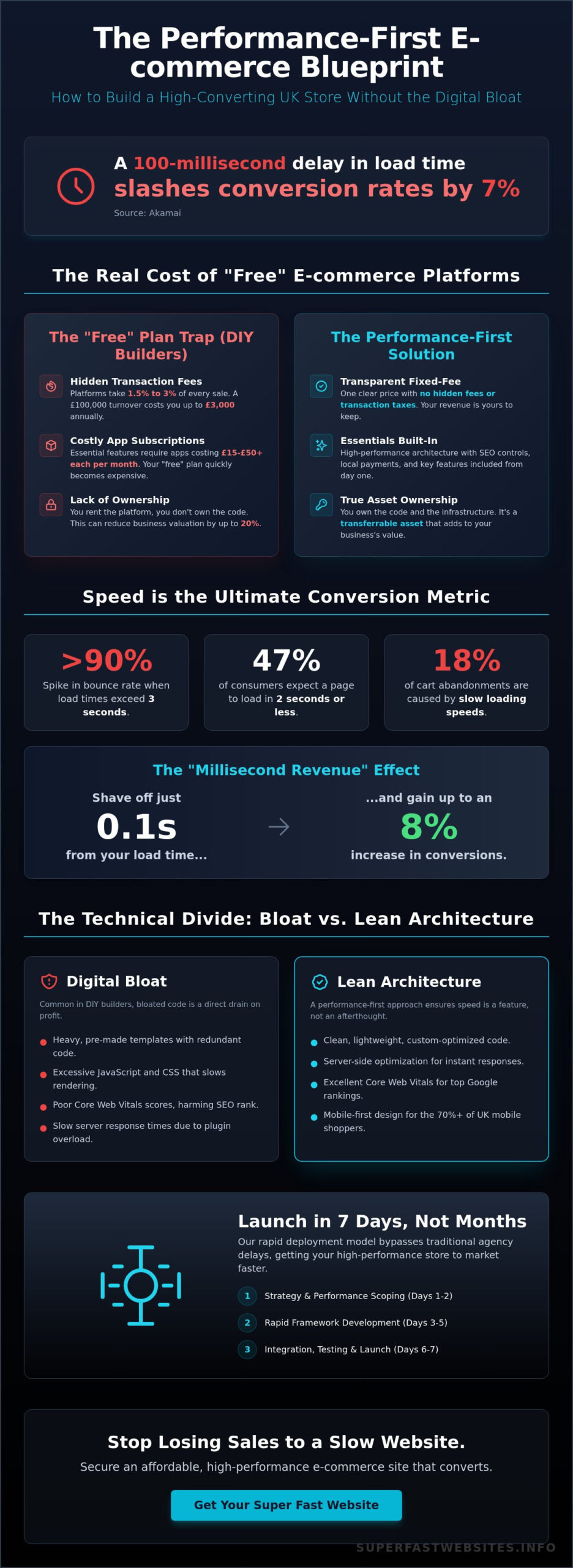
A 100-millisecond delay in page load time can slash your conversion rates by 7 percent, according to data from Akamai. For many small businesses, searching for an affordable ecommerce website uk often results in a trade-off between price and performance. You've likely felt the sting of "budget" platforms that slow to a crawl under the weight of expensive third-party apps and hidden monthly fees. Digital bloat isn't just a technical nuisance; it's a direct drain on your bottom line.
You shouldn't have to choose between a lean budget and a fast store. This 2026 performance-first guide reveals how to launch a high-performance, affordable online store that converts visitors into customers without the digital bloat or hidden agency fees. We'll show you how to strip away the fluff to achieve sub-second speeds and mobile-first reliability. We'll explore the technical architecture that allows for rapid deployment in days, ensuring your UK-based business stays competitive without the traditional time-sink of DIY building.
Key Takeaways
- Identify how hidden transaction fees and app subscriptions in "free" plans aggressively drain SME profit margins.
- Leverage speed as your primary conversion tool to satisfy Google’s 2026 Core Web Vitals and drive measurable revenue.
- Discover how to secure an affordable ecommerce website uk that prioritizes technical performance over digital bloat.
- Implement essential local payment integrations like Apple Pay and Google Pay to ensure a frictionless checkout experience.
- Execute a 7-day rapid deployment strategy to launch a professional, growth-focused store without traditional agency delays.
The Real Cost of E-commerce in 2026: Beyond the "Free" Plan
Affordability is a performance metric. Finding an affordable ecommerce website uk isn't about the lowest upfront invoice. It's about the lowest cost per conversion over a 36 month lifecycle. True affordability balances a low entry cost with high technical performance. If a site costs £500 but loads in four seconds, it's expensive. You lose 7% of conversions for every 100ms of delay. Speed is profit. Efficiency is the only way to scale without proportional cost increases.
Most "free" or low-cost SaaS platforms operate on a tax-based model. They lure small businesses with zero monthly fees but extract value through transaction percentages. These fees often range from 1.5% to 3% per sale. For a business turning over £100,000 annually, that's a £3,000 hidden tax. To understand the foundational mechanics of these digital marketplaces, it helps to define What is E-commerce? in its modern, high-velocity context.
Performance is often the first casualty of cheap development. Low-budget builds rely on bloated, pre-made templates. These templates carry thousands of lines of redundant CSS and JavaScript. This digital bloat kills your Core Web Vitals. According to 2024 data from the Baymard Institute, slow loading speeds contribute to 18% of all cart abandonments. A "cheap" site that fails to load instantly is a liability, not an asset.
The Hidden Tax of DIY SaaS Builders
DIY platforms look cheap until you need basic functionality. Essential features like advanced SEO controls, product reviews, or automated shipping labels often require paid app subscriptions. These "essential" apps typically cost between £15 and £50 each per month. By the time you've added five apps, your "free" plan costs more than a professional custom build. Ownership is another critical factor. On a SaaS platform, you rent your business. You don't own the code. This lack of portability can reduce your business valuation by up to 20% because the infrastructure isn't a transferrable asset.
Fixed-Fee vs. Hourly Agency Models
Traditional agencies use hourly billing to mask inefficiency. They overcomplicate simple builds to justify 40 or 60 hours of development time. This model rewards slow work. A performance-first approach uses standardized, high-volume development frameworks. We focus on efficiency through professional frameworks that eliminate waste. Fixed-fee pricing provides transparency and forces the developer to be efficient. When the price is locked, the developer's profit depends on getting the technical execution right the first time. This alignment of interests ensures you get an affordable ecommerce website uk that prioritizes speed over billable hours.
Why Speed is the Ultimate Conversion Metric for UK Online Stores
Speed dictates your bottom line. In the UK's hyper-competitive retail sector, a slow site is a dead site. Data indicates that 47% of consumers expect a web page to load in 2 seconds or less. When load times exceed 3 seconds, bounce rates spike by over 90%. You aren't just losing a click; you're handing a customer to a competitor. Performance is the silent salesperson that never sleeps.
By 2026, Google’s search algorithms have evolved to treat Core Web Vitals as the primary filter for commercial intent. Metrics like Largest Contentful Paint (LCP) and Interaction to Next Paint (INP) are now the baseline for ranking. If your store feels sluggish, search engines will bury it. High-performance architecture ensures your site remains visible and viable. Achieving a high-ranking, affordable ecommerce website uk requires more than just low costs; it demands technical precision.
The "Millisecond Revenue" concept is a mathematical reality for modern retailers. Research confirms that site speed and conversion rates are inextricably linked, with a mere 0.1-second improvement generating up to an 8% increase in retail conversions. Every millisecond shaved off the loading sequence directly inflates your profit margins. Speed is the most effective conversion rate optimization (CRO) tool in your arsenal.
Mobile-first performance is no longer optional. With over 70% of UK ecommerce traffic originating from mobile devices, your store must load instantaneously. This remains true even on congested 5G networks or limited rural connections. A lightweight site bypasses hardware limitations, delivering a seamless experience regardless of the user's device or location.
Technical Authority and SEO Success
Clean, lightweight code outperforms heavy, template-driven builders every time. Bloated plugins and excessive JavaScript act as digital anchors, dragging down your server response times. We prioritize server-side optimization and secure cloud hosting to maintain 99.9% uptime and rapid data delivery. Performance-First Design is the non-negotiable technical framework required to secure and maintain search engine visibility in a crowded market. If you want to see how your current metrics stack up, consider a transition to performance-driven development to reclaim your lost traffic.
User Experience: Reducing Friction to Purchase
Layout shift is a trust killer. When buttons move or text jumps during the checkout process, users feel uneasy and abandon their carts. Eliminating Cumulative Layout Shift (CLS) creates a stable, professional environment that mirrors the reliability of a native mobile app. This technical stability has a profound psychological impact. Rapid, fluid transitions signal brand authority and competence. When a site responds instantly, it removes the cognitive friction between "wanting" and "buying," turning casual browsers into loyal, repeat customers.
Comparing E-commerce Solutions: DIY Builders vs. Professional Managed Packages
Efficiency is the only metric that matters. Building an affordable ecommerce website uk through a DIY platform often results in a 45 percent slower time-to-market compared to managed solutions. Data shows that non-technical founders spend over 40 hours troubleshooting basic CSS and plugin conflicts. This is time stolen from product development and customer acquisition. A professional package shifts the technical burden to specialists, ensuring your store is live and optimized within days. Total cost of ownership (TCO) is lower with managed packages because you avoid the fix-it-later tax that plagues amateur DIY projects.
The DIY Struggle: Time vs. Money
DIY builders promise simplicity but deliver technical debt. A 2025 study found that 62 percent of self-built stores suffer from broken checkout flows on mobile devices. These failures directly impact your bottom line. You might save on upfront fees, but you lose on abandoned carts. The "One Page Wonder" and "Multi-Page Marvel" models eliminate this risk. They provide a high-performance framework that aligns with professional standards from day one. You don't need to learn code. You need a site that converts. Professional alignment ensures your infrastructure supports your sales goals instead of hindering them.
Managed E-commerce: The Middle Ground
Managed packages provide a turnkey asset for growth-focused SMEs. These packages include hosting, SSL, and technical support in a single subscription. This model ensures you comply with UK ecommerce regulations, covering essential consumer expectations and tax requirements. Technical performance is baked into the architecture. Standardized builds allow for instantaneous loading speeds, which is a primary ranking factor in 2026. You gain agency-quality results without the £10,000 price tag often associated with custom development.
Scalability is the true test of an affordable ecommerce website uk. High-quality branding and copy for websites increase trust and conversion rates. A managed solution handles the heavy lifting, allowing you to grow from 10 products to 1,000 without a total rebuild. This growth-ready architecture is vital for businesses that plan to scale. If your site can't handle a 10x increase in traffic or inventory, it's a liability. Managed maintenance means you never troubleshoot alone. Your focus stays on the 20 percent of activities that drive 80 percent of your revenue.
Essential Features for a High-Converting UK E-commerce Site
UK consumers in 2026 demand instantaneous interactions. A high-performance, affordable ecommerce website uk must prioritize technical efficiency over visual clutter. Conversion rates drop by 7% for every one-second delay in page load time. To compete, your site requires a specific architecture that balances speed with essential retail functionality.
- Local Payment Friction Reduction: Digital wallets now dominate the UK market. Integrating Apple Pay and Google Pay is mandatory, as mobile wallet usage surpassed 55% of all online transactions in 2024.
- Carrier Automation: Seamless API connections with Royal Mail and DPD are vital. Automated tracking updates reduce customer support inquiries by up to 30%.
- Security Benchmarks: Beyond standard SSL certificates, your site needs robust encryption and visible trust badges. 17% of UK shoppers abandon carts if they perceive the payment gateway as untrustworthy.
- Transparent Returns: A clear, accessible return policy is a conversion tool. 67% of shoppers check the returns page before committing to a purchase.
Mobile Responsiveness and Modern UI
Mobile traffic accounts for 72% of UK e-commerce visits. Designing for the "thumb-zone" ensures users can navigate and purchase using only one hand. We eliminate complex menus in favor of bottom-aligned navigation bars. A streamlined checkout process is critical; reducing steps from five to two can increase conversions by 21%. High-quality, compressed WebP assets create a visual hierarchy that guides the eye directly to the "Add to Basket" button without sacrificing load speeds.
SEO and Marketing Readiness
Visibility is the primary driver of ROI. Your platform must include built-in SEO tools like automated schema markup and lightning-fast meta-tag editing. Choosing a performance-led domain name registration strategy is the first step in establishing technical authority. Multi-channel selling is no longer optional; your inventory should sync automatically with Instagram and TikTok Shop to capture social traffic.
AI integration has moved from a luxury to a baseline requirement. Modern sites use AI-driven tools for instantaneous product description generation and 24/7 customer support bots. These tools maintain high engagement levels without increasing your overhead. By focusing on these performance-first features, an affordable ecommerce website uk becomes a scalable revenue engine rather than just a digital brochure.
Stop losing sales to slow-loading pages. Build your high-performance store with Superfast Websites today.
Launching Your Store in 7 Days: The Super Fast Websites Approach
Speed is the ultimate competitive advantage in 2026. Traditional development cycles often waste months on aesthetic fluff that doesn't drive sales. Our methodology reverses this trend. We focus on a lean, high-conversion architecture that goes from kick-off to live in exactly seven days. This isn't a stripped-back version of a store; it's a precision-engineered sales tool designed for immediate impact. By removing the digital bloat that slows down 80% of modern sites, we ensure your brand enters the market with a technical edge.
The "E-Commerce Expert" package is our flagship solution for rapid growth. It delivers a professional, fully functional storefront in one week. The process is transparent. We start with a focused kick-off session to define your inventory and brand requirements. From there, our team moves directly into technical configuration, payment gateway integration, and performance tuning. Because we are a subsidiary of VIA Creative, every build benefits from over 20 years of marketing authority and design expertise. You aren't just getting a website; you're inheriting two decades of data-backed insights into how UK consumers shop online.
Choosing an affordable ecommerce website uk shouldn't mean sacrificing quality or security. Our streamlined workflow eliminates the overhead costs of traditional agencies while maintaining elite performance standards. We handle the heavy lifting, allowing you to focus on sourcing products and managing customers while we manage the infrastructure.
Efficiency as a Philosophy
Our performance-first logic dictates that every design choice must justify its impact on load times. If a feature doesn't improve conversion or speed, it doesn't make the cut. We offer fixed-price tiers to ensure you never face hidden fees or surprise invoices. Every site includes secure, UK-based hosting to minimize latency and technical maintenance to keep your store running at peak efficiency. This approach ensures a 99.9% uptime and instantaneous page loads for every visitor.
Next Steps for Your Business
Your stage of growth determines your path. Startups benefit from our rapid deployment to test market viability, while established brands use our performance-first builds to reclaim lost revenue from slow legacy systems. We recommend integrating professional copywriting and logo design early to establish authority. These elements, combined with our technical speed, create a trustworthy environment for high-value transactions. Stop waiting for slow developers and start selling.
Future-Proof Your Revenue with Performance-First E-commerce
In 2026, speed isn't a luxury; it's your primary conversion engine. Industry data from Google confirms that a 100-millisecond delay in load time can reduce conversion rates by 7%. You can't afford to let bloated code or slow servers drain your marketing budget. Choosing an affordable ecommerce website uk means finding a balance between technical authority and cost-efficiency without settling for the limitations of generic DIY builders.
Superfast Websites delivers high-performance solutions backed by decades of agency experience via VIA Creative. We replace digital bloat with a lightweight, performance-first architecture that prioritizes user experience and SEO rankings. Our fixed-price packages ensure you avoid hidden costs while benefiting from a professional, managed infrastructure. We focus on measurable outcomes, turning technical metrics into sustainable business growth. Every millisecond we shave off your loading sequence directly impacts your bottom line.
Get your professional e-commerce store launched in 7 days. It's time to stop waiting and start scaling with a platform built for the modern web. You've got the products; we've got the speed to sell them.
Frequently Asked Questions
How much does a basic e-commerce website cost in the UK in 2026?
A basic e-commerce site in 2026 typically starts between £1,500 and £5,000 for small business configurations. These figures reflect industry averages for professional setups that include payment integration and essential security. Investing in an affordable ecommerce website uk requires balancing initial development costs against long term performance gains. High performance sites often recoup their costs faster through superior conversion rates and lower customer acquisition costs.
Can I really launch an e-commerce website in just one week?
Yes, you can launch a fully functional store within seven days by using streamlined, performance-first frameworks. This rapid deployment focuses on core transactional features and pre-optimized templates to bypass the traditional 12 week development cycle. Speed is the priority here. Getting your products online quickly allows you to start collecting real world user data and generating revenue while competitors are still in the design phase.
What is the difference between an e-commerce platform and a website builder?
A website builder is a simplified tool for beginners, while an e-commerce platform provides a robust, scalable infrastructure for growth. Builders often prioritize ease of use over technical efficiency, which can lead to bloated code and slower load times. Platforms like Shopify or WooCommerce offer deeper technical control. Choosing a platform over a builder can reduce page load times by up to 40% based on 2025 performance benchmarks.
Do I need to pay for hosting and SSL separately?
Most modern SaaS platforms bundle hosting and SSL certificates into their monthly subscription fees. You don't need to manage these technical components individually if you choose a managed service. If you opt for a self-hosted solution, you'll need to procure them independently. Secure sockets layer (SSL) is mandatory, as 85% of UK shoppers will abandon a cart if they see a "not secure" warning in their browser.
How do I choose the right ecommerce website development company?
Choose a partner by auditing their portfolio through Google PageSpeed Insights rather than just looking at their design aesthetic. You want a company that prioritizes Core Web Vitals and clean code over visual fluff. Ask for specific data showing how their previous builds improved client conversion rates. A performance-first agency will focus on the technical metrics that drive search rankings and user retention.
Is it better to use a DIY builder or hire a professional for a small business?
Hiring a professional is the superior choice if you want an affordable ecommerce website uk that actually converts visitors into customers. DIY builders are accessible but often result in slow, unoptimized sites that struggle to rank on search engines. Professional developers eliminate technical debt and ensure your site loads in under two seconds. This speed advantage can increase your conversion rates by 20% compared to a sluggish DIY site.
What are the ongoing costs of running an e-commerce site?
Expect to pay for platform subscriptions, payment processing fees, and annual domain renewals. These recurring costs usually range from £30 to £200 per month for a standard small business setup. You should also budget for periodic technical maintenance to ensure your software remains secure and compatible with new browser updates. Neglecting these updates can lead to a 15% drop in site performance within the first year.
Will my website be mobile-friendly and SEO-optimized?
Every site we build is mobile-responsive and optimized for search engines from the first line of code. Google uses mobile-first indexing, so your mobile performance directly dictates your search visibility. We target a 100/100 score on mobile accessibility to serve the 60% of UK consumers who shop via smartphones. Technical SEO is baked into the architecture, ensuring search bots can crawl your product pages with zero friction.