

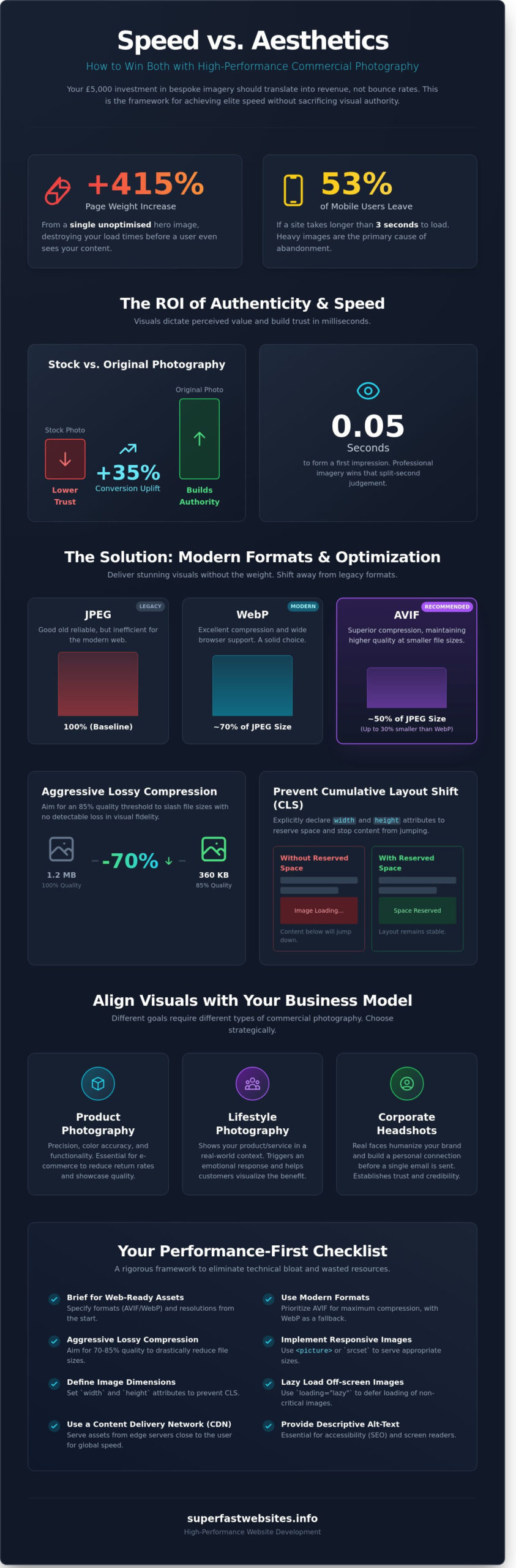
A single unoptimised hero image can increase your total page weight by 415%, effectively stalling your conversion rate before a visitor even sees your product. You already know that generic stock photos erode brand trust, yet the fear of high-resolution files slowing your site to a crawl is a valid technical concern. It's a common trade-off that many businesses get wrong, resulting in either a beautiful but sluggish interface or a fast but visually uninspiring one. Speed and aesthetics shouldn't be a zero-sum game.
This principle is amplified in sectors like global real estate, where buyers often rely exclusively on digital presentations. For instance, international property platforms like HomesGoFast depend on high-fidelity commercial photography to build trust and facilitate transactions across borders, demonstrating the direct link between visual quality and sales velocity.
This guide demonstrates how to leverage professional commercial photography to build an elite, high-conversion brand presence while maintaining sub-second loading speeds. We'll provide a rigorous framework for briefing photographers for web-ready assets and show you how to justify the ROI through measurable performance data. You'll learn the specific technical requirements for lightweight assets that ensure your site remains lightning-fast, ensuring your £5,000 investment in bespoke imagery translates into revenue rather than bounce rates.
Key Takeaways
- Professional imagery builds immediate authority and acts as a high-impact driver for visitor trust and ROI.
- Prevent unoptimised assets from destroying your LCP scores by adopting modern formats like WebP and AVIF.
- Learn how to leverage **commercial photography** to create a high-conversion environment tailored to your specific business model.
- Streamline production with a performance-first checklist designed to eliminate technical bloat and wasted resources.
- Master the integration of high-resolution assets into a framework that maintains elite, millisecond loading speeds.
What is Commercial Photography and Why Does it Matter for ROI?
Commercial photography is the creation of high-quality imagery designed specifically to promote or sell a product, service, or brand. It's a strategic asset, not a decorative one. High-performance websites rely on these visuals to convert visitors into leads. When a user lands on your site, they form an opinion in 0.05 seconds, according to research by the CXL Institute. Professional imagery provides the technical authority needed to win that split-second judgement.
Visual quality dictates perceived value. If your website features low-resolution or poorly lit photos, users associate that lack of care with your service quality. Investing in original commercial photography eliminates the "uncanny valley" of generic stock photos. A study by MarketingExperiments demonstrated that original imagery can increase conversion rates by 35% compared to stock alternatives. Stock photos are digital bloat; they lack the authenticity required to build genuine trust with a UK audience.
The Core Categories of Commercial Imagery
- Product photography: These images focus on precision, colour accuracy, and functionality. They're essential for reducing return rates in e-commerce.
- Lifestyle photography: This shows your service in a real-world context. It triggers an emotional response by helping the customer visualise the benefit.
- Corporate headshots: Real faces humanise your brand. They build a personal connection before a single email is sent.
Commercial vs. Advertising Photography: The Technical Difference
Advertising photography focuses on the broad "dream" of a brand, often used in high-level awareness campaigns. Commercial photography is more transactional and specific. It highlights the features that drive a sale. Your website requires a strategic blend of both to guide the user journey effectively.
Performance is the priority for web-based assets. You don't just need high-resolution files; you need web-ready files. This means commercial photography assets must be optimised for the modern web. We focus on delivering visual fidelity without the weight, ensuring your site remains fast and responsive. Every millisecond saved in loading an image directly correlates to better user retention and higher revenue.
The Technical Impact of Imagery on Website Performance
Unoptimised commercial photography is the leading cause of digital bloat. High-resolution files often exceed 5MB, which directly destroys Largest Contentful Paint (LCP) scores. Google data indicates that 53% of mobile users abandon a site if it takes longer than 3 seconds to load. Every millisecond of delay caused by a heavy image correlates to a drop in conversion rates. A performance-first approach treats visual assets as data packets that must be as lean as possible to maintain a competitive edge.
Modern workflows require a shift away from legacy formats like JPEG. Professional shoots should result in WebP or AVIF delivery. AVIF provides up to 30% better compression than WebP while maintaining superior colour depth and detail. Serving the correct image dimensions for specific responsive breakpoints is equally critical. Delivering a 4000-pixel wide image to a mobile device with a 390-pixel screen is a waste of bandwidth that penalises your users and your search rankings.
Optimising High-Resolution Assets for Instant Loading
Finding the balance between visual crispness and file size requires aggressive lossy compression. Aiming for an 85% quality threshold often reduces file sizes by 70% without detectable loss in visual quality. Use a Content Delivery Network (CDN) to serve assets from edge servers closest to the user. This reduces round-trip time and ensures global performance. Implementing native lazy loading prevents the browser from downloading off-screen galleries, prioritising the critical path for the initial page load sequence.
Core Web Vitals and Visual Stability
Cumulative Layout Shift (CLS) occurs when images load without defined dimensions, causing content to jump and frustrating the user. Prevent this by declaring explicit width and height attributes in your code to reserve the necessary space. Professional framing during the commercial photography process allows for better hero image placement. This ensures your focal point remains centred across various mobile viewports without needing multiple heavy assets.
Accessibility remains a pillar of high-performance design. Including descriptive alt-text supports the 2 million people in the UK living with sight loss and provides essential context for search engine crawlers. Speed is the foundation of a successful digital presence. Ensure your high-performance website isn't slowed down by unmanaged visual assets that serve no technical purpose.
Choosing the Right Commercial Photography for Your Business Model
Visual strategy must align with your specific revenue model. A service-based firm requires different assets than a high-volume e-commerce store. Commercial photography isn't just about aesthetics; it's a technical component of your conversion funnel that dictates how users perceive your brand's authority.
- Service-Based Businesses: Focus on "Expertise and Environment." High-resolution imagery of your UK headquarters or team in action builds immediate credibility. It proves your physical existence and professional scale.
- E-commerce: Precision is non-negotiable. 22% of UK online returns occur because products look different in person than online. Implement 360-degree views and consistent lighting across your entire catalogue to eliminate visual friction and reduce cognitive load.
- B2B and SaaS: Abstract imagery works best here. Visualise complex concepts like "cybersecurity" or "distributed ledgers" through bespoke, high-contrast photography rather than generic stock icons. This maintains a premium, technical feel.
Effective ROI analysis dictates that you shouldn't spread your budget evenly. Allocate 70% of your visual investment to the top 10% of your highest-traffic pages. A £3,000 bespoke shoot for a primary landing page yields better long-term returns than 50 mediocre shots spread across a blog. Prioritise assets that live "above the fold" where user engagement is highest.
Product Photography for Conversion
The "Hero Shot" is your most critical asset. It creates a singular focal point that guides the user's eye toward the primary Call to Action. Consistency in lighting and background is vital; it prevents the "visual noise" that slows down decision-making. High-quality commercial photography manages customer expectations accurately. This directly reduces return rates and protects your profit margins by ensuring the physical product matches the digital promise.
Lifestyle and Brand Storytelling
Lifestyle shots capture the behaviour of your ideal customer interacting with your brand. They demonstrate your Unique Value Proposition (UVP) in a real-world context. Ensure your photographer uses colour palettes that complement your website’s UI design and CSS variables. This creates a unified brand experience. Authenticity is a performance metric. Users spend 10% more time viewing original photos of real people than they do looking at generic stock images, according to NN Group research.
Preparing for a Commercial Shoot: A Performance-First Checklist
High-performance websites require technical precision. You can't afford to fix mistakes in post-production when every millisecond of load time impacts your conversion rate. A 2023 study indicated that 39% of users stop engaging with a website if images take too long to load or fail to render correctly. Effective commercial photography begins with a technical roadmap that eliminates waste and ensures asset compatibility with your site architecture.
- Define the objective: Identify if the asset is for a 21:9 ultra-wide hero banner, a 1:1 product gallery, or a vertical social feed.
- Develop a shot list: Plan every frame to avoid overshooting. A typical UK commercial shoot costs between £800 and £3,000 per day; inefficiency is a direct hit to your ROI.
- Technical briefing: Specify aspect ratios and the exact amount of negative space required for text overlays.
- Set the scene: Ensure products are in pristine condition. Dust or scratches require retouching, which adds unnecessary bytes to the final file.
- Review against wireframes: Test shots against your live site layout during the session to ensure zero layout shift.
Creating a Detailed Creative Brief
Your brief must dictate the brand voice with absolute clarity. If your brand identity is direct and efficient, your imagery should be sharp, high-contrast, and uncluttered. Provide examples of preferred styles to align expectations before the first shutter click. Crucially, specify the need for "white space" or "copy room." For hero banners, ensure at least 40% of the frame remains clear. This allows your H1 tags and CTAs to sit over the image without compromising readability or failing accessibility standards.
Logistics and Efficiency on Set
Organise the schedule to exploit natural light, reducing the reliance on heavy studio setups that can lead to over-processed, "heavy" files. Involving a web developer in the planning phase is a strategic advantage. Their perspective prevents common layout issues, such as a subject's head being obscured by a mobile navigation bar. Finally, secure comprehensive usage rights for UK and international digital use to prevent future licensing disputes. Well-executed commercial photography saves 15% to 20% in post-production time, accelerating your go-to-market speed.
Build a faster digital presence by learning how to optimise your visual assets for peak performance.
Integrating Professional Assets into a High-Speed Framework
Performance is non-negotiable for modern UK businesses. High-resolution commercial photography often creates a technical bottleneck, but our framework eliminates this trade-off. We process every asset through a 4-step optimisation pipeline that reduces file sizes by up to 80% without visible quality loss. This ensures your Largest Contentful Paint (LCP) remains under 1.2 seconds, even with full-width hero imagery.
Our workflow moves assets from the photographer's lens to a live environment with surgical precision. We don't just upload files; we deploy them. The process includes:
- Automated Conversion: Transforming RAW or JPEG files into next-gen WebP and AVIF formats for superior compression.
- Lightweight CMS Injection: Our proprietary CMS lacks the 40% code bloat found in traditional platforms like WordPress.
- Edge Delivery: Serving images via a global Content Delivery Network (CDN) with sub-50ms latency.
- Lazy-Loading Scripts: Ensuring images only load as they enter the viewport to preserve initial page speed.
Speed is your biggest conversion driver. A 100ms delay in load time can decrease conversion rates by 7%. We prioritise millisecond performance to ensure your visual investment generates a measurable ROI.
The Synergy Between Design and Content
Your visual identity must remain consistent across every digital touchpoint. Our "Multi-Page Marvel" template provides a structured environment for expansive portfolios, while the "One Page Wonder" focuses on high-impact, singular conversions. We use AI-driven scaling to generate responsive variants for every screen size. This ensures a 300ppi appearance on high-end Retina displays while maintaining a tiny 45kb footprint on mobile devices. Consistency builds authority; speed builds profit.
Next Steps for Your Online Presence
Transitioning from generic stock photos to bespoke commercial photography is a critical upgrade for your brand's E-E-A-T (Experience, Expertise, Authoritativeness, and Trustworthiness). Websites featuring authentic team and product shots see a 35% increase in dwell time compared to those using placeholder assets. This engagement signals quality to search engines, directly boosting your organic reach in UK search results. Stop letting slow, stock-heavy pages hold your business back.
Turn Visual Assets Into Conversion Engines
High-quality commercial photography is a liability if it compromises your load speed. Industry data indicates that a one-second delay in mobile response times can slash conversion rates by 20%. You don't have to sacrifice aesthetic excellence for technical performance. By implementing a performance-first architecture, your business can showcase high-resolution assets while maintaining a sub-second Time to Interactive. This technical balance ensures your visual investment translates directly into measurable ROI.
We leverage 20 years of marketing expertise via VIA Creative to build elite digital platforms. Our team launches fully optimised websites in as little as seven days. This framework eliminates digital bloat, ensuring every millisecond is geared towards revenue. Your site should be as fast as it is visually compelling.
Get a Professional Website That Performs as Good as it Looks
Your brand deserves a platform that matches its visual ambition.
Frequently Asked Questions
What is the average cost of commercial photography in the UK?
Average daily rates for commercial photography in the UK range from £500 to £2,500. This figure fluctuates based on the photographer's expertise and the technical requirements of the shoot. Junior photographers may charge £400, while high-end specialists often exceed £3,000 for complex sessions involving advanced lighting and post-production.
Can I use my own photos for my business website?
You can use your own photos, but low-quality imagery will damage your conversion rates. Data shows that 38% of users stop engaging with a website if the layout or content is unattractive. Professional assets ensure your site maintains a premium feel that aligns with high-performance technical standards and fast-loading interfaces.
How many photos do I need for a standard five-page website?
A standard five-page website requires between 15 and 25 high-quality images. You should allocate 5 hero images for primary headers, 10 shots for service or product pages, and 5 to 10 images for team or office sections. This volume provides enough variety to maintain engagement without adding unnecessary digital weight to your server.
What is the difference between commercial and editorial photography?
Commercial photography is designed to sell a product or brand, whereas editorial photography illustrates a narrative. Commercial shoots focus on ROI and brand identity, often requiring specific lighting to highlight product features for marketing. Editorial work is typically for magazines or news, prioritising storytelling over direct sales conversions.
How do I ensure my high-resolution photos don’t slow down my site?
Optimise high-resolution photos by using modern file formats like WebP and implementing lazy loading. Compressing images to under 200KB ensures they load in milliseconds rather than seconds. This technical approach prevents visual assets from increasing your Time to First Byte (TTFB) or damaging your Core Web Vitals scores.
Do I own the rights to the photos after a commercial shoot?
Photographers generally retain the copyright while granting you a commercial usage license. In the UK, the creator owns the rights automatically under the Copyright, Designs and Patents Act 1988. Most contracts provide a perpetual license for digital use, but you must confirm if print or global advertising requires additional fees.
How long does a typical commercial photography session take to organise?
Organising a professional commercial photography session typically takes two to four weeks. This timeline includes three days for location scouting and seven days for talent procurement or equipment hire. Proper planning prevents wasted time on set and ensures every image serves a specific performance goal on your website.
What file formats should I ask my photographer to provide?
Request WebP files for web performance and RAW files for your long-term archives. WebP files are 30% smaller than JPEGs, which directly improves site speed and user experience. Ensure all web assets use the sRGB colour profile to maintain visual consistency across 100% of mobile and desktop displays.