

Your choice of domain is the first performance bottleneck your business will face in 2026. While most UK entrepreneurs view domain name registration as a simple administrative box to tick, a poorly managed portfolio can lead to 400ms DNS resolution delays and unexpected £75 renewal spikes. You likely already understand that every millisecond of latency erodes your conversion rate, yet the technical architecture behind your URL often remains an afterthought until ownership disputes or slow propagation times stall your growth.
This guide provides the technical and strategic essentials to secure a high-performance digital identity. You'll learn how to navigate the £15 to £100 price gap between registrars, choose between .com and .co.uk based on current SEO metrics, and lock down your assets against theft. We're moving beyond the marketing fluff to ensure your domain supports an instantaneous user experience from the very first click.
Key Takeaways
- Optimise your digital foundation by understanding how TLD selection and DNS settings dictate your site's loading velocity.
- Build brand authority with a concise, hyphen-free URL designed for maximum memorability and search engine performance.
- Master the technical steps of domain name registration to secure high-performance assets tailored for the UK market.
- Integrate your domain with a streamlined hosting and SSL strategy to eliminate latency and drive measurable business growth.
Understanding Domain Name Registration: Beyond the Web Address
Domain name registration isn't a permanent purchase. It's a strategic lease of digital real estate. You pay a registrar to reserve a specific string of characters for a fixed period, typically between 12 and 120 months. This process acts as the human-readable gateway to your server. Computers communicate using complex numerical strings, but your customers don't. They use names. A professional domain name is the first technical handshake between your brand and a potential lead.
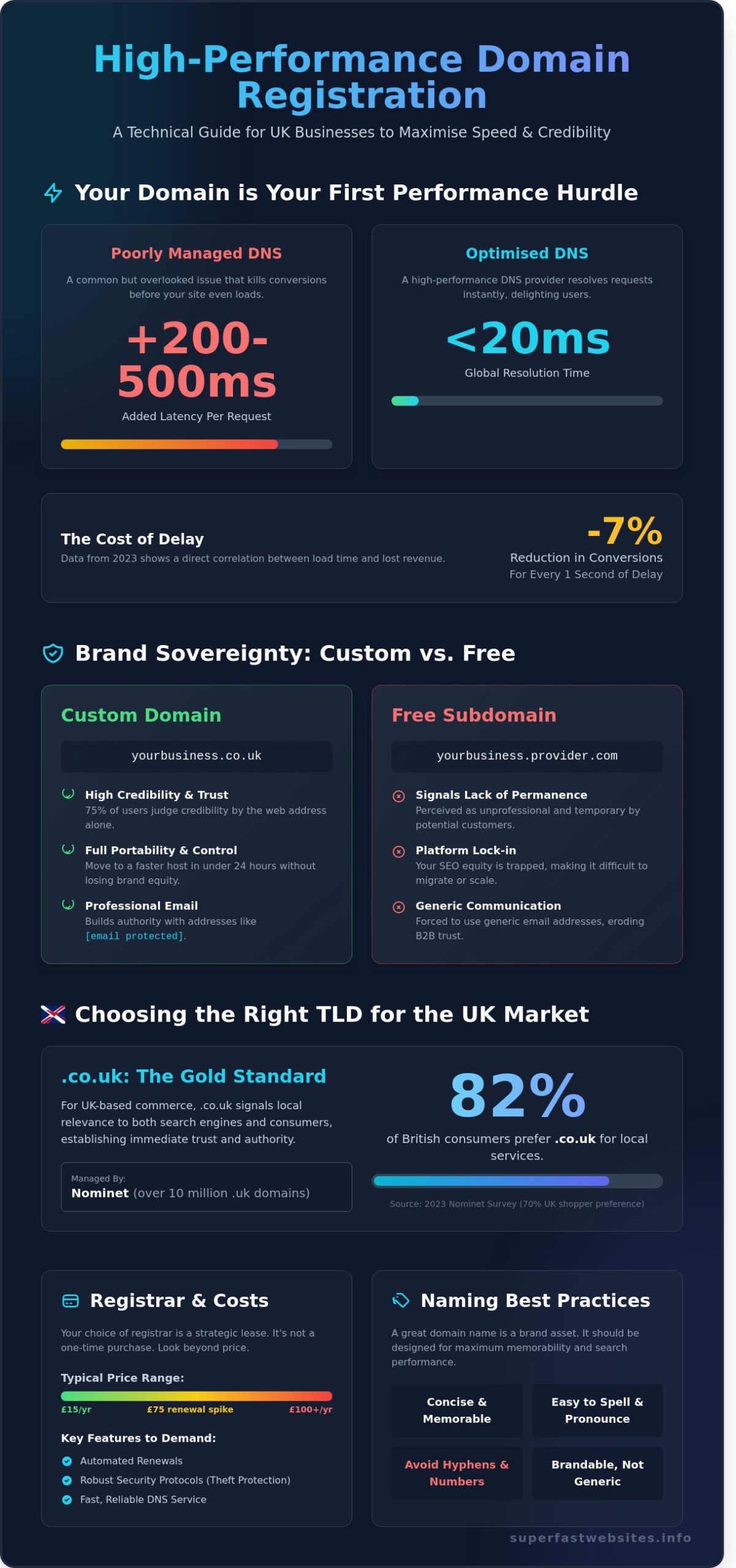
Behind every name is a specific IP address. The Domain Name System (DNS) acts as the internet's phonebook, mapping your brand to a physical server location. High-performance registration isn't just about the name; it's about how quickly that name resolves to your content. Milliseconds lost during DNS lookups directly impact your bounce rate. Data from 2023 shows that every second of delay results in a 7% reduction in conversions. Efficiency starts at the root level.
Ownership is a common misconception in the industry. You don't own the domain; you hold the exclusive right to use it. If you fail to renew your registration, the name returns to the open market. This makes your choice of registrar critical. You need a partner that provides automated renewals and robust security protocols. A professional domain is the foundation of digital credibility. It builds trust before a single pixel of your website loads. Without a dedicated domain, you're building on borrowed land.
The Role of ICANN and Nominet in the UK
ICANN manages the global database of IP addresses and domains. They ensure the internet remains stable and interoperable. Within the United Kingdom, Nominet operates as the official registry. They manage over 10 million .uk, .co.uk, and .org.uk domains. Using a .uk extension signals local relevance and technical compliance. A 2023 Nominet survey revealed that 70% of UK shoppers prefer buying from .uk websites over generic extensions. These governing bodies ensure your digital property is protected and unique.
Why a Custom Domain Trumps Free Sub-domains
Free sub-domains like yourbusiness.provider.com are performance liabilities. They signal a lack of permanence and professional intent. Research indicates that 75% of users judge a business's credibility by its web address alone. Custom domains are essential for professional communication. You can't build authority with a generic Gmail address; you need you@yourbusiness.co.uk to secure B2B contracts and customer trust. It's about brand sovereignty.
Portability is the ultimate technical advantage. A custom domain name registration gives you total control. If your current host underperforms, you can move your domain to a faster provider in under 24 hours. Free sub-domains lock you into a single ecosystem. They trap your SEO equity and brand value within a third-party platform. Investing in a custom domain ensures your brand remains mobile and scalable as your traffic grows. You own the destination, regardless of the engine powering it.
Successful domain name registration requires foresight. It's a calculated business decision that impacts SEO, email deliverability, and user perception. Don't settle for sub-standard addresses that dilute your technical authority. Secure a name that reflects the speed and reliability of your business operations.
Of course, securing a domain is just one part of launching a new venture. The legal and administrative setup is equally critical. For entrepreneurs with international ambitions, particularly in markets like the UAE, professional guidance can be invaluable. To explore what's involved in that process, you can visit Fast Zone Business.
The Technical Anatomy of a Domain: TLDs, DNS, and Speed
A domain name isn't just a static address. It's a complex hierarchy of technical protocols that dictate how quickly a user reaches your server. The Top-Level Domain (TLD) is the suffix at the end of your URL, such as .com or .co.uk. While it appears simple, your choice of TLD and the initial strategy behind it impact both SEO and user trust. Following a professional guide to registering a domain name helps avoid common pitfalls, but the technical execution remains the primary driver of performance.
DNS, or the Domain Name System, acts as the internet's phonebook. It translates human-readable names into IP addresses. This resolution process is the first hurdle in website performance. If your DNS provider is slow, your site is slow before a single pixel loads. Poorly managed DNS configurations often add 200 to 500 milliseconds of latency to every page request. In a market where 53% of mobile visits are abandoned if a page takes longer than three seconds to load, these milliseconds are expensive. Efficiency here isn't optional; it's a core business requirement.
Choosing the Right TLD for the UK Market
Selecting a TLD requires a performance-first mindset. For British businesses, the choices are clear and should be based on target demographics:
- .co.uk: This remains the gold standard for UK-based commerce. It signals local relevance to search engines, and 82% of British consumers prefer it for local services.
- .com: Essential for companies with international ambitions. It carries global authority but lacks the specific local SEO boost of a country-code TLD.
- .uk: Launched in 2014, this shorter alternative is gaining traction. It offers a modern aesthetic and is ideal for mobile-first brands where character count matters for display.
How DNS Management Affects Your Site Performance
Speed starts at the DNS level. Premium DNS providers use global Anycast networks to ensure the lookup happens at the server closest to the user. This reduces the Time to First Byte (TTFB) significantly. Standard registrars often provide "free" DNS that relies on overloaded, centralised servers, leading to inconsistent resolution times. When you handle your domain name registration, the provider you choose for your nameservers is as vital as the name itself.
Effective DNS management involves more than just uptime. Lightweight DNS records, stripped of unnecessary TXT or legacy entries, streamline the lookup process. We've seen cases where optimising DNS records alone cut 150ms from the initial connection time. Super Fast Websites prioritises efficient DNS configuration for every client because we know that performance-optimised infrastructure is the foundation of conversion. Every record is audited to ensure zero bloat and maximum uptime. We don't tolerate digital friction, and your DNS shouldn't either.
Strategic Selection: How Your Domain Impacts SEO and Brand Authority
Your domain is your primary digital asset. It dictates how users perceive your speed and reliability before they even click a link. Efficiency starts here. Keep your domain short. A 2021 study by Gaebler found that the world's top 500 websites have an average domain length of 10 characters. Shorter URLs reduce cognitive load. They minimise typos. They load faster in the user's mind, which is the first step in a high-performance user journey.
Avoid hyphens and numbers. These elements are conversion killers. They complicate verbal sharing; if you have to explain your URL, you've already lost the lead. Hyphenated domains often trigger spam filters or appear like low-quality "parked" pages. A clean, alphanumeric string projects technical authority. Your domain name registration isn't just a technical formality; it's the foundation of your brand's digital architecture.
Prioritise brandability over keyword stuffing. The 2012 Google EMD (Exact Match Domain) update stripped away the unfair advantage of URLs like "cheap-fast-laptops-london.co.uk". Modern algorithms favour brands. A unique brand name allows you to scale. It builds equity. Before you commit, check social media availability. Consistency across X, Instagram, and LinkedIn ensures your brand footprint is unified and professional.
- Short length: Aim for 6 to 14 characters.
- Readability: Ensure it passes the "radio test" (easy to spell when heard).
- TLD Choice: Use .com for global reach or .co.uk for UK-specific authority.
Domain Names and Search Engine Optimisation
Keywords in your URL provide a minor relevance signal, but the impact is negligible compared to content quality. Focus on domain history instead. A domain previously used for spam will struggle to rank, regardless of your current performance optimisation. Use the Wayback Machine to check the 10-year history of a URL before purchase. For UK businesses, the .co.uk TLD is a powerful local ranking signal. It tells Google your services are relevant to the UK market, often outperforming .com variants in local search results by up to 15% in click-through rates.
Protecting Your Brand from 'Cybersquatting'
Brand protection is a defensive necessity. Register common misspellings of your name. This prevents competitors from siphoning your traffic. Secure both .com and .co.uk versions of your brand to lock down your intellectual property. It costs roughly £10 to £20 per year per extension; a small price to pay for security. Your domain name registration should always include WHOIS privacy. Since the 2018 GDPR implementation, some data is masked, but additional privacy layers prevent your personal phone number and address from being scraped by marketing bots. This keeps your focus on performance rather than managing inbox spam.
The Registration Process: Securing Your Digital Asset Safely
Securing a domain is a clinical, technical procedure. It requires precision. Start by using a reputable registrar's search tool. Avoid third-party suggestion sites that might front-run your ideas. Your choice of Top-Level Domain (TLD) dictates your market reach. For a UK-centric operation, the .co.uk or .uk extension is mandatory. Data from Nominet shows that 70% of UK consumers prefer local extensions for online transactions. If your strategy is global, secure the .com variant simultaneously to protect your brand equity and prevent competitors from squatting on your identity.
Accuracy during domain name registration is non-negotiable. Inputting false registrant data leads to legal complications and potential loss of the asset. ICANN regulations mandate that registrars suspend any domain that fails email verification within 15 days of purchase. This isn't a suggestion; it's a hard technical requirement. Once registered, activate auto-renewal immediately. Industry data suggests that 10% of small business domains expire due to administrative oversight. This results in immediate site downtime and potential loss of the asset to drop-catchers who auction expired names for thousands of pounds.
Avoiding Common Pitfalls and Hidden Costs
Cheap entry points often mask high long-term overheads. Many registrars offer teaser rates as low as £0.99 for the first year. These prices frequently spike to £18.00 or £25.00 upon renewal. Always calculate the three-year Total Cost of Ownership (TCO) before committing. Watch for transfer-out fees. Some providers charge a £20.00 exit fee to release your domain. Most importantly, verify that you are listed as the Registrant. If your developer uses their own details, they legally own your brand. You become a tenant on your own land. Demand full ownership records from day one.
Transferring an Existing Domain
Moving a domain shouldn't cause a blackout. For .uk domains, the process relies on the IPS Tag. You simply instruct your current registrar to change the tag to the new provider's identifier. This change is usually instantaneous. For .com or other gTLDs, you must unlock the domain and request an EPP or Auth code. This code acts as a digital key for the transfer process. Transfers of .com domains can take up to seven days, so plan your migration window carefully.
Technical execution determines your downtime. High-performance setups require planning. Lower your DNS Time-to-Live (TTL) settings to 300 seconds at least 24 hours before the transfer. This ensures that when you update your records, the change propagates across the global network in five minutes rather than 48 hours. Efficiency is the priority. Slow propagation is a choice, not a technical limitation. If your current provider cannot handle these adjustments, they are a bottleneck to your growth.
Stop losing visitors to slow-loading infrastructure and poor configuration. Optimise your digital presence with Superfast Websites today.
Integrating Your Domain with a High-Performance Website Strategy
A domain name is a digital signpost, but it's worthless if it directs traffic to a slow, unresponsive destination. Speed is the primary metric that dictates whether a visitor stays or bounces. Research from Google shows that as page load time goes from one second to three seconds, the probability of a bounce increases by 32%. We don't just treat your domain as an isolated asset. We treat it as the entry point to a high-performance engine. Our performance-first logic ensures your domain and site work in perfect synchronisation, eliminating the latency that kills conversions.
Superfast Websites handles the technical heavy lifting by organising your domain name registration, hosting, and SSL certificates into one seamless package. This integration removes the friction of managing multiple vendors. We focus on "The Multi-Page Marvel" for our deployments because it provides a professional, scalable structure without the unnecessary code that slows down standard WordPress builds. By hosting your site on UK-based LiteSpeed servers, we achieve sub-500ms Time to First Byte (TTFB) speeds, ensuring your brand feels instantaneous to your local audience.
Every technical choice we make must justify its existence through its impact on speed. We strip away the digital bloat that plagues 85% of small business websites in the UK. This lean approach means your domain points to a site that isn't just a brochure, but a high-speed conversion tool designed to turn clicks into revenue. For businesses seeking comprehensive performance optimisation, our website hosting and support strategy ensures your infrastructure operates at peak efficiency.
The 7-Day Launch Philosophy
Traditional web projects often stall for 12 weeks or more due to "technical bloat" and indecision. We've replaced that outdated model with a 7-day execution framework. Speed of launch is just as vital as site speed. We require your domain name registration to be finalised before the design phase begins to ensure DNS propagation occurs in the background. This proactive approach allows us to link your new domain to professional creative add-ons, such as custom logo design and brand-aligned typography, without delaying the go-live date. We focus on deployment, not endless deliberation.
Next Steps for Your Small Business Web Presence
Your first priority is a technical audit. Check your current domain status; 60% of small business owners don't actually have direct control over their domain accounts, which creates a massive operational risk. Ensure your domain is secure, has an active SSL certificate, and is registered in your business's name. It's time to consider how your domain aligns with your broader small business web strategy. If your current site takes longer than two seconds to load, you're losing money to faster competitors every day. Stop settling for mediocre performance and start prioritising technical excellence.
Ready to outpace the competition?
Secure Your Performance Foundation
Your domain name registration serves as the critical first link in your digital supply chain. It dictates DNS resolution speeds and establishes the authority search engines require to rank your business in 2026. A misconfigured domain or a bloated hosting environment creates unnecessary latency that kills conversion rates before your page even loads. Success in the UK market requires a performance-first approach where every technical asset is optimised for millisecond gains.
Super Fast Websites removes the complexity of launching a high-performance presence. As a subsidiary of VIA Creative, we leverage 20 years of technical expertise to deliver results without typical agency delays. We specialise in a standardised 7-day deployment model that transforms your domain into a live, revenue-generating asset. You'll benefit from transparent, fixed-fee pricing that ensures your budget remains predictable while your digital infrastructure scales. We don't do fluff; we deliver measurable speed.
Secure your domain and launch your site in 7 days with Super Fast Websites. It's time to stop waiting and start outperforming your competition with a site built for the modern web.
Frequently Asked Questions
How much does domain name registration cost in the UK?
Standard domain name registration for a .co.uk extension typically costs between £5 and £12 per year. Popular .com addresses are slightly more expensive, usually ranging from £10 to £20 annually. These prices exclude 20% VAT and any premium valuations which can drive costs above £5,000 for high-demand keywords. You should always check if your registrar includes hidden renewal hikes that exceed 50% of the initial price.
Can I change my domain name after I have registered it?
You cannot edit a domain name once the registration is officially processed by the registry. If you make a typo or decide on a different brand name, you'll need to purchase a completely new registration. The original fee is non-refundable because registries like Nominet charge for the entry immediately. Most businesses simply let the incorrect domain expire after its 12 month term while they launch the corrected version.
What is the difference between a domain name and web hosting?
A domain name is your digital address while web hosting is the physical server space where your site files are stored. Think of the domain as the postcode and the hosting as the actual house. High-performance hosting is what delivers your content to users; our servers aim for sub-200ms response times. Successful domain name registration is only the first step, as you'll need a fast hosting environment to actually go live.
How long does it take for a new domain to become active?
Most domains become active within 5 to 10 minutes of a successful purchase. However, full global visibility requires DNS propagation which can take up to 48 hours to complete. During this window, your website might appear offline in 15% to 20% of geographic regions as local internet providers update their records. We recommend monitoring your status with a global propagation tool to ensure 100% resolution before starting any paid advertising.
Do I legally own my domain name forever?
You don't own a domain name outright; you lease the exclusive rights to use it for a fixed period. Most contracts last between 1 and 10 years depending on your initial selection. If you fail to pay the renewal fee, the domain enters a grace period before eventually being released to the public market. Data shows that 70% of expired domains are snatched up by automated bots within milliseconds of becoming available for re-registration.
What happens if I forget to renew my domain name?
Your website and professional email services will stop functioning immediately upon the expiry date. Most registrars provide a 30 day grace period where you can renew at your standard annual rate. After 30 days, the domain enters a redemption period where recovery fees often exceed £100. If you miss this 90 day window entirely, the domain is deleted and becomes available for anyone else to register at the base price.
Can I register a domain name without building a website?
You can register a domain name to secure your brand identity without having an active website. This practice, known as domain parking, prevents competitors from acquiring your preferred URL and protects your intellectual property. Over 25% of registered domains are currently parked or used solely for professional email services. Securing your domain now ensures you don't face 10x price increases from aftermarket resellers when you're ready to build.
Is it better to register a .com or a .co.uk domain?
Choose a .co.uk extension if 90% of your target audience is based in the United Kingdom. It signals local relevance to search engines and often results in higher click-through rates for local searches. Select a .com extension if you plan to scale your business internationally. For maximum brand protection, 65% of UK businesses complete domain name registration for both extensions and redirect the secondary one to their primary site to capture all traffic.