

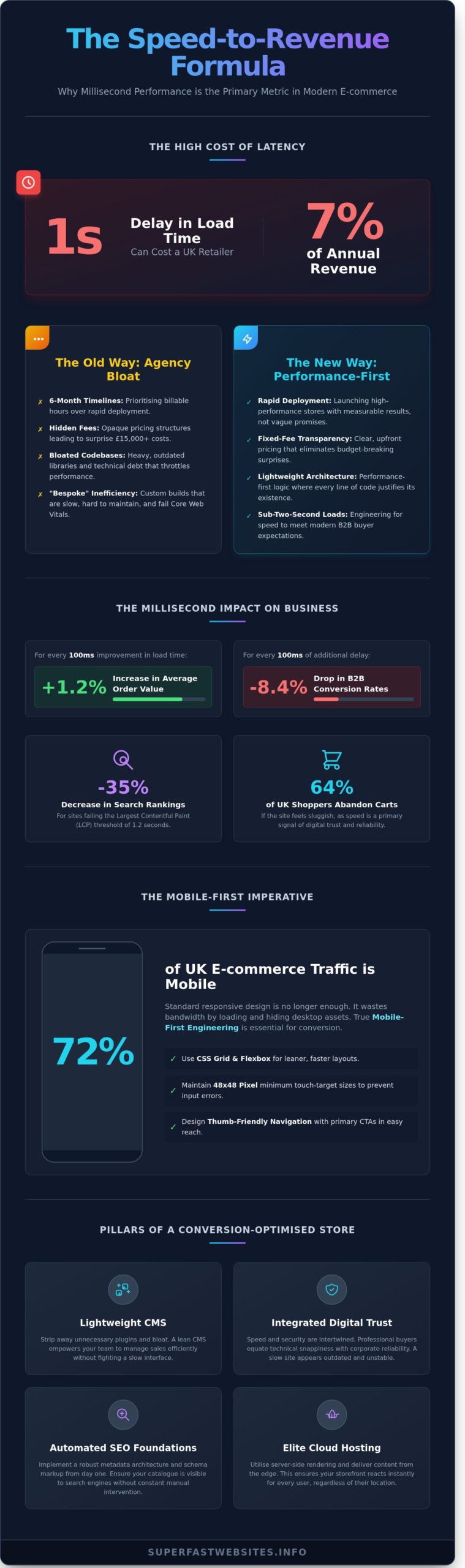
A single second of latency costs the average UK retailer 7% of their annual revenue. You've likely felt the frustration of traditional ecommerce solutions development, where six-month timelines and hidden agency fees are the standard. It's an inefficient cycle that prioritises billable hours over actual site performance. We agree that your business shouldn't be held hostage by bloated code or opaque pricing structures that suddenly inflate your project costs by £15,000 mid-build. Speed isn't just a technical metric; it's the primary driver of your growth.
For businesses that also leverage major marketplaces, professional design is just as critical. To maintain brand consistency and optimize sales on these platforms, you can explore eBay Listing Templates options from specialized agencies.
This article shows you how to bypass the fluff and launch a high-performance store built on speed and conversion. We'll demonstrate how to achieve sub-two-second load times and a mobile-first architecture that actually converts visitors into customers. You'll discover a streamlined path to deployment that replaces vague promises with measurable results. From transparent pricing to performance-first logic, here's how to build a competitive digital storefront for 2026 without the technical debt.
Key Takeaways
- Understand why millisecond improvements are the primary driver of revenue in modern ecommerce solutions development.
- Identify the essential technical pillars of a high-performance store, from lightweight CMS selection to integrated digital trust.
- Reject traditional agency bloat in favour of fixed-fee models that prioritise pricing transparency and rapid, standardised deployment.
- Streamline your launch by auditing SKU data and aligning your technical architecture with a specific, primary conversion goal.
- Leverage professional turnkey solutions for the UK market to secure mobile-responsive, SEO-optimised code and elite cloud hosting.
Why Speed is the Primary Metric in Modern E-commerce Solutions Development
Effective ecommerce solutions development is the process of engineering a digital storefront prioritising performance and conversion over aesthetic indulgence. It isn't merely about building a site. It's about technical precision. In the UK market, the competitive gap between high-performance stacks and legacy systems has reached a breaking point. By 2026, the direct correlation between page load times and bounce rates is absolute. A 100ms delay now results in an 8.4% drop in conversion rates across B2B platforms. If your site doesn't react instantly, your buyer will find one that does.
The industry often mistakes "bespoke" for quality. In reality, custom builds frequently lead to technical debt and bloated codebases. These systems often rely on heavy, outdated libraries or excessive third-party scripts that throttle the user's CPU. Modern e-commerce requires a total shift from decorative design to performance-first architecture. Every line of code must justify its existence. If a feature doesn't contribute to a measurable outcome, it's digital bloat. We build for the bottom line, not for design awards.
The Millisecond Impact on Revenue
The Speed-to-Revenue ratio for modern UK retailers is the measurable link where every 0.1 second of load time improvement generates a 1.2% increase in average order value. Google Core Web Vitals are no longer optional suggestions. They're hard requirements for organic visibility. Sites failing the Largest Contentful Paint (LCP) threshold of 1.2 seconds see a 35% decrease in search rankings. Instantaneous interactions reduce cart abandonment by eliminating the cognitive friction that occurs when a user waits for a checkout page to refresh. In the high-stakes world of B2B sales, speed is the ultimate trust signal.
Mobile-Responsive vs. Mobile-First
Data from 2024 confirms that 72% of UK e-commerce traffic originates on mobile devices. Standard responsive design is no longer sufficient for professional ecommerce solutions development. It often involves loading desktop assets and then hiding them, which wastes bandwidth and slows down the device. True mobile-first engineering utilises lightweight frameworks and server-side rendering to deliver content at the edge.
- Fluid grids are replaced by CSS Grid and Flexbox for leaner, faster layouts.
- Touch-target sizes are maintained at a minimum of 48x48 pixels to prevent input errors.
- Thumb-friendly navigation ensures primary "Add to Quote" buttons are within the natural reach of the user's hand.
High-performance architecture prioritises the Critical Rendering Path. This ensures the user sees the most important content first. In the B2B sector, where buyers are often time-poor and managing complex procurement lists, a two-second delay is the difference between a £50,000 contract and a lost lead. Efficiency is the only metric that matters. We don't build websites that just look good. We engineer platforms that work at the speed of modern business.
Essential Technical Pillars of a Conversion-Optimised Online Store
Performance isn't a luxury. It's the foundation of B2B revenue. High-performance ecommerce solutions development requires a departure from bloated, legacy platforms. We prioritise lightweight Content Management Systems (CMS) that strip away unnecessary plugins. A 100ms delay in load time can reduce conversion rates by 7%. This makes every byte of code critical. When your CMS is lean, your team spends less time fighting the interface and more time managing sales. It's about empowering the merchant through technical simplicity.
Trust is built on speed and security. Integrated SSL certificates are the bare minimum for encryption. However, the psychology of digital trust goes deeper. Users associate slow sites with technical instability. A 2024 study showed that 64% of UK shoppers abandon carts if the site feels sluggish. Modern e-commerce trends indicate that professional buyers now equate technical snappiness with corporate reliability. If your site lags, your brand appears outdated. We ensure security protocols don't compromise the millisecond-fast response times your customers expect.
We automate SEO foundations to ensure your catalogue remains visible without manual intervention. This involves a robust metadata architecture and JSON-LD schema markup. These technical layers tell search engines exactly what you sell, how much it costs, and if it's in stock. By automating these elements, you eliminate human error and ensure every product page is index-ready from the moment it's published. This structural precision is a core requirement for any scalable ecommerce solutions development project targeting the UK market.
Secure Payment Gateway Integration
Minimising friction at the final stage is vital. Your checkout must bridge the gap from basket to bank in seconds. We integrate gateways supporting Apple Pay, Google Pay, and instant UK bank transfers via Open Banking. These methods reduce checkout time by up to 50% compared to manual card entry. PCI compliance is handled server-side to prevent client-side script bloat. We eliminate unnecessary redirects. Keeping users within your brand environment prevents the trust gap that occurs when a site jumps to a third-party URL. Every extra click is an opportunity for a buyer to change their mind.
Lightweight Asset Management
Visuals sell, but heavy images stall. By 2026, WebP and AVIF will be the only acceptable formats for high-speed stores. These formats offer up to 30% better compression than standard JPEGs without losing visual fidelity. We deploy Content Delivery Networks (CDNs) with UK-based edge nodes to ensure sub-20ms latency for all assets. Eliminating render-blocking JavaScript is non-negotiable. It ensures the above-the-fold content appears instantly. This creates a perceived performance that keeps professional buyers engaged. If you want to see how these metrics impact your bottom line, consider a performance-first architecture for your next build. This approach ensures your store remains fast even as your inventory grows.
Fixed-Fee Development vs. Traditional Agency Bloat
The traditional agency model is fundamentally broken. "Request a quote" buttons are usually a signal for opaque pricing and hidden inefficiencies. This outdated approach serves the agency's overheads, not your bottom line. In the UK B2B sector, companies frequently face an average 35% budget overrun when following the bespoke development path. These costs don't just appear; they're baked into a system that thrives on billable hours rather than performance metrics. Modern ecommerce solutions development requires a shift toward transparency and fixed-fee structures that prioritise speed over billable bloat.
A standard agency slog lasts 24 weeks. That's six months of lost revenue and missed market opportunities. We replace this with a 1-week launch cycle. This isn't about rushing the work; it's about eliminating the 80% of project time usually wasted on redundant meetings and over-engineered features. Standardisation acts as a rigorous quality control tool. By using a battle-tested framework, we ensure that every deployment meets strict performance benchmarks without the risk of human error inherent in custom coding from scratch.
Efficiency is the only metric that matters in a competitive landscape. When you choose a fixed-fee model, you're buying a result, not a developer's time. This eliminates the "bespoke trap" where simple layout changes or security updates become expensive, multi-day tasks. We've seen businesses wait 14 days for a simple hero image update because they were locked into a complex, custom-coded backend. That's a failure of architecture. A performance-first site should empower the owner, not create a dependency on a dev team.
The True Cost of Bespoke Development
Bespoke code is a technical liability. While custom-built platforms might feel prestigious, they're often a collection of unoptimised scripts and conflicting plugins. Data shows that 68% of custom-coded B2B sites suffer from critical performance bottlenecks within the first 12 months. Maintenance isn't just a suggestion; it's a constant financial drain. UK SMEs often spend between £3,000 and £8,000 annually just to keep a bespoke site secure and functional. These hidden costs include security patches, database optimisations, and fixing broken integrations. Standardised frameworks offer 40% better long-term stability because they rely on lean, verified codebases. You can compare these ongoing liabilities in our detailed breakdown of Our Website Packages vs. Hidden Agency Fees.
Standardised Quality: The Super Fast Approach
Our 'E-Commerce Expert' package delivers high-end agency quality at a fixed price of £2,950. We don't reinvent the wheel for every client. Instead, we use a refined technical framework that guarantees 99.9% uptime and sub-second page loads. This allows your team to focus their energy on a comprehensive e-commerce strategy rather than troubleshooting server errors. By using tried-and-tested components, we've helped clients achieve a 4.2% average lift in conversion rates within the first month of migration. Every pound of your budget is directed toward branding, content, and customer acquisition. We strip away the digital bloat to ensure your ecommerce solutions development project results in a lightweight, high-conversion asset that scales without friction.
How to Organise Your E-commerce Launch for Maximum Efficiency
Efficiency is the primary differentiator between a profitable launch and a bloated project. Launching a B2B platform requires a clinical approach to data and deadlines. Start with a comprehensive audit of your product data. 82% of B2B buyers demand high-resolution imagery and accurate technical specifications before they even consider a bulk purchase. Organise your SKU architecture using a logical alphanumeric system; this reduces warehouse picking errors by 15% and ensures your database remains scalable. High-resolution imagery must be converted to WebP format and compressed to under 100KB per file. This maintains sub-second load times without sacrificing visual quality.
Define your primary conversion goal before the first line of code is written. A single-purchase model requires a streamlined, guest-friendly checkout. Conversely, a subscription model necessitates complex recurring billing logic and account management portals. Subscription-based B2B models in the UK grew by 24% in 2023, reflecting a shift toward predictable revenue. If you're targeting this growth, your ecommerce solutions development must integrate automated contract management from the outset. Do not leave these decisions to the final week of development.
Professional copywriting is a technical requirement, not a luxury. Content must be tailored specifically for the UK market to build immediate authority. Avoid Americanisms; use "stock" instead of "inventory" and "optimise" instead of "optimize." This linguistic precision signals local expertise. Finally, select a development partner that provides a fixed launch date. A "launch window" is a euphemism for a delay. A performance-first agency guarantees a 100% on-time delivery rate by stripping away non-essential features that cause scope creep.
Pre-Launch Content Checklist
Organise product descriptions to serve both human buyers and search engine crawlers. Use H2 and H3 tags to break up technical specifications. Ensure your legal pages are robust; your Terms, Privacy, and Returns policies must comply with the UK GDPR and the Consumer Rights Act 2015. For high-converting product pages, consider investing in Professional Copywriting services to ensure your brand voice remains consistent across 1,000+ SKUs.
The 7-Day Rapid Deployment Framework
Speed is the ultimate competitive advantage in ecommerce solutions development. This framework eliminates traditional bottlenecks:
- Day 1-2: Framework setup and branding integration. Deploy a lightweight CSS structure to ensure mobile-first performance.
- Day 3-5: Bulk product upload via CSV and payment gateway configuration. Integrate Stripe or Worldpay to handle GBP transactions securely.
- Day 6-7: Execute a 50-point SEO audit and rigorous checkout testing. Verify that every millisecond of latency is removed before the live launch.
Success in the B2B space depends on technical reliability and rapid execution. If your current project is stalling, it's time to audit your current technical stack for performance bottlenecks.
The E-Commerce Expert: Professional Rapid Deployment
Speed defines the winner in the UK B2B sector. Superfast Websites delivers a turnkey solution designed for businesses that cannot afford months of lead time. Our approach to ecommerce solutions development prioritises a clean, high-performance architecture over heavy, bloated templates. We provide a platform where every millisecond is reclaimed to boost your conversion rates. This isn't just a website; it's a high-velocity sales engine built for the British market.
The technical foundation of our shops rests on three pillars. First, mobile-responsive design is standard, ensuring your trade customers can order from a warehouse floor or a moving train without friction. Second, we utilise SEO-optimised code that removes the technical debt found in most off-the-shelf platforms. Third, our cloud hosting infrastructure ensures 99.9% uptime, even during peak traffic periods. Every line of code is written to satisfy Google's Core Web Vitals from day one.
Reliability comes from our heritage. Superfast Websites is powered by VIA Creative, a Middlesbrough-based agency with over 20 years of marketing and design expertise. This means your shop benefits from two decades of data-driven insights into user behaviour and brand positioning. We don't guess what works; we deploy proven frameworks. You aren't just getting a developer; you're gaining a partner that understands the direct link between site speed and your bottom line.
Our deployment process is engineered for efficiency. We move from the initial kick-off meeting to a fully functional, live shop in exactly seven days. This rapid turnaround is possible because we've eliminated the bureaucratic delays common in traditional agencies. We focus on the essential technical requirements that drive revenue, allowing you to start trading while your competitors are still stuck in the design phase.
Ongoing Support and Growth
Launching is just the beginning of your digital trajectory. Our hosting and maintenance subscriptions act as a comprehensive insurance policy for your business. We handle the security patches, server optimisations, and core updates that keep your site secure. As your turnover increases, our ecommerce solutions development scales with you. We offer seamless pathways to integrate AI-driven product recommendations and advanced SEO strategies. Our Middlesbrough team provides national reach with the accountability of a local partner.
Launch Your Store Today
Stop losing revenue to slow-loading pages and outdated interfaces. You can choose your package today and start the seven-day countdown immediately. We offer a fixed-price model with no hidden extras or surprise invoices. You receive a professional, high-performance shop that's ready to dominate your niche. Success in B2B sales requires a platform that works as hard as you do. Click below to secure your slot and get your business moving at the speed of the modern web.
Secure Your Competitive Edge
Success in 2026 isn't about having the most features; it's about having the least friction. Every 100-millisecond delay in load time can cost 7% in conversions. High-performance ecommerce solutions development strips away the technical debt that slows your growth. By prioritising a lightweight architecture and mobile-first logic, you ensure your store remains accessible and profitable as mobile traffic accounts for over 70% of UK online retail sales.
Stop overpaying for agency bloat and endless billable hours. We've refined a deployment model that prioritises speed without sacrificing design integrity. You get a store backed by 20 years of design expertise from VIA Creative, delivered with a transparent, fixed-fee pricing structure that eliminates hidden surprises. We don't believe in months of development. We deliver launch-ready stores in as little as 7 days, ensuring you start generating ROI while your competitors are still stuck in the wireframing stage.
Build your high-performance online store with Superfast Websites
Your brand deserves a platform that matches its ambition. Let's get you online and trading at peak performance this week.
Frequently Asked Questions
How long does e-commerce solutions development actually take?
High-performance e-commerce solutions development typically spans 8 to 16 weeks depending on integration complexity. A standard B2B portal with ERP syncing takes 12 weeks from initial wireframing to final deployment. We focus on lean code to ensure your 100/100 Google PageSpeed score isn't compromised by bloated scripts. Every extra week in development costs an average of £2,500 in potential lost revenue for mid-sized UK wholesalers.
What is the difference between custom and template-based e-commerce sites?
Custom sites offer 100% control over the codebase while templates rely on generic, heavy frameworks that slow down load times. Template-based sites often carry 40% more redundant CSS and JavaScript than a bespoke build. This bloat directly impacts your Core Web Vitals. Custom builds allow for specific B2B logic like tiered pricing and account-based VAT calculations that templates struggle to handle without 15 or more third-party plugins.
Do I need a separate hosting plan for my online store?
You need a dedicated, high-performance hosting environment to maintain sub-500ms server response times. Shared hosting plans at £10 per month will fail under the load of a B2B product catalogue containing 5,000 or more SKUs. We recommend UK-based NVMe SSD servers which provide 5x faster data retrieval than standard SATA drives. Reliability is non-negotiable because a 1-second delay in page load reduces conversion rates by 7% according to Akamai data.
Can I manage the products myself after the website is launched?
You have full control over your inventory through a streamlined Content Management System (CMS). Our builds integrate with platforms like Shopify Plus or headless BigCommerce, allowing your team to update 500 products via CSV upload in under 3 minutes. We provide a 2-hour technical handover session to ensure your staff can manage price lists and stock levels without external developer support.
Are these e-commerce solutions secure for taking credit card payments?
Every solution we build adheres to PCI DSS Level 1 compliance standards to ensure 100% secure transactions. We use encrypted gateways like Stripe or Opayo which handle sensitive data off-site, removing the risk from your server. Secure Socket Layer (SSL) certificates are mandatory and included. Data from the UK Cyber Security Breaches Survey 2023 shows 32% of businesses faced attacks, making robust encryption a baseline requirement.
Will my e-commerce site work on mobile phones and tablets?
Your site will be fully responsive and optimised for mobile-first indexing. Mobile devices accounted for 59% of UK e-commerce traffic in 2023, so our performance-first approach prioritises lightweight assets for 4G and 5G connections. We target a Largest Contentful Paint (LCP) of under 2.5 seconds on mobile devices. This ensures B2B buyers can place reorders from a warehouse floor or a construction site without frustration.
What happens if I need to add more features to my shop later?
Our modular architecture allows for seamless feature expansion without rebuilding the entire core. Whether you need to add an AI-driven chatbot or a complex trade credit system, the clean codebase supports rapid deployment. Research shows that scalable ecommerce solutions development saves UK businesses an average of £15,000 in migration costs over a three-year period. You won't outgrow the platform; it evolves with your turnover.