

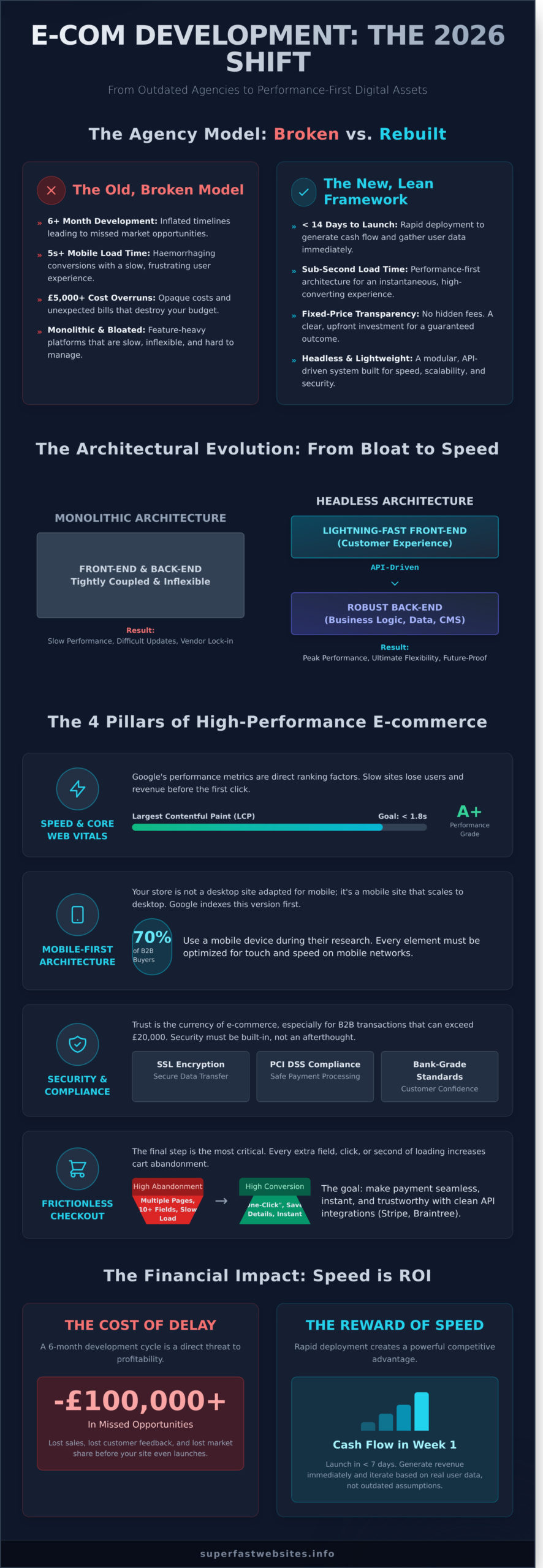
The traditional agency model for ecom web development is broken. It's an outdated system built on inflated timelines and opaque costs, leaving you with a store that launches months late and haemorrhages conversions. You've likely seen the results firsthand: a mobile experience that takes over five seconds to load, a complicated back-end you can't manage, and a final bill that creeps £5,000 over the initial quote.
It doesn't have to be this way. This guide delivers a new framework for building elite, performance-first online stores in 2026. You will learn the exact technical strategy to launch a sub-second, high-converting asset for your business, all with fixed-price transparency. We’ll break down the lightweight architecture, streamlined project management, and conversion-focused design needed to go from concept to launch in under 14 days.
Key Takeaways
- Discover why the modern standard for e-commerce has shifted from feature-heavy platforms to lightweight, performance-first architectures.
- Learn which technical metrics, like Core Web Vitals, directly impact your store's ranking and revenue in a mobile-first market.
- Understand the critical differences between SaaS and open-source frameworks to avoid the common "DIY trap" that leads to slow, unrankable sites.
- Implement a lean ecom web development process that focuses on speed and conversion from day one, bypassing traditional agency bloat.
What is Ecom Web Development in 2026?
Ecom web development is the technical process of building a digital storefront. In 2026, this means engineering an asset optimized for three things: transactions, security, and instantaneous speed. It's a fundamental move away from the feature-heavy platforms of the past toward performance-first architectures. Your digital presence is no longer just a catalogue; it's a high-frequency trading floor for your products and services.
The old model was simple. You bought a template, loaded it with plugins, and hoped for the best. That approach is now obsolete. Today's standards demand lean code because digital bloat is the primary killer of revenue. Every unnecessary line of JavaScript, every unoptimized image, and every slow database query directly reduces your conversion rate. A modern E-commerce (electronic commerce) platform must be built with a scalpel, not a sledgehammer. This changes the role of the developer entirely. They are no longer just implementing a design; they are conversion engineers, architecting a system where every millisecond is accounted for and tied to a measurable business outcome.
The Evolution of E-commerce Architecture
The industry has shifted from monolithic platforms to headless and modular systems. Monolithic sites bundle the front-end (what customers see) and back-end (the business logic) together, creating a slow, inflexible system. Headless architecture decouples them. This allows for a lightweight, lightning-fast front-end built on modern frameworks while the back-end handles the complex logic. This modular approach, powered by APIs, is essential for performance. With the widespread adoption of 5G networks in the UK, user expectation for speed is absolute. A site that isn't instantaneous feels broken.
Why Rapid Deployment Matters for ROI
A six-month development cycle is a direct threat to your profitability. In a market moving at the speed of data, six months of development means six months of lost sales, lost customer feedback, and lost market share. For a mid-sized B2B firm in the UK, that delay can easily represent over £100,000 in missed opportunities before the site even launches. The goal of modern ecom web development is to shrink that timeline.
Getting to market in under seven days completely transforms your financial projections. It means generating cash flow in the first week, not the third quarter. It allows you to test, iterate, and adapt based on real user data, not outdated assumptions. This speed is a competitive advantage. Development Velocity is the time from concept to the first successful transaction.
The 4 Technical Pillars of High-Performance Ecom Development
A B2B e-commerce site in 2026 is a performance machine. Its success isn't built on aesthetics alone; it's engineered from the code up. Flawless design means nothing if the underlying structure is slow, insecure, or unusable on mobile. High-revenue platforms are built on four technical pillars: speed, mobile-first architecture, security, and a frictionless checkout. Neglect one, and the entire structure fails.
Effective ecom web development treats these pillars as non-negotiable requirements. They are the foundation for every pound of revenue your site generates.
Consider a visually-rich business, such as an online art gallery selling fine art prints. The aesthetic is paramount, but if the high-resolution images cause slow load times, the entire enterprise fails. A well-executed example of a clean, professional storefront can be seen at gallery.first4frames.co.uk; the challenge for developers is ensuring such a site remains fast and responsive.
- Core Web Vitals: Google's performance metrics are now direct ranking factors. For e-commerce, two matter most. Largest Contentful Paint (LCP) must be under 1.8 seconds. Cumulative Layout Shift (CLS) must be below 0.1. A slow LCP kills user engagement before it begins. A high CLS causes mis-clicks and destroys trust. These aren't just SEO scores; they are hard metrics for user experience.
- Mobile-First Indexing: Over 70% of B2B buyers use a mobile device during their research. Google indexes your mobile site first. This means your platform isn't a desktop site that adapts to mobile; it's a mobile site that scales to desktop. Every element, from navigation to product filtering, must be lightweight and optimized for touch input.
- Security and Compliance: Trust is the currency of B2B e-commerce. Integrating SSL encryption and PCI DSS compliance isn't optional; it's the baseline. For transactions that can exceed £20,000, your customers expect bank-grade security. It must be built-in, not bolted on.
- Checkout Optimization: The final step is the most critical. Every unnecessary field and every extra click increases abandonment. Clean API integrations with payment gateways like Stripe, Braintree, or unified platforms such as Strictly are essential. The goal is to make payment seamless and instant.
Optimizing the Path to Purchase
Technical execution must serve a single goal: making it easy to buy. This starts with developing "one-click" checkout environments that use saved credentials to eliminate data entry. It extends to instantaneous search and filter functions, especially for catalogues with thousands of SKUs. This technical precision is a core component of an effective e-commerce strategy, where user experience directly impacts revenue. To achieve this speed, server-side rendering (SSR) is used to deliver fully loaded product pages, slashing load times and getting buyers to the "add to cart" button faster.
Security Standards in 2026
The padlock icon is just the start. Modern security means implementing AI-driven fraud protection at the development level to analyse transaction patterns in real-time. For UK and EU customers, GDPR compliance must be architected into the database structure itself, ensuring data privacy by default and avoiding fines from the ICO. This entire system must be hosted on secure cloud infrastructure like AWS or Google Cloud, which provide the 99.99% uptime guarantee that B2B operations demand. Achieving this level of performance requires a specialized approach; our team focuses exclusively on engineering high-performance e-commerce platforms that deliver results.
Choosing the Right Framework: Speed vs. Flexibility
Your technology stack is the foundation of your digital revenue. A poor choice here guarantees performance issues, security vulnerabilities, and scaling problems. The debate isn't just about features; it's about the architectural trade-offs that dictate speed and future costs. In 2026, making the right decision from day one is the most critical factor in successful ecom web development.
Most businesses fall into one of two traps: the restrictive but simple SaaS platform or the bloated and unmanaged open-source build. Both are compromises. We reject compromise.
SaaS vs. Open Source: The 2026 Reality
SaaS platforms like Shopify and BigCommerce offer a "walled garden." They are secure and easy to manage, making them a viable choice for B2B companies with simple product catalogues and no need for complex, real-time API integrations. If your operations fit inside their box, they work.
Open-source frameworks like Magento or WooCommerce offer limitless flexibility. This is essential for businesses needing deep integration with bespoke ERP, PIM, or CRM systems. But this power is where the "DIY trap" springs. Businesses often hire developers to bolt on dozens of off-the-shelf plugins, creating a slow, unmaintainable site. This isn't architecture; it's digital hoarding. At Super Fast Websites, we build on a standardized, high-performance core. You get the control of open source without the catastrophic performance debt.
The Hidden Costs of "Cheap" Development
A low upfront cost is a red flag. A £5,000 website build often accumulates over £15,000 in maintenance, security patching, and performance fixes within 24 months. Poor code quality is technical debt, and the interest payments are severe. This debt manifests as slow load times, which directly impacts your bottom line.
The numbers are brutal. Google's 2022 data shows a 1-second delay in load time can decrease conversions by 20%. Let's be more granular. Every 100ms of latency can cost 1% of revenue. For a B2B portal processing £2 million annually, a 500ms slowdown-barely perceptible to a user-translates to a potential £100,000 loss per year. This isn't just theory; it's the core principle of technical Website optimization that underpins every profitable e-commerce operation.
Our "E-Commerce Expert" package is engineered to eliminate this risk. It's an investment in a performance-first asset, not a short-term expense. We build a lightweight, efficient foundation that prevents technical debt from ever accumulating. Your website becomes a stable, revenue-generating machine from day one, not a ticking financial time bomb.
The Lean Ecom Development Process: From Concept to Checkout
Traditional B2B website builds are slow and expensive. Months of development lead to bloated platforms that miss market opportunities. A lean process is the antidote. It’s a ruthless, efficient methodology designed to get a high-performance sales tool into the market fast. The goal isn't perfection; it's momentum. It's about generating revenue and data from day one.
Our entire philosophy is built on a streamlined, four-phase sprint. This isn't just theory. It's a repeatable system for launching revenue-generating assets with maximum velocity.
- Phase 1: Discovery and Architecture. We define the Leanest Viable Product (LVP). This isn't your dream feature list. It's the absolute minimum required for a customer to find a product, add it to their cart, and complete a secure transaction. We map the core user journey and eliminate everything else.
- Phase 2: Performance-First Design. We don't design visuals; we architect conversion pathways. Wireframes are built for speed, targeting a Largest Contentful Paint (LCP) of under 1.8 seconds. Every element is scrutinised. If it doesn't improve conversion or speed, it's cut.
- Phase 3: Rapid Build. The architecture is set. The goals are clear. We execute the core build in a focused 7-day sprint. This intense pace is possible only because we've eliminated complexity in the preceding phases. This is the core of our lean ecom web development approach.
- Phase 4: Optimization and Launch. Before going live, we conduct rigorous performance testing. Using Google Lighthouse and real-device testing, we ensure the site scores above 95 on mobile performance. We validate all on-page SEO elements, from schema markup to XML sitemaps, ensuring you launch with immediate search visibility.
Eliminating Feature Creep
Feature creep is the single biggest threat to budget and timeline. We focus only on "Must-Have" features that directly impact the initial sale. Using AI integration, we can automate the generation of thousands of unique product descriptions and SEO metadata via API, cutting content prep time by over 90%. We champion a "Launch and Iterate" philosophy. A live site generating data is infinitely more valuable than a "perfect" site stuck in development for six months.
Post-Launch Technical Support
The "Go Live" button is the starting line, not the finish. Your digital asset requires constant maintenance to perform. This includes applying critical security patches within 24 hours of release to protect against vulnerabilities and ensuring compliance with UK GDPR standards. We monitor key conversion metrics post-launch, using data from tools like Hotjar to inform targeted technical tweaks that deliver measurable ROI improvements. Effective ecom web development is an ongoing process of optimisation.
A slow, complex build process costs you more than just development fees; it costs you sales. See how our accelerated process delivers a superior, faster B2B platform. Schedule your performance consultation today.
The Superfast Approach: Your "E-Commerce Expert" Store
Traditional agency builds are slow. They are bloated with unnecessary meetings and unpredictable costs that delay your revenue. We reject that model. Our approach to ecom web development is built on a foundation of ruthless efficiency. We deliver a high-performance, conversion-optimised B2B store in just one week. No exceptions.
This is achieved through our "E-Commerce Expert" package. It's the culmination of over 20 years of VIA Creative's experience building digital platforms for UK small businesses, refined into a system that delivers exactly what you need to start selling. We focus on the core components that drive sales and strip out the rest.
Your store is built with a performance-first architecture, including:
- A lightweight, optimised WooCommerce installation.
- Secure and reliable payment gateway integration (Stripe and PayPal as standard).
- A clean, fast-loading product and category structure designed for conversions.
- A foundational technical SEO setup that Google's crawlers favour from day one.
We operate on a transparent, fixed-fee basis. The price you are quoted is the price you pay. There are no hidden "agency management" fees, no escalating hourly rates, and no surprise invoices. You get a professional, high-speed e-commerce store for a single, predictable investment, allowing you to budget with 100% certainty. This streamlined process is how we deliver professional ecom web development without the typical 3-month agency timeline.
Why Our Clients Launch Faster
Our speed comes from a standardised development workflow that eliminates agency bloat. We've replaced endless discovery calls and revision cycles with a precise, repeatable process. This lean build directly impacts your SEO. A clean, error-free codebase and rapid deployment signal health and authority to Google, giving you a critical advantage over competitors from the moment you launch. Learn more about our E-Commerce Expert package.
Ready to Start Selling?
Our onboarding process is as efficient as our builds. It moves from a simple digital brief directly to development. To guarantee the 7-day turnaround, we just need your core assets ready to go: your logo, brand colours, and a simple spreadsheet with your product data (names, prices, descriptions, and images). With these components in place, our team gets to work immediately. Get your high-performance store online now.
Your Store's Performance Defines Its Future
The 2026 landscape is clear. High-performance isn't an add-on; it's the core of successful e-commerce. Your store's survival depends on a lightweight technical stack and a ruthless focus on sub-second load times. This is the new standard for modern ecom web development, where every kilobyte directly impacts your bottom line. Anything less is a competitive liability.
We've engineered the solution. The E-Commerce Expert package delivers a performance-first store, built and launched in just 7 days. We guarantee this one-week delivery with transparent, fixed-fee pricing from £495. As a subsidiary of VIA Creative, an agency established in 2003, we build on over two decades of digital excellence. Ready to stop losing customers to slow load times?
Launch your high-performance online store in 7 days with the E-Commerce Expert. Don't settle for average. Build the fastest store your customers have ever used.
Frequently Asked Questions
How much does ecom web development cost in 2026?
E-commerce web development costs in the UK for 2026 typically range from £5,000 to over £50,000. A basic Shopify or WooCommerce site using a premium template starts at the lower end. Custom builds with bespoke features, complex third-party integrations, and a performance-first architecture command prices of £25,000 and up. The final investment directly correlates with the level of optimization required to achieve sub-second load times and high conversion rates.
How long does it take to develop a professional e-commerce website?
A professional e-commerce website takes between 6 weeks and 6 months to develop. Template-based projects on platforms like Shopify can launch in 6 to 10 weeks. A custom, performance-first build requires a more intensive 4 to 6-month timeline. This extended period accounts for in-depth strategy, bespoke UI/UX design, custom feature development, and rigorous performance testing to ensure every millisecond is optimized for maximum conversion and revenue impact.
Do I need a custom-built e-commerce site or a template?
Your choice between a custom site and a template depends entirely on your performance goals. Templates offer a faster launch but often come with code bloat that can slow your site by 500ms or more, directly impacting conversions. A custom build provides a lightweight, performance-first foundation. It's engineered specifically for your business goals, ensuring every feature serves a purpose and contributes to a faster user experience and a higher return on investment.
What is the best platform for ecom web development for small businesses?
For small businesses, Shopify is often the most efficient platform for its integrated ecosystem and ease of use. It handles security and hosting, allowing you to focus on sales. However, for businesses requiring greater customization and control over performance, WooCommerce on a WordPress installation is a superior choice. This platform offers limitless flexibility for bespoke ecom web development, enabling deep optimization for site speed and a unique customer journey. To create a truly cohesive brand experience that extends from the digital storefront to the physical delivery, many businesses also invest in professional vehicle branding; you can visit KR Graphics to see how this complements an online presence.
Will my e-commerce site be mobile-friendly and SEO-optimized?
Yes, mobile-first design and technical SEO are fundamental to our process. Over 60% of UK e-commerce traffic now originates from mobile devices, and Google's indexing is mobile-first. We build every site to be fully responsive and optimized for Core Web Vitals. This ensures a flawless user experience on any device and provides the technical foundation required for high search engine rankings. A fast mobile site isn't a feature; it’s a requirement for online revenue. To capitalize on this technical foundation, a robust digital marketing strategy is the next step, and working with an experienced agency like Webtalent can be crucial for driving traffic and converting visitors.
Can I manage the store myself after the development is finished?
Yes, you will have complete control to manage your store. We build on user-friendly Content Management Systems (CMS) like Shopify or WordPress with WooCommerce. You'll be able to add new products, update pricing, manage inventory, and process orders without any technical knowledge. We provide comprehensive training and documentation to ensure your team can operate the site efficiently from day one, empowering you to manage your business operations independently.
What security features are essential for a new online store?
Essential security features include an SSL certificate for data encryption, PCI DSS compliance for handling card payments, and integration with trusted payment gateways like Stripe. We also implement robust firewalls and conduct regular security patching. For UK businesses, ensuring full GDPR compliance for customer data is non-negotiable. These measures are critical for protecting your business and building the customer trust necessary for high conversion rates. Security is a baseline, not an add-on.
How does site speed affect my e-commerce conversion rate?
Site speed has a direct, measurable impact on your conversion rate. A delay of just 100 milliseconds in load time can decrease conversion rates by up to 7%, according to data from Akamai. For a site earning £100,000 per day, that's a £7,000 loss. An instantaneous user experience reduces friction and bounce rates, keeping users engaged in the buying process. In e-commerce, every millisecond directly translates to revenue, making speed your most critical business metric.