
The traditional UK agency model for web development is a legacy system that prioritises billable discovery hours over actual site performance. Industry data indicates that UK SMEs often spend upwards of £12,000 on ecommerce website design uk only to receive a bloated, slow-loading site that fails to meet Google's Core Web Vitals. If your mobile store takes longer than 3 seconds to load, Google research confirms that 53% of your visitors have already abandoned the journey. You've likely experienced the frustration of opaque pricing structures and bespoke design phases that stretch beyond 12 weeks while your conversion rates stagnate.
We agree that the current market is saturated with "add-on" fees and unnecessary technical complexity that serves the agency rather than the merchant. This guide promises a direct alternative. You'll discover how to launch a high-conversion, lightning-fast online store in the UK without typical delays or recurring financial surprises. We break down the performance-first framework that delivers instantaneous load speeds and a fully functional store in days, not months.
Key Takeaways
- Understand the direct causal link between millisecond load times and revenue growth for British online retailers in 2026.
- Identify the essential technical architecture required for high-performance ecommerce website design uk that prioritises speed over decorative bloat.
- Learn to avoid budget creep by choosing fixed-fee packages over unpredictable hourly agency rates and hidden DIY costs.
- Follow a streamlined buying guide to audit your product requirements and verify the technical performance credentials of any potential provider.
- Discover how to launch a professional, conversion-ready store in as little as one week without the typical agency delays or technical friction.
The State of Ecommerce Website Design in the UK for 2026
The UK retail market has fundamentally changed. By 2026, the concept of a digital shop window has been replaced by the high-speed data engine. British consumers no longer browse; they execute transactions with surgical precision. This shift means ecommerce website design uk must prioritise technical performance over decorative flair. If your site doesn't react instantly, you're invisible to the modern buyer.
Many agencies still sell bespoke designs as a premium service. In reality, this has become a buzzword for digital bloat. These custom builds often involve excessive JavaScript, unoptimised CSS, and redundant plugins that create a sluggish user experience. Modern UK retail requires a performance-first architecture. Every line of code must justify its existence through a measurable impact on load speed or conversion. Efficiency is the new aesthetic.
Why Speed is Your Primary Conversion Tool
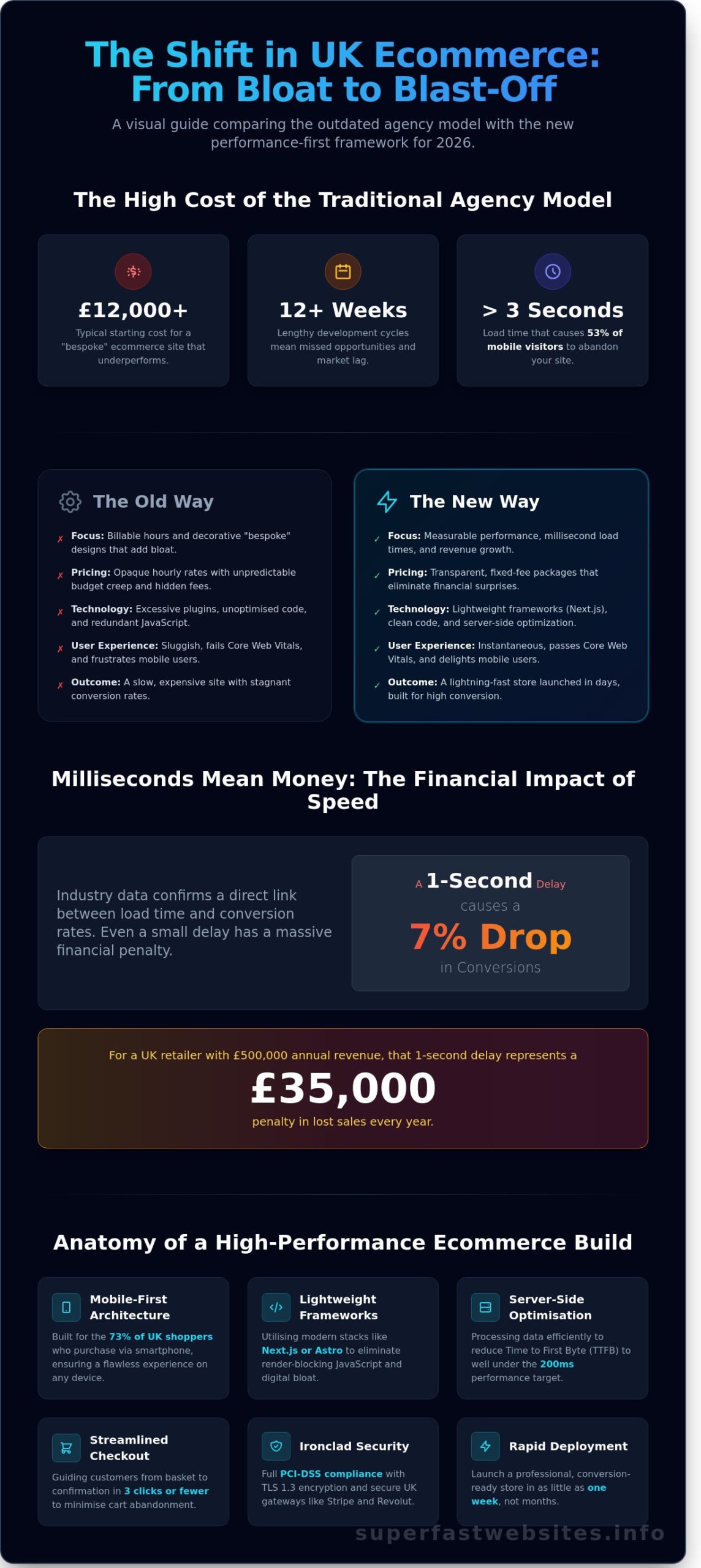
Speed isn't a luxury; it's a fundamental requirement for SEO and user retention. Google's Core Web Vitals, specifically the Interaction to Next Paint (INP) metric, now dictate visibility in UK search results. If your site feels sluggish, your rankings will drop. The correlation between milliseconds and money is absolute. Industry data confirms a one-second delay can slash conversion rates by 7%. For a UK retailer generating £500,000 in annual revenue, that's a £35,000 penalty for poor optimisation. Instantaneous loading is the only way to prevent mobile cart abandonment in a distracted market.
The Death of the Three-Month Build
The era of the ninety-day development cycle is over. Agile brands can't afford to wait months while an agency tinkers with "perfect" aesthetics. The modern approach to ecommerce website design uk focuses on rapid deployment and iterative growth. Launching a high-performance, lean site in three weeks is superior to launching a bloated masterpiece in three months. This strategy allows you to:
- Capture market share while competitors are still in the design phase.
- Gather real-world user data to inform functional updates.
- Minimise initial capital expenditure by avoiding unnecessary feature creep.
- React to UK market trends in real-time rather than following a static plan.
Perfectionism is often just a mask for technical inefficiency. In 2026, the fastest site wins the sale, not the one with the most decorative animations. You don't need a three-month build to start selling; you need a stable, lightning-fast foundation that can scale as your revenue grows. The market rewards those who launch quickly and optimise relentlessly.
Anatomy of a High-Performance Ecommerce Build
Effective ecommerce website design uk in 2026 prioritises architecture over aesthetics. Visual appeal matters, but it cannot compensate for a sluggish core. A high-performance build starts with mobile-first architecture, not just a responsive layout. While responsive design adapts a desktop site for smaller screens, mobile-first builds the experience specifically for the 73% of UK shoppers who now purchase via smartphone. This approach ensures that every kilobyte of data serves a specific purpose.
The Technical Engine: Beyond the Visuals
Clean code is the foundation of technical authority. Excessive reliance on third-party plugins creates digital bloat, increasing page load times and security vulnerabilities. Every 100ms of latency can reduce conversion rates by 7% according to recent retail studies. This makes lightweight, bespoke code a financial necessity. Server-side optimisation further enhances this by processing data closer to the user, reducing the Time to First Byte (TTFB) to under 200ms.
- Lightweight Frameworks: Use modern stacks like Next.js or Astro to eliminate render-blocking JavaScript.
- AI-Driven Management: Integrate AI for predictive inventory tracking, which can reduce overstocking costs by 15% annually.
- Security Protocols: Deploy TLS 1.3 encryption and integrate secure UK gateways like Stripe or Revolut for full PCI-DSS compliance.
Security is not an optional add-on. It's a core component of the user journey. Secure payment integration and visible SSL certificates provide the technical reassurance British consumers demand before sharing financial data. If your current platform feels heavy or slow, it might be time to audit your site speed to identify performance bottlenecks.
User Experience (UX) for the British Shopper
UK consumers value efficiency and transparency. A streamlined checkout process must lead a customer from basket to confirmation in three clicks or fewer. Friction at this stage is the primary cause of the 69% cart abandonment rate seen across the industry. Navigation must be "thumb-friendly," placing key interactive elements within easy reach at the bottom of the screen to accommodate larger modern handsets.
Local trust signals are vital for conversion. This includes displaying UK-based contact details and using professional copy for websites that speaks directly to the local market. Avoid generic templates; instead, check out Mosse and Mosse to see how a specialist brand communicates its unique heritage. High-performance ecommerce website design uk requires precise language that builds authority and clarifies the value proposition instantly. Clear shipping costs and delivery timelines, specifically for UK postcodes, should be visible before the final checkout stage to prevent last-minute exits.
Evaluating Ecommerce Platforms: Fixed-Fee vs. Hourly Agency Rates
Choosing the wrong financial model for your ecommerce website design uk project kills ROI before the first sale. DIY builders appear cost-effective at £20 per month; they aren't. These platforms carry a performance debt that often slows page loads by 400ms or more. Data from 2024 shows that 53% of mobile visitors abandon sites taking longer than three seconds to load. Cheap builders trade long-term revenue for low entry costs. They lack the granular control required for elite Core Web Vitals scores.
Hourly agency rates introduce project friction. They incentivise slow work. A project estimated at 100 hours frequently swells to 120 hours due to scope creep, adding thousands to the final bill. Fixed-fee packages eliminate this uncertainty. You pay for the outcome, not the clock. This model aligns the agency's goals with yours: efficiency and rapid delivery. Predictable pricing allows for better reinvestment into marketing and inventory.
The "Bespoke" Trap Explained
Custom-coded solutions often lead to developer lock-in. If an agency uses a proprietary framework, you're tethered to them for every minor update. Maintenance becomes a nightmare. Industry reports indicate that 70% of a software system's total cost occurs after the initial launch. Standardised frameworks offer a safer path. They provide regular security patches and a global ecosystem of experts. You own the site; the site doesn't own you. Standardisation ensures your code remains lightweight and compatible with future browser updates.
Total Cost of Ownership (TCO) Analysis
Look beyond the setup fee. Your TCO includes hosting, security, and domain name registration. High-performance UK hosting for a scaling store requires a robust infrastructure to handle traffic spikes. Avoid the success tax found in platforms that take a 2% commission on every transaction. This fee eats your margins as you grow.
Scale requires a platform that handles 10,000 concurrent UK users without crashing or spiking your monthly overheads. Professional management ensures your ecommerce website design uk remains lean, fast, and profitable. Consider these factors before signing:
- Platform Fees: Monthly subscriptions plus transaction percentages.
- Plugin Bloat: The cost of third-party apps to fix "missing" features.
- Technical Debt: The price of fixing slow code six months later.
- Support Latency: The cost of downtime during peak UK shopping periods like Black Friday.
Efficiency is the only metric that matters in 2026. A fixed-fee, performance-first approach ensures your capital goes toward growth, not fixing avoidable technical errors.
Buying Guide: Choosing Your Ecommerce Package in 2026
Selecting the right framework for your ecommerce website design uk requires a clinical approach to technical specifications. Don't settle for vague promises of "quality." Demand data. Follow these five steps to secure a high-performance build that converts visitors into customers.
- Step 1: Audit your product range. A shop with 10 SKUs needs a lightweight, high-conversion landing page. A shop with 1,000+ SKUs requires a robust database architecture. Match your build to your inventory volume to avoid paying for unnecessary bloat.
- Step 2: Verify speed credentials. Ask for PageSpeed Insight reports from the provider's recent launches. In 2026, a Largest Contentful Paint (LCP) over 1.2 seconds is a failure. Speed is your primary SEO ranking factor.
- Step 3: Demand upfront pricing. Avoid "bespoke" quotes that hide ongoing costs. Ensure your contract explicitly lists hosting, security updates, and plugin licences. Hidden fees can erode 20% of your annual profit margins.
- Step 4: Secure UK support. If your site goes down at 9:00 AM GMT, a support desk in a different time zone is a liability. UK-based technical teams ensure immediate resolution during your peak trading hours.
- Step 5: Review the timeline. Modern automation allows for rapid deployment. If a provider quotes three months for a standard build, they're using outdated, bloated workflows. High-efficiency firms deliver in seven days.
Identifying Your Business Needs
The "One Page Wonder" model suits approximately 18% of UK start-ups focusing on single-product hero launches. If you're scaling, the "E-Commerce Expert" build provides the infrastructure for complex categorisation. This is essential for businesses managing dynamic inventory, such as Fotballturer.no, which coordinates match tickets and accommodation across various European leagues. By 2026, 72% of mobile shoppers expect AI-driven product recommendations as standard. Ensure your CMS is intuitive. You shouldn't need a developer to update a price or change a promotional banner. Efficiency starts in the back office, not just the front end.
Vetting Your Development Partner
Before signing with an ecommerce website development company, test their live work on a standard 4G connection. Portfolios often hide slow loading times behind high-resolution images. Ask them how they handle UK-specific requirements like VAT calculations and GDPR-compliant data processing. A partner who understands the UK SME market will prioritise local payment gateways and Royal Mail integrations. This ensures your ecommerce website design uk isn't just fast; it's built for the local economy.
The E-Commerce Expert: Rapid Results for UK Retailers
Speed is the ultimate competitive advantage for UK retailers in 2026. While traditional agencies spend months in discovery meetings, Superfast Websites delivers fully functional, high-converting stores in seven days. Our E-Commerce Expert package democratises high-end performance. It removes the financial barrier to entry without sacrificing technical excellence. We build every store with a performance-first architecture. This ensures your site passes Core Web Vitals from the moment it goes live. You don't need a massive budget to compete with industry giants; you just need a faster site.
Every build includes mobile optimisation and SEO-ready frameworks as standard. We've stripped away the digital bloat that kills conversion rates. By focusing on lightweight code, we ensure your customers experience instantaneous page loads. This approach isn't just about retail. We've evolved our expertise to become a B2B web development powerhouse. We help companies build lead engines that perform under the pressure of modern search algorithms. Our technical authority ensures your business stays ahead of the curve.
Our Performance-First Process
Our methodology eliminates the common discovery time-sink that plagues traditional development. We use standardised, high-performance builds that incorporate 20 years of design authority from our VIA Creative pedigree. This isn't a basic template; it's a refined framework engineered specifically for speed. We've optimised every element for ecommerce website design uk standards. Your site launches with UK search engine optimisation baked into the code from day one. We focus on millisecond improvements because data shows a one-second delay can drop conversions by 7%. Our team treats speed as a core philosophy, not an afterthought.
- Rapid Deployment: Go from concept to live store in one week.
- Technical Authority: Benefit from two decades of design and development expertise.
- Conversion Focused: Every pixel is placed to drive user action and sales.
Take Control of Your Online Growth
We don't believe in locking clients out of their own assets. You get intuitive management tools to update stock, change prices, and track sales without needing technical help. Our hosting and support packages maintain 99.9% uptime and rigorous security protocols. We handle the technical heavy lifting so you can focus on scaling your revenue. Stop waiting for slow developers to catch up with the 2026 market. Your customers expect instant results, and we provide the infrastructure to deliver them. Launch your E-Commerce Expert store today and start selling within the week. We provide the technical foundation that turns visitors into loyal customers through pure performance.
Secure Your Competitive Edge in the UK Market
Performance is no longer a luxury; it's the baseline for survival. By 2026, British retailers must choose between bloated, slow-loading templates or lean, high-conversion architectures. Data indicates that a 0.1-second improvement in mobile speed can increase conversion rates by 8.4% for retail sites. This guide proves that successful ecommerce website design uk relies on technical precision and transparent, fixed-fee structures that eliminate agency bloat. You don't need months of development to see measurable results.
Superfast Websites is a subsidiary of VIA Creative, bringing over 20 years of technical expertise to every build. We've stripped away the fluff to offer a streamlined process that gets your site live in as little as 7 days. Our fixed-fee pricing ensures you invest in performance, not billable hours. It's time to transform your digital storefront into a high-speed revenue engine. We're ready to help you dominate the search results and the checkout page alike.
Launch your high-performance online store with our E-Commerce Expert package
Frequently Asked Questions
How much does a professional ecommerce website design cost in the UK?
Professional ecommerce design in the UK typically starts from £3,000 for basic setups and exceeds £50,000 for complex enterprise builds. According to 2024 industry data, mid-market UK agencies often charge between £10,000 and £25,000 for custom builds. These figures depend on SKU count and performance requirements. High-performance sites require more investment in backend optimisation to ensure rapid loading speeds and stable checkout environments.
How long does it take to build an ecommerce website for a small business?
A standard ecommerce build for a small business takes between 8 and 12 weeks from discovery to launch. This timeline includes 2 weeks for design, 4 weeks for development, and 2 weeks for testing. Complex migrations or custom API integrations can extend this to 20 weeks. Efficiency is vital. We prioritise a lean development cycle to ensure your site goes live before market trends shift or competitors gain ground.
Is Shopify or WooCommerce better for a UK-based startup?
Shopify is better for UK startups seeking a managed, scalable solution, while WooCommerce offers more control for those with existing WordPress infrastructure. Shopify powers 25 percent of the UK ecommerce market because it handles hosting and security automatically. WooCommerce requires manual server management but avoids monthly subscription fees. For ecommerce website design uk projects, Shopify often delivers a faster time-to-market and lower technical overhead.
What features are essential for a high-converting online shop?
High-converting shops require one-click checkouts, advanced product filtering, and sub-200ms server response times. Data from Baymard Institute shows that 70 percent of users abandon carts due to checkout friction. You must include Apple Pay and Google Pay integrations to capture mobile traffic. Performance-first design ensures these features don't bloat your code. We focus on lean scripts to maintain peak efficiency during high-traffic periods.
Can I manage the website myself without any technical knowledge?
Yes, modern platforms allow you to manage inventory, process orders, and update content through intuitive dashboards. You don't need to write code to add products or change prices. Most UK businesses use Shopify or BigCommerce for this reason. We provide specific documentation and training to ensure your team can handle 100 percent of daily operations. This removes the need for expensive monthly maintenance retainers or developer intervention.
Do I need a specific type of hosting for a fast ecommerce site?
You need dedicated ecommerce hosting or a Content Delivery Network with UK-based edge servers. Shared hosting is too slow for modern retail and often fails during peak sales events. Using a provider like Cloudflare or AWS ensures your site handles 5,000 concurrent visitors without crashing. Fast hosting reduces Time to First Byte by up to 50 percent. This is critical for maintaining high conversion rates and user trust.
How does website speed affect my SEO rankings in the UK?
Google uses Core Web Vitals as a direct ranking factor, meaning slower sites rank lower in UK search results. A 100ms delay in load time can decrease conversion rates by 7 percent, according to Akamai research. Rapid page speeds improve your crawl budget and lower bounce rates. Optimising your ecommerce website design uk for speed is the most effective way to outrank competitors who rely on bloated, legacy codebases.
Will my ecommerce site be mobile-responsive by default?
Every site we build is mobile-responsive by default to accommodate the 60 percent of UK shoppers who buy via smartphones. We use a mobile-first approach where the code is optimised for 4G and 5G connections. This ensures your layouts adapt perfectly to iPhones and Android devices. Responsive design isn't just about layout. It's about touch-target sizing and lightning-fast mobile rendering to prevent users from abandoning their sessions.