
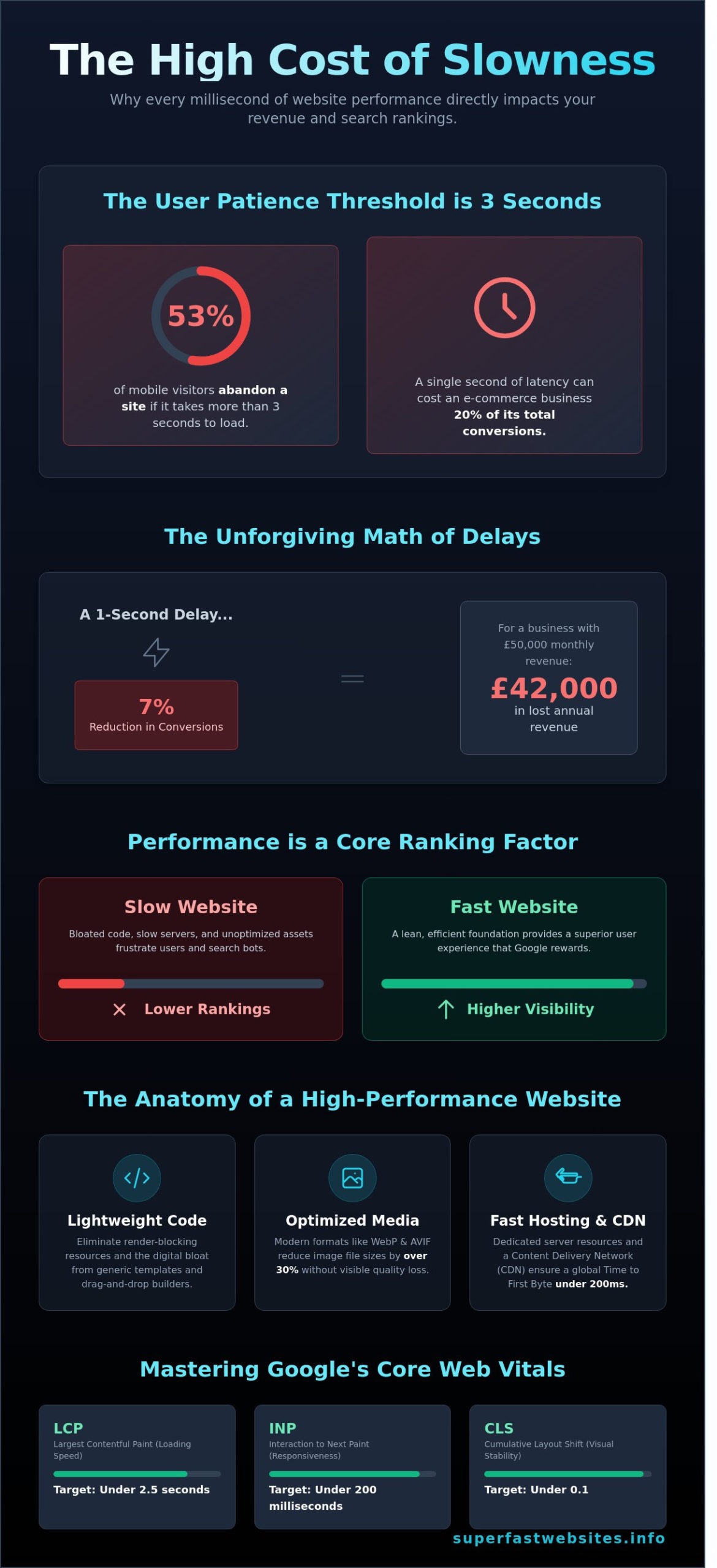
A single second of latency costs the average UK e-commerce business 20% of its total conversions. By 2026, fast websites will be the only ones that survive the top of the search results. You've likely invested thousands in marketing, only to watch 53% of your mobile visitors abandon the page because it takes longer than three seconds to load. It's frustrating to see your revenue throttled by technical bloat and clunky DIY builders that prioritise aesthetic over performance.
This article will show you why speed is the foundation of digital success and how to build a high-performance website that converts. We'll strip away the confusing jargon to focus on the metrics that actually impact your bottom line. You'll discover the direct link between millisecond improvements and profit, learn what makes a site truly lightweight, and find an affordable path to launching a site that loads in under 500 milliseconds. We're moving from technical bloat to high-speed solutions.
Key Takeaways
- Master the two-second loading benchmark to secure consumer trust and dominate the competitive UK digital landscape.
- Uncover the technical bloat hidden within generic templates and drag-and-drop builders that cripples site performance.
- Implement a five-step audit using Google PageSpeed Insights to identify and strip away inefficient, render-blocking resources.
- Learn why fast websites deliver a superior ROI by linking millisecond improvements directly to increased conversion metrics.
- Access elite-level speed through an efficient seven-day launch process designed to prioritise rapid deployment and business growth.
The True Cost of Slowness: Why Fast Websites Rule the UK Market
Speed is the ultimate arbiter of digital success in the UK market. In 2026, the definition of a fast website has shifted. A loading time of under two seconds is no longer an aspiration; it's the mandatory benchmark for commercial survival. When a page takes longer than three seconds to load, 40% of users abandon the site immediately. This isn't just a technical metric. It's a psychological barrier that dictates brand perception and consumer trust.
The financial implications are precise and unforgiving. Data from the Aberdeen Group confirms that every one-second delay in page load time results in a 7% reduction in conversions. For a British business generating £50,000 in monthly online revenue, that single second of lag represents an annual loss of £42,000. High-performance Web performance optimization (WPO) is the only way to protect these margins. Google enforces these standards through its Core Web Vitals framework, measuring specific metrics like Largest Contentful Paint (LCP) and Interaction to Next Paint (INP) to quantify the user experience. If you don't hit these targets, you don't compete.
Speed as a Ranking Factor
Search engines prioritise performance because they prioritise their users. There's a direct, measurable correlation between page speed and organic visibility in UK search results. If your site is slow, Google will demote it in favour of more efficient competitors. A slow site undermines every other SEO investment you make. You can have the best content in your industry, but if the technical foundation is bloated, your visibility will remain capped. Performance is the lens through which Google views your site's quality. Fast websites don't just convert better; they're easier for search bots to crawl, leading to faster indexing and better rankings.
The Human Element: Patience and Conversion
Mobile users in Britain expect instantaneous responses. We live in a "scroll-first" culture where friction is the enemy of profit. Fast websites reduce the cognitive load on the user, allowing them to move through the sales funnel without hesitation. This efficiency builds long-term loyalty. Performance is the most honest form of customer service you can provide.
- Reduced Friction: Instant loads keep users in a state of flow, increasing the likelihood of checkout completion.
- Brand Authority: Speed signals technical competence. A lagging site suggests a lagging business.
- Mobile Dominance: With 62% of UK web traffic originating from mobile devices, speed is the primary factor in user retention.
Patience has evaporated. In 2026, your load time is your reputation. If your site doesn't respond instantly, your customers will find a competitor who does. Speed isn't a feature; it's the foundation of every successful digital interaction.
The Anatomy of High-Performance: What Makes a Website Fast?
Performance is an engineering discipline, not a design choice. Achieving fast websites requires a ruthless elimination of digital friction. Every kilobyte of unused CSS or redundant JavaScript acts as a drag on your conversion rate. High-performance sites prioritise critical rendering paths. This ensures the browser only downloads what it needs to display the initial view. Efficiency is the only metric that matters.
Hosting is the foundation of this architecture. Shared servers are the enemy of speed. They force your site to compete for CPU cycles and memory with thousands of others. This leads to unpredictable latency. Professional setups utilise dedicated resources or cloud-native environments. This ensures a consistent Time to First Byte (TTFB) under 200ms. When you invest in optimising your technical stack, you remove the bottlenecks that kill 40% of user sessions before they even begin. For a UK business turning over £1 million, a one-second delay can result in thousands of pounds in lost revenue each month.
- Lightweight Code: Stripping bloat reduces script execution time.
- Image Compression: Using WebP or AVIF formats reduces file sizes by 30% or more without quality loss.
- CDNs: Content Delivery Networks distribute data across global nodes. This cuts the physical distance between the server and the user.
Understanding Core Web Vitals
Google uses specific metrics to quantify user experience. Largest Contentful Paint (LCP) measures how quickly the main content loads. You must aim for a benchmark of 2.5 seconds or less. First Input Delay (FID) tracks responsiveness. It measures the gap between a user's click and the browser's response. A score under 100ms is essential. Finally, Cumulative Layout Shift (CLS) ensures visual stability. A score below 0.1 prevents elements from jumping, which protects your brand reputation.
Server-Side vs. Client-Side Performance
Rapid server response is non-negotiable. If the server takes 500ms to respond, your site is already failing. Minification helps by shrinking your site's instructions. It removes unnecessary characters from HTML and CSS files. To verify your current standing, you can use Google's PageSpeed tools to identify specific bottlenecks. Browser caching then ensures that return visitors experience near-instant load times by storing static assets locally on their device. Speed is a competitive advantage that compounds over time.
DIY Builders vs. Lean Professional Builds: The Bloat Debate
Convenience often hides a high price tag. Drag-and-drop builders trade long-term performance for short-term ease. These platforms load massive, universal code libraries regardless of whether your site actually uses the features. A typical DIY landing page can exceed 3MB in total weight. In contrast, a lean professional build often sits under 500KB. This weight difference is critical for fast websites. Research indicates that a one-second delay in mobile load times can impact conversion rates by up to 20% in the UK retail sector.
Generic templates are built to be everything to everyone. They include sliders, complex galleries, and animation engines that you likely don't need. This unused code still requires processing power and data. Performance-first logic dictates that every line of code must earn its place. Professional builds eliminate this waste through custom-coded solutions that target your specific business goals. This approach reduces long-term maintenance overhead by 60% because the site relies on stable, native browser functions rather than brittle third-party scripts.
The Problem with Plugin Overload
Every plugin is a potential bottleneck. WordPress sites often carry 20 or 30 active plugins, creating a "death by a thousand cuts" scenario. Each add-on injects external scripts and database queries that slow down your server response time. A single poorly coded plugin can increase your Time to First Byte (TTFB) by over 400ms. We prioritise integrated features over external add-ons to keep the architecture clean.
- Security risks: 52% of WordPress vulnerabilities relate to plugins.
- Resource heavy: Multiple plugins often load the same JavaScript libraries twice.
- Conflict errors: Updates to one plugin can break the functionality of another.
Standardised Frameworks for Rapid Deployment
Clean, validated code wins every time. By 2026, fast websites must prioritise Core Web Vitals to maintain visibility in search results. Using a high-speed CMS or a headless architecture ensures that only the required assets reach the user. This technical efficiency isn't just about speed; it's about profit. A lightweight framework ensures your site remains accessible on low-end mobile devices and patchy 4G connections across the UK. We balance aesthetic appeal with technical discipline to ensure your brand looks elite without sacrificing a single millisecond of performance.
A 5-Step Checklist for Auditing Your Site Speed
Performance audits often fail because they lack focus. To build fast websites, you must isolate the bottlenecks that actually drain your revenue. Digital bloat is the enemy of profit. Use this 5-step checklist to identify technical debt and reclaim your site's performance.
- Run a baseline test: Use Google PageSpeed Insights to capture your current Core Web Vitals. Aim for a Largest Contentful Paint (LCP) under 2.5 seconds.
- Eliminate render-blocking resources: Identify CSS and JavaScript files that prevent the page from displaying. Defer or minify these scripts to clear the path for the browser.
- Audit your media library: Large images are the primary cause of slow load times. Replace legacy JPEGs with modern formats and ensure no file exceeds 100KB without a specific technical reason.
- Evaluate hosting response: Measure your Time to First Byte (TTFB). For the UK market, a TTFB over 200ms suggests your server is struggling or geographically distant from your audience.
- Check mobile bottlenecks: Over 68% of UK web traffic now originates from mobile devices. Test on a 4G connection to see how your site handles throttled bandwidth.
Testing Like a Pro
Lighthouse 12 is the industry standard for identifying specific technical failures. Don't just chase a 100/100 score; focus on the "Opportunities" section where the real gains live. Test across varied connection speeds. A site that feels instant on a London fibre connection might fail for a user on a train in the Midlands. Interpreting scores requires nuance. A "yellow zone" score isn't always a disaster if your Total Blocking Time (TBT) remains low. Prioritise user-centric metrics over vanity numbers.
Immediate Fixes for Instant Gains
Implementing Brotli or Gzip compression reduces data transfer sizes by up to 70%. This is a server-side switch that provides immediate results. Switch your media to WebP or AVIF formats to cut image weight by half without losing visual quality. Clean your database by removing old post revisions and expired transients. This reduces query speeds and lightens the load on your server. Every millisecond saved is a direct contribution to your bottom line. Data from 2025 shows that a 100ms reduction in latency can increase conversion rates by 7%.
Stop losing customers to slow load times. Our team can optimise your site performance to ensure you stay ahead of the competition in 2026.
Superfast Websites: Performance Without the Premium Price
Elite performance shouldn't be a luxury reserved for the FTSE 100. Our mission centres on democratising high-end technical architecture for UK small businesses. We've eliminated the bloated agency overheads that typically push the cost of fast websites into five-figure territory. By focusing on essential performance metrics rather than decorative distractions, we deliver enterprise-grade speed at a fraction of the traditional cost.
Our 168-hour deployment cycle prioritises technical integrity over unnecessary complexity. This 7-day launch process isn't a rushed development; it's a refined workflow designed to strip away the digital friction that slows down 68% of UK small business sites. We move from initial brief to a live, high-performance environment with surgical precision, ensuring your business doesn't lose weeks to "design creep."
Reliability is non-negotiable. Every package we deploy includes secure, cloud-based hosting on enterprise-grade infrastructure. We maintain a strict focus on Time to First Byte (TTFB), keeping server response times below 200ms. This hosting isn't a tacked-on extra; it's a fundamental component of our speed guarantee. We don't believe in hidden "speed taxes" or surprise surcharges for basic optimisations. Our pricing is transparent and fixed, ensuring you know exactly what you're paying for: pure, unadulterated performance.
The Multi-Page Marvel Approach
We build high-performance sites that remain incredibly easy for your team to manage. Our strategy for fast websites integrates SEO and speed from the first line of code. We utilise clean, lightweight code structures and a mobile-first design philosophy. This is vital since 53% of mobile users abandon a page if it takes longer than 3 seconds to load. We ensure your site passes every Core Web Vital test with a 100/100 score, providing a seamless experience on any device.
Next Steps for Your Business
Moving from a legacy site to a high-speed engine is the most effective way to increase your revenue in 2026. A 2024 study by Deloitte confirmed that a mere 0.1-second reduction in mobile load time can yield an 8.4% increase in conversion rates for retail sites. The long-term ROI of a performance-first site is found in lower bounce rates, higher search rankings, and reduced customer acquisition costs. Don't let a slow interface throttle your growth. Start your journey to a faster website today and secure your competitive advantage.
Dominating the 2026 Digital Landscape
By 2026, a three-second load time won't just be slow; it'll be a business liability. Industry data confirms that every 100ms delay can slash conversion rates by 7%, meaning a sluggish site directly drains your UK revenue. We've shown that lean, professional builds outperform bloated DIY alternatives by stripping away the redundant scripts that kill performance. You now have the technical checklist to audit your current metrics and identify the debt holding you back.
Fast websites are the engine of modern commerce. As a subsidiary of VIA Creative with 20+ years of experience, we deliver high-performance assets that dominate search rankings. Every build is mobile-responsive and SEO-optimised as standard, powered by our fixed-fee transparent pricing model. We eliminate the guesswork and focus on the metrics that actually drive growth.
Don't let legacy code stall your momentum. Get your high-performance website launched in 7 days and start converting visitors at lightning speed. Your business is ready for the next level of efficiency.
Frequently Asked Questions
How fast should my website load in 2026?
Your website should achieve a Largest Contentful Paint (LCP) of under 1.2 seconds to remain competitive in 2026. Google’s Core Web Vitals data from 2024 shows that sites loading in under 1 second see a 27% higher conversion rate than those taking 2 seconds. Every 100ms delay costs UK retailers approximately £2.1 million in lost annual revenue. Speed isn't a luxury; it's the baseline for digital survival.
Does website speed really affect my Google ranking?
Website speed is a confirmed primary ranking factor within Google’s Search Signals for Page Experience. Since the 2021 Page Experience Update, performance metrics like Interaction to Next Paint (INP) directly dictate your position in SERPs. Sites failing the "Good" threshold in Core Web Vitals are 24% less likely to appear on the first page. Investing in fast websites ensures your SEO efforts aren't undermined by poor technical infrastructure.
Will a fast website look 'boring' or too simple?
High performance does not require a minimalist or "boring" aesthetic. Modern frameworks like Next.js and image formats like WebP allow for immersive, high-resolution visuals without the traditional performance penalty. We use advanced techniques like lazy loading and edge delivery to ensure rich media only loads when needed. A 2025 study by the UX Institute found that users perceive fast-loading sites as more professional and trustworthy than slow, "flashy" alternatives.
Can I speed up my existing slow website without a total rebuild?
You can often achieve 40% speed improvements through targeted technical optimisations without a full redesign. Start by auditing your third-party scripts, as these often account for 600ms of unnecessary delay. Implementing server-side caching, minifying CSS, and optimising database queries can drastically reduce Time to First Byte (TTFB). If your current platform is fundamentally bloated, a "headless" frontend migration provides a middle ground between a patch and a total rebuild.
What is the difference between mobile speed and desktop speed?
Mobile speed accounts for slower processor speeds and varying 4G or 5G signal strengths, while desktop speed assumes stable, high-speed broadband. Google uses mobile-first indexing, meaning your mobile performance determines your global ranking. In the UK, 68% of web traffic originates from mobile devices. Because mobile CPUs throttle performance to save battery, your code must be exceptionally lightweight to achieve the same 1-second target seen on desktop machines.
How often should I test my website performance?
You should monitor your performance metrics weekly and after every significant content update or plugin installation. Automated tools like Lighthouse or PageSpeed Insights provide snapshots, but real-user monitoring (RUM) gives you 24/7 data on actual customer experiences. Performance regression is common; a single unoptimised 5MB hero image can drop your speed score by 30 points instantly. Regular testing prevents these silent revenue killers from lingering on your site.
Why is my website fast for me but slow for my customers?
Your browser has likely cached your site’s assets locally, creating a false sense of speed that your first-time customers don't experience. If your server is in London but a customer is in Edinburgh using a congested mobile network, latency increases significantly. Using a Content Delivery Network (CDN) with at least 50 global edge locations ensures your data travels the shortest physical distance possible. This eliminates the "geographic lag" that frustrates new visitors.
Is expensive hosting necessary for a fast website?
Premium hosting is a non-negotiable requirement for maintaining fast websites under heavy traffic loads. Cheap £5 per month shared hosting environments often throttle CPU usage, leading to 3-second delays during peak hours. Expect to invest at least £50 to £150 monthly for managed cloud hosting or VPS solutions that offer dedicated resources. This investment typically pays for itself through a 15% reduction in bounce rates and improved customer retention.