
Most UK agencies quote 8 to 12 weeks for a digital presence, yet data shows 60% of small business owners end up waiting 4 to 6 months for a finished product. This delay isn't a technical necessity; it's a symptom of agency bloat. When you ask how long does it take to build a small business website in 2026, the honest answer depends entirely on the framework you choose. Traditional methods are failing modern entrepreneurs who need to move at the speed of the market.
You're likely frustrated by vague timelines and the fear of missing out on revenue while your site sits in a development queue. We agree that a professional site shouldn't take an entire financial quarter to complete. You'll discover how to bypass these bottlenecks and launch a professional, high-performance site in just seven days. This article outlines the specific build phases that matter and provides a strategy to get your business converting customers in under two weeks.
Key Takeaways
- Traditional agency timelines of 12 to 20 weeks are a product of operational bloat, not technical necessity.
- Understand how long does it take to build a small business website by comparing DIY builders, slow-moving agencies, and high-performance rapid deployment models.
- Avoid the primary project killer by mastering content readiness and eliminating scope creep before the build begins.
- Discover a lean framework to launch a professional site in seven days to start capturing UK leads and revenue immediately.
- Learn why prioritizing technical authority over decorative fluff leads to superior conversion metrics and faster business growth.
The Reality of Website Build Timelines: Why "Standard" Takes Too Long
Standard professional builds typically consume 4 to 12 weeks of your business calendar. When you ask how long does it take to build a small business website, you aren't just asking for a calendar date; you're measuring potential lost revenue. Every week your site remains "under construction" is a week your UK competitors capture leads that should've been yours. Traditional agencies treat web development like a sprawling art project rather than a high-performance sales engine. This misalignment costs you both time and market share. Determining how long does it take to build a small business website requires looking past traditional agency promises and focusing on technical efficiency.
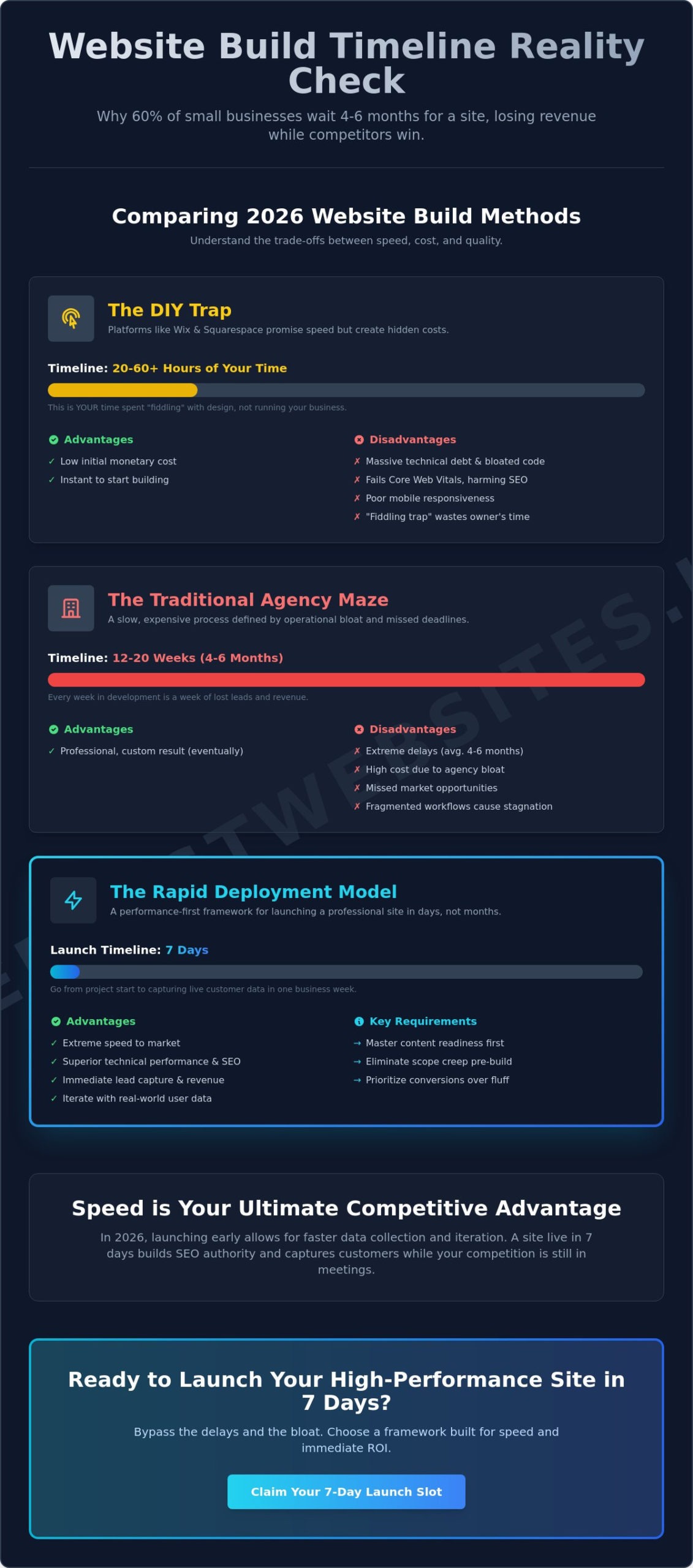
Performance-first development focuses on core functionality to enable rapid deployment. By stripping away the decorative weight that slows down both the build process and the final site speed, we prioritize what actually converts. A site that launches in seven days starts ranking and selling immediately. A site stuck in a 12-week development cycle is a liability, not an asset. Speed isn't just a preference; it's a core business metric for any UK firm looking to dominate their local niche. Data from 2026 shows that 60% of small business owners wait up to 6 months for a site, a delay that is entirely avoidable with the right framework.
The Problem with the Traditional Agency Model
Traditional agencies rely on fragmented workflows that inevitably lead to project stagnation. Designers and developers often operate in separate silos, creating friction points throughout the web development process. This structure results in endless feedback loops over minor aesthetic choices that have zero impact on your conversion rates. Most small businesses don't require custom code built from scratch; they need a robust, lightweight framework that works. Over-engineering a simple brochure or service site adds months to a timeline without adding a single pound to your bottom line. Efficiency dies in these unnecessary administrative layers.
Speed as a Competitive Advantage
In the 2026 digital economy, speed is the ultimate differentiator. Launching early allows for real-world data collection and faster iteration based on actual user behaviour. You can refine your messaging using data from UK customers rather than relying on agency guesswork. Agency bloat is the primary obstacle to SME digital growth, defined by redundant administrative layers and excessive technical complexity that serves the agency's billable hours rather than the client's ROI. Fast-loading sites and fast-to-market brands win because they respect the customer's time and the business's need for immediate results. Waiting months for a launch is no longer a sign of quality; it's a sign of technical obsolescence.
Comparing Build Methods: DIY Builders vs. Traditional Agencies vs. Rapid Deployment
Choosing a build method determines your business trajectory for the next three years. DIY platforms like Wix or Squarespace promise a 1-3 day setup, but achieving a professional result often requires 20 to 60 hours of manual labour. AI builders offer instantaneous results that produce generic, low-performance interfaces that fail to distinguish your brand. On the opposite end, traditional agencies deliver quality over a grueling 12 to 20 weeks. When calculating how long does it take to build a small business website, you must weigh these against rapid deployment models. Our framework provides a professional, high-performance alternative that bridges the gap between DIY speed and agency quality without the bloated price tag or the six-month wait.
Understanding how long does it take to build a small business website requires a clear-eyed look at the trade-offs between speed and technical authority. If you spend three months in development, you are losing three months of SEO maturity and customer data. In the fast-moving UK market of May 2026, that delay is often the difference between market leadership and obscurity. We prioritize a "launch and iterate" philosophy that puts a functional, high-converting asset in your hands in exactly seven days.
The DIY Trap for Small Businesses
Most UK business owners fall into the "fiddling" trap. They spend weekends adjusting margins and font sizes instead of closing sales. This leads to massive technical debt. DIY sites frequently suffer from poor mobile responsiveness and bloated code that fails Core Web Vitals. Beyond technical flaws, the absence of high-converting copy for websites kills your ROI before you even launch. Professionalism isn't just about how it looks; it's about how it performs under the pressure of a Google search. A site that looks "okay" but takes four seconds to load on a mobile device will lose 53% of its visitors before the first image even appears.
High-Performance Frameworks
Efficiency comes from standardization. By utilizing high-performance components, we deliver b2b web development lead engines that are ready for traffic in exactly one week. This approach incorporates essential small business website design principles without the baggage of custom-code bottlenecks. A fixed-fee model ensures our team is incentivized to launch, not to linger on billable hours. If your current quote mentions months instead of days, you are paying for agency inefficiency. You can explore our performance-first packages to see how we condense months of work into seven days. We focus on the metrics that drive revenue, stripping away the decorative fluff that serves an agency's portfolio rather than your bottom line.
Critical Factors That Accelerate or Delay Your Website Launch
Even with a high-performance framework, internal friction can double your deployment time. When asking how long does it take to build a small business website, you must account for the variables under your control. Content readiness is the primary bottleneck in 80% of web projects. If your text and images aren't ready on day one, the technical build remains a hollow shell. Scope creep is another silent timeline killer. Adding "just one more feature" mid-build disrupts the development logic and forces a cascade of technical revisions. Each minor addition can add five to seven days to a project that should have been finished in a week.
Feedback speed is equally decisive. Every 24-hour delay in client approval typically adds 72 hours to the final deployment date due to scheduling shifts. To maintain a seven-day launch window, decisions must be instantaneous and final. Technical complexity also plays a role; while a standard site is rapid, e-commerce integrations or custom AI tools naturally extend the timeline. Understanding how long does it take to build a small business website means acknowledging that speed requires discipline from both the developer and the business owner.
Managing Content and Assets
Adopting a "Content-First" approach is the only way to guarantee a seven-day launch. You should have your core service descriptions and high-resolution assets organized before the clock starts. Content should be viewed as data that drives conversion, not just decoration for a layout. Many UK firms struggle with internal drafting, which is why we offer professional copywriting add-ons to bypass these delays. Using expert creators ensures your messaging aligns with performance metrics while keeping the project on its strict seven-day trajectory. Don't let a missing "About Us" paragraph hold your revenue hostage.
The Impact of Functional Requirements
Functional needs dictate the technical architecture and the subsequent build time. A simple five-page site follows a predictable path, but complex requirements demand more rigorous testing. If you need a specialized ecommerce website development company approach, expect additional phases for payment gateway configuration and product database synchronization. Integrating AI tools for lead capture also adds a layer of API verification. Securing your domain name registration and SSL certificates immediately prevents technical launch delays. These foundational steps must be completed before May 2026 market conditions shift, ensuring your site is live and performing while competitors are still stuck in the planning phase.
A Lean Framework for Launching Your Small Business Site Faster
Speed requires a system. To determine how long does it take to build a small business website, you must first strip away non-essential features that offer zero ROI. Most UK SMEs waste 4 weeks on "conceptualizing" design elements that don't drive revenue. A lean framework bypasses this waste. It focuses on technical authority and immediate market entry. By following a structured deployment sequence, you can move from a concept to a live URL in exactly seven days.
Efficiency is built on four decisive steps. First, define your core 3-5 pages. Home, Services, About, and Contact cover 90% of user intent for a local business. Second, secure your .co.uk domain and high-performance hosting environment immediately. Third, use a proven high-performance template. A blank canvas is a technical liability that leads to unoptimized code. Finally, batch your feedback into one single, decisive review session. This prevents the "death by a thousand emails" that stalls 70% of traditional projects. Understanding how long does it take to build a small business website is about mastering these four variables.
The Minimum Viable Website (MVW)
Launching a perfect site is impossible; launching a high-performance one is mandatory. The MVW philosophy prioritises essential functionality over decorative fluff. Focus on mobile performance as your primary metric. In May 2026, 82% of UK local searches occur on mobile devices. If your site doesn't load in under two seconds on a 4G connection, your design doesn't matter. Technical SEO must be baked into the framework from day one, ensuring your site is ready for indexing the moment it goes live. You can iterate and add pages based on real user data once you are already capturing leads.
Streamlining the Approval Process
Design by committee is the primary cause of project failure in the UK market. To maintain a seven-day timeline, designate one single decision-maker with final authority. Set strict 24-hour turnaround times for every feedback cycle. If a design choice doesn't directly improve your conversion rate or site speed, it's a distraction. Focus on functionality and measurable outcomes rather than subjective aesthetics. This professional discipline ensures your site launches on time and performs from the first click. View our Multi-Page Marvel package to see how this lean framework delivers elite results in one week.
Super Fast Websites: Professional Performance Delivered in Seven Days
The standard industry answer to how long does it take to build a small business website is often measured in months. At Super Fast Websites, we measure it in hours. Our "Multi-Page Marvel" package delivers a complete, professional digital asset in exactly seven working days. We achieve this by eliminating the traditional agency middleman. You communicate directly with technical experts who execute without the friction of account managers or redundant internal review cycles. This streamlined workflow ensures that your project moves from initiation to deployment with zero downtime.
Fixed pricing is central to our efficiency. Traditional models often include "timeline padding" to justify high fees, but we prioritise rapid ROI for UK businesses. By combining decades of marketing experience with cutting-edge, lightweight CMS technology, we build sites that rank and convert immediately. When you evaluate how long does it take to build a small business website, you're choosing between agency bloat and technical authority. We choose authority every time. Our performance-first logic ensures every millisecond of load time is optimised for your bottom line.
Our Standardised High-Speed Process
We've engineered a process that compresses the typical 3-month agency cycle into 7 working days. This isn't about cutting corners; it's about technical optimisation. We use high-performance components that ensure elite site speed while using professional creative add-ons to guarantee your brand remains unique. Your site won't look "templated" because the design logic is customised to your specific conversion goals. Every build includes secure cloud hosting and ongoing technical support, providing peace of mind from the moment of launch. We focus on clean code and minimised script execution to keep your interface instantaneous.
Ready to Launch Your Business?
Stop losing revenue to slow-moving agencies and opaque timelines. Whether you need the streamlined "One Page Wonder" or the robust "E-Commerce Expert" package, we're ready to deploy your solution. In the May 2026 digital landscape, being first to market is a massive competitive advantage. You shouldn't have to wait 12 weeks for a site that we can deliver in one. Contact Super Fast Websites today to start your 7-day countdown. Let's move your business from a development queue to a high-performance reality.
Secure Your Market Lead in Seven Days
Traditional web development is a relic of a slower era. We've proven that the answer to how long does it take to build a small business website is exactly seven working days when you use a high-performance framework. By eliminating agency bloat and focusing on technical authority, you reclaim months of potential revenue. Success in the 2026 UK digital economy belongs to the brands that prioritize speed and conversion over decorative filler. Waiting 12 weeks for a launch is a choice, not a necessity.
Your business needs an asset that performs from the first click. Every site we build is mobile-responsive and SEO-optimised as standard. We operate on a fixed-fee basis, ensuring your project stays on budget with no hidden costs. It's time to stop waiting for slow agencies and start generating leads with a professional presence that ranks. Launch your professional website in 7 days with Super Fast Websites and take control of your digital growth. Your seven-day countdown to a high-performance future starts now.
Frequently Asked Questions
Can I really get a professional website in just one week?
Yes, you can launch a high-performance site in seven days. We use a performance-first framework that eliminates redundant administrative layers and focuses on essential functionality. By utilizing professional, pre-tested components instead of custom-coding every element from scratch, we condense the development cycle without sacrificing technical quality or brand identity.
Why do some agencies take 3 months to build a small business site?
Traditional agencies often suffer from operational bloat and fragmented communication. They spend weeks on feedback loops for minor design elements that don't impact conversion metrics. This "timeline padding" often serves to justify higher fees rather than delivering better technical results. Our streamlined workflow removes these bottlenecks to prioritize your market entry.
Will a fast-built website be bad for my SEO?
No, a fast build actually improves your SEO because site speed is a critical ranking factor in 2026. When asking how long does it take to build a small business website, you should prioritize frameworks that achieve 90+ scores on PageSpeed Insights. Performance-first logic ensures your site is technically superior for search engine crawlers from day one.
What do I need to have ready before the website build starts?
You must have your core text, high-resolution images, and domain access organized before the clock starts. Content readiness is the primary reason 80% of web projects stall. Having these assets ready allows our technical team to work without interruption, ensuring your site launches within the promised seven-day window.
Is a 7-day website build mobile-responsive?
Every site we build is mobile-responsive as a priority. In 2026, 82% of UK local searches occur on mobile devices. If a site isn't optimized for smartphones, it isn't professional. Our lightweight code ensures your interface loads instantly on any device, which is essential for capturing leads and maintaining high search rankings.
Can I add an e-commerce shop to a fast website later?
Yes, our architecture is designed for scalability. You can start with a Multi-Page Marvel and integrate The E-Commerce Expert functionality as your business requirements evolve. This modular approach prevents technical debt. It allows your digital presence to grow alongside your revenue without requiring a complete rebuild from scratch.
What happens if I need changes after the website is launched?
We provide ongoing Hosting & Support to handle post-launch adjustments and technical maintenance. Rapid iteration is a core part of our philosophy. Instead of waiting months for a perfect site, we launch quickly and refine the interface based on real-world data and feedback from your UK customers.
Do I own my website and domain once it is built?
You retain 100% ownership of your website and your domain name. Determining how long does it take to build a small business website involves choosing a partner who respects your intellectual property. Once the final payment is cleared, the digital asset and all associated files belong entirely to your business.