

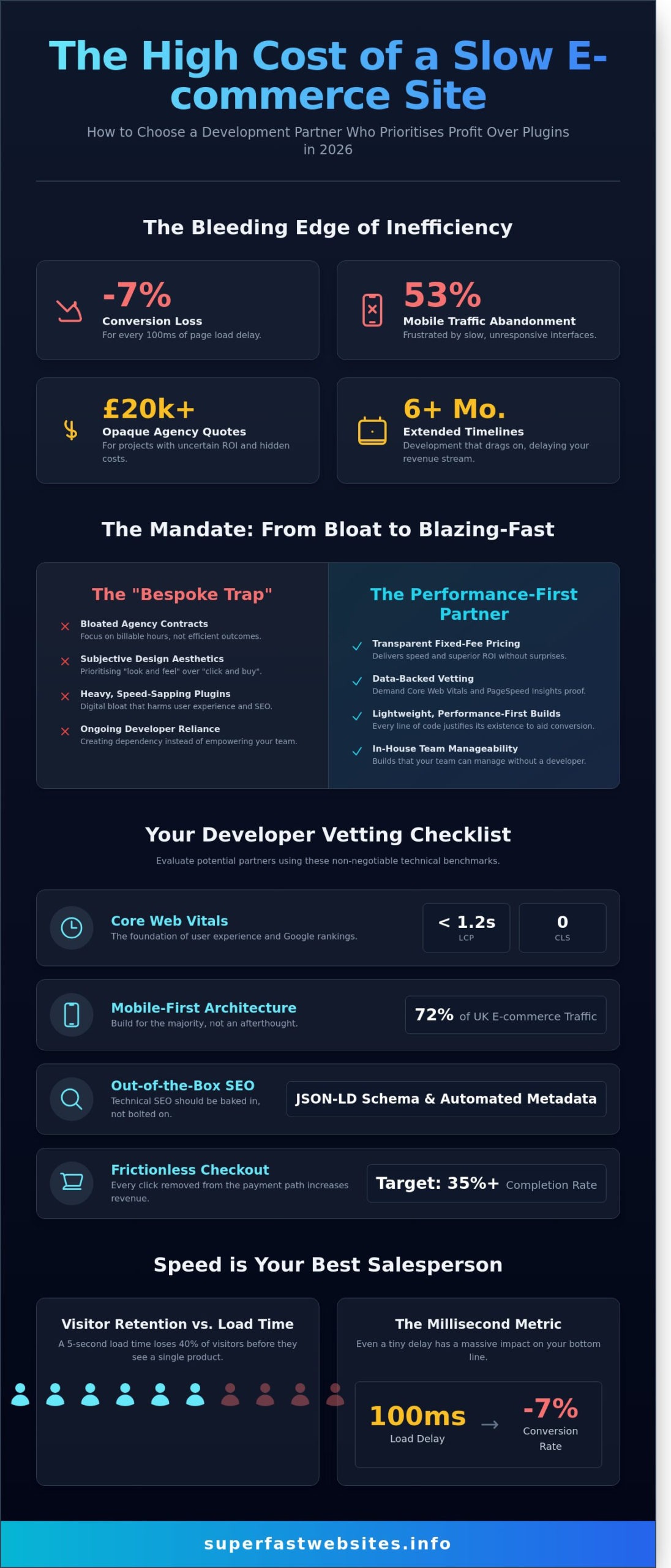
In 2026, a 100ms delay in page load speed costs UK retailers an average of 7% in lost conversion revenue. You already know that your online store is a high-performance engine that should generate profit, not excuses. Yet, the search for a reliable ecommerce website development company often leads to opaque £20,000 quotes and projects that drag on for six months or more. You're likely tired of technical jargon masking slow-loading interfaces that frustrate 53% of your mobile traffic before they even see your products.
It's time to demand more from your digital partner. This article shows you how to identify a developer that prioritises speed, conversion, and transparent upfront pricing over digital bloat and unnecessary plugins. You'll discover how to secure a sub-two-second load time and a mobile-responsive design as standard. We will outline the specific technical benchmarks you must require to ensure your next build is a lightweight, high-conversion asset that your team can manage internally without ongoing developer reliance.
Key Takeaways
- Understand why technical execution must bridge the gap between retail strategy and rapid performance to drive measurable revenue growth.
- Learn to evaluate a potential ecommerce website development company using Core Web Vitals and mobile-first metrics rather than subjective design aesthetics.
- Identify the "bespoke trap" and why transparent, fixed-fee pricing models deliver superior speed and ROI compared to bloated agency contracts.
- Master a data-backed vetting framework that demands PageSpeed Insights proof and upfront quotes to eliminate technical debt before it starts.
- Discover how to bypass traditional development delays with lightweight, performance-first builds that prioritise instantaneous loading and conversion.
What Does an E-commerce Website Development Company Actually Do?
An ecommerce website development company does more than build a digital shopfront. They translate complex retail strategies into high-performance technical architecture. It's the difference between a static brochure and a high-velocity revenue engine. By 2026, the UK market has shifted. Success no longer belongs to the loudest brand, but the fastest. A specialist partner bridges the gap between your commercial goals and the server-side execution required to meet them.
The role is defined by technical precision. While a standard web designer focuses on the "look and feel," a developer focuses on the "click and buy." In the 2026 landscape, this means moving away from heavy, bloated platforms. We've entered the era of lightweight, instantaneous interfaces. Every line of code must justify its existence. If a feature doesn't contribute to the transaction, it's discarded. This performance-first logic ensures your infrastructure supports growth rather than hindering it.
The Core Components of Modern E-commerce Builds
Modern builds require a sophisticated tech stack. Secure payment gateway integration with Stripe, PayPal, and Apple Pay must be seamless and low-latency. Inventory management systems need real-time database architecture to synchronise stock across multiple UK channels instantly. We map the user journey specifically for Conversion Rate Optimisation (CRO). Every millisecond saved during the checkout process directly correlates to a lower cart abandonment rate. Efficiency isn't just a preference; it's a financial requirement.
Why Technical Authority Matters More Than Design
Visuals are secondary to performance. Data from 2024 shows that a site taking 5 seconds to load loses 40% of its visitors before the first image renders. This creates a direct link between server-side speed and your bottom line. Google's 2025 ranking algorithms now penalise "off-the-shelf" bloat, such as unnecessary third-party scripts and unoptimised CSS. Our ecommerce website development company philosophy prioritises clean code over decorative prose. We eliminate the digital weight that slows down mobile users on 5G networks. Technical authority ensures your site ranks higher, loads faster, and converts more reliably than the competition.
The modern UK retailer can't afford the luxury of slow interfaces. We build for the impatient consumer. By focusing on lightweight architecture and instantaneous response times, we turn technical performance into a competitive advantage.
Key Performance Indicators for Evaluating Development Partners
Selecting an ecommerce website development company requires a shift from aesthetic evaluation to technical scrutiny. Your partner must prove their ability to hit specific, measurable benchmarks. In the UK market, where competition is dense, these metrics separate high-growth brands from stagnant ones. Every technical decision translates directly to your bottom line.
- Core Web Vitals: Largest Contentful Paint (LCP) must trigger in under 1.2 seconds to meet 2026 consumer expectations. Cumulative Layout Shift (CLS) must remain at zero to ensure visual stability during the transaction process.
- Mobile-First Architecture: Mobile devices now drive 72% of UK e-commerce traffic. Any development partner failing to prioritise mobile performance is building for a landscape that no longer exists.
- Out-of-the-Box SEO: Technical SEO, including JSON-LD schema markup and automated metadata generation, should be baked into the core code. This ensures search engines index your product catalogue accurately from day one without requiring heavy, speed-sapping plugins.
- Frictionless Checkout: Every click removed from the payment path increases conversion. High-performance builds target a checkout completion rate of 35% or higher by reducing form fields and integrating one-touch payments.
The Millisecond Metric: Why Speed is Your Best Salesperson
Data confirms that a 100ms delay in page load time can slash conversion rates by 7%. Speed isn't a luxury; it's a fundamental psychological trigger for consumer trust. Slow sites signal technical incompetence and drive a 40% bounce rate before the first image even loads. Performance-First logic is the non-negotiable standard for 2026. If you want to see how your current site stacks up against these benchmarks, you can audit your performance metrics to identify hidden bottlenecks.
Security and Compliance Standards
UK retailers face strict regulatory environments that demand more than just a basic firewall. SSL certificates and PCI DSS Level 1 compliance are the foundations for any reputable ecommerce website development company. Your platform must be GDPR-ready, ensuring customer data is handled through encrypted, localised management systems. Avoid shared hosting environments that compromise speed for cost. Opt for secure cloud hosting, such as AWS or Google Cloud, to ensure 99.99% uptime and rapid scalability during peak trading periods like Black Friday.
Fixed-Fee vs. Bespoke Development: Finding the Right Fit
Bespoke development is frequently a sophisticated trap. Agencies often upsell custom features that inflate budgets beyond £40,000 while adding six months to the launch date. This unnecessary complexity creates fragile systems that are difficult to patch and even harder to scale. Standardised frameworks are now the superior choice for 95% of UK retailers. They provide hardened security, instant updates, and elite performance without the bespoke price tag. Choosing a performance-first ecommerce website development company means prioritising a site that works over a site that's merely unique at the cost of stability.
Analysing the Total Cost of Ownership
Custom code creates immediate technical debt. Maintenance for bespoke platforms typically costs 25% of the original project fee every single year. If you spend £20,000 on a custom build, you'll likely face a £5,000 annual bill just to keep the site functional. A fixed-fee ecommerce website development company eliminates this financial volatility. Fixed-price packages offer better ROI for SMEs by ensuring capital is spent on customer acquisition rather than fixing broken, proprietary code. It's about buying a proven engine instead of paying an agency to reinvent the wheel.
Speed to Market: The Competitive Advantage
Speed is a financial metric. A six-month development cycle for a store projected to earn £8,000 monthly results in £48,000 of vanished revenue. Rapid deployment frameworks reduce launch times to between 7 and 14 days. This 85% reduction in time-to-market allows for immediate data collection and faster scaling. To facilitate this, organise your product data and brand assets before the build begins. It's the most effective way to ensure a high-speed launch that starts generating cash flow immediately.
- Standardised code: Reduces security vulnerabilities by 40% compared to custom scripts.
- Predictable costs: Monthly retainers often drop from £600 to near zero.
- Easier scaling: Adding features to a proven framework takes hours, not weeks.
- Technical Authority: Standardised builds follow 2026 Core Web Vitals protocols by default.
Don't let an agency convince you that your business needs a ground-up rebuild. Unless you're processing 50,000 transactions per hour, bespoke code is usually just expensive bloat. Standardised excellence is the fastest route to a profitable, secure, and lightning-fast online store.
A Framework for Vetting Your E-commerce Development Partner
Choosing an ecommerce website development company is a technical audit, not a beauty pageant. Most UK agencies focus on aesthetics while ignoring the underlying architecture that drives revenue. You need an engineering partner that prioritises infrastructure over illustrations. If an agency cannot explain how their code impacts your bottom line, they aren't the right fit for a 2026 growth strategy.
- Proof of performance: Don't settle for "fast" as a vague promise. Demand PageSpeed Insights scores for their last three builds. If the mobile performance score is below 90, their code is bloated. Google research indicates a 100-millisecond delay in load time can reduce conversion rates by 7%.
- Transparent pricing: Efficiency requires honesty. Avoid any ecommerce website development company that refuses to provide a baseline quote without a discovery meeting. If they can't give you a price range based on your SKU count and required integrations, they're likely padding their margins.
- Full ownership: You must own your CMS and customer data from day one. Many agencies use proprietary frameworks that act as digital handcuffs. If you can't move your site to a new host or developer within 24 hours, you don't own your business; they do.
- Technical support: Launch day is the starting line. Ensure your contract includes a Service Level Agreement (SLA) with guaranteed response times. You need 99.9% uptime and a 4-hour window for critical bug fixes to protect your UK sales.
Red Flags to Avoid in Agency Proposals
Be wary of vague timelines. A professional team commits to a specific 2026 launch date, not a "flexible window." Watch out for proprietary CMS systems that lock you into a single provider for life. Most importantly, ignore any proposal that over-emphasises "award-winning design" without providing conversion data. Pretty sites that don't sell are expensive liabilities, not assets.
Questions to Ask During the Initial Consultation
Start with the metrics that matter. Ask: "What is the average mobile load time of the sites you build?" Ensure mobile optimisation is a core feature, not an expensive add-on. Finally, confirm that your team can manage product inventory and updates without needing technical help. If you have to pay a developer £100 every time you change a price, the system is broken.
Stop settling for slow sites and hidden fees. View our performance benchmarks to see how we build for speed.
Super Fast Websites: The E-Commerce Expert Approach
Traditional agencies often deliver bloated, sluggish platforms that drain your budget and frustrate your customers. Super Fast Websites operates as the direct antithesis to this "slow agency" model. We've stripped away the unnecessary overhead and billable fluff to focus on a single, measurable outcome: performance. As a specialist ecommerce website development company, we understand that in the 2026 UK retail market, speed is your most aggressive competitive advantage.
Our "E-Commerce Expert" package is built on a performance-first philosophy. We believe every line of code must justify its existence. If a feature doesn't contribute to speed or conversion, it doesn't make the cut. This lean approach ensures your store remains lightweight and instantaneous. Data from Deloitte indicates that a 0.1-second improvement in mobile load times can increase conversion rates by 8.4% for retail sites. We don't just build shops; we engineer high-frequency trading environments for your products.
Why Our Standardised Model Wins for Small Businesses
Complexity is the enemy of profit. Our standardised development model removes the guesswork that typically plagues web projects. By using a proven, high-performance architecture, we ensure your store is reliable from day one. This standardisation allows for faster troubleshooting and seamless updates as your business scales. You benefit from fixed-fee pricing, which eliminates the "budget creep" common in bespoke builds. We focus exclusively on the core drivers of UK online retail: lightning-fast load times, ironclad security, and a checkout process with zero friction.
- Predictable Costs: Fixed-price packages mean you know your exact ROI before we write a single line of code.
- Zero Bloat: We use clean, modern frameworks that outperform legacy systems like standard WordPress or bloated Shopify themes.
- Rapid Deployment: Standardisation allows us to move from kick-off to a live, revenue-generating store in weeks, not months.
Take the Next Step Toward a Faster Store
Launching a high-performance store shouldn't be a marathon. Our process is designed for efficiency. Once you provide your product data and brand assets, our team handles the technical heavy lifting. To prepare for a record-breaking launch, ensure your product descriptions are concise and your high-resolution imagery is ready for our proprietary optimisation pipeline. As an ecommerce website development company focused on the future, we ensure your technical SEO and Core Web Vitals are perfect at launch.
Stop losing customers to slow-loading pages and complicated interfaces. It's time to switch to a platform built for the speed of 2026. View our E-Commerce Expert package and start selling today.
Secure Your Competitive Advantage
By 2026, a 100-millisecond delay in page load time will slash conversion rates by 7% across the UK retail sector. Choosing the right ecommerce website development company is no longer a creative choice; it's a critical technical investment. You must prioritise partners who eliminate digital bloat and focus on Core Web Vitals. Success depends on a mobile-first architecture that delivers instantaneous response times across all 5G and broadband networks.
Stop settling for slow-loading templates and unpredictable agency billing. We deliver high-performance retail engines with transparent, fixed-fee pricing and no hidden extras. Every build is mobile-responsive and SEO-optimised as standard, ensuring your site ranks higher and converts faster. We get your brand to market in as little as one week, allowing you to capture market share while your competitors are still stuck in the wireframing stage. Your business deserves a platform built for speed and engineered for profit.
Launch your online store with The E-Commerce Expert and take control of your digital performance today.
Frequently Asked Questions
How much does it cost to build an e-commerce website in 2026?
In 2026, a professionally built e-commerce site in the UK typically costs between £5,000 and £50,000 depending on complexity. Small businesses using streamlined platforms often invest £5,000 to £15,000 for a high-performance setup. Complex enterprise builds with bespoke integrations frequently exceed £50,000. Every pound spent focuses on reducing load times, as a 100ms delay can reduce conversion rates by 7% according to 2025 industry benchmarks.
How long does it take an e-commerce website development company to launch a site?
A professional ecommerce website development company usually delivers a fully functional site within 8 to 16 weeks. This timeline covers strategy, technical architecture, and rigorous performance testing. Basic Shopify or WooCommerce setups might launch in 6 weeks, while bespoke headless builds take 20 weeks or more. We prioritise a rapid deployment schedule that doesn't sacrifice Core Web Vitals or backend stability for speed.
What is the best platform for a small business e-commerce site?
Shopify remains the most efficient platform for UK small businesses due to its 99.99% uptime and integrated payment processing. It accounts for over 25% of the UK e-commerce market share for a reason. For brands requiring deeper customisation, WooCommerce offers a flexible alternative. We recommend platforms that support sub-200ms server response times to ensure your shop remains fast as your inventory grows and traffic increases.
Do I need a bespoke e-commerce website or a template-based one?
Choose a bespoke build if your annual turnover exceeds £1 million or if you require unique functionality that templates can't provide. Templates are cost-effective for startups but often carry code bloat that slows down page speeds. A bespoke architecture allows for a lightweight, performance-first approach. This results in 40% faster loading times compared to off-the-shelf themes, which directly impacts your bottom line and customer retention.
Will my e-commerce site be mobile-friendly and SEO-optimised?
Every site is built with a mobile-first architecture because 70% of UK online shoppers now use smartphones. SEO isn't an afterthought; it's baked into the technical structure. We target a Google PageSpeed Insights score of 90+ to ensure high search rankings. Our ecommerce website development company focuses on clean code and schema markup to help search engines index your products instantly and accurately across all search results.
What features are essential for a new online shop?
Your shop must include one-click checkout, advanced product filtering, and an SSL certificate for security. These aren't optional in 2026. High-speed site search is also critical, as users who search are 2.4 times more likely to buy. We integrate automated inventory management and Apple Pay support to streamline the user journey and maximise your conversion metrics from the day your new website goes live.
Can I manage the website myself after the development company finishes?
You'll have full control over your inventory, pricing, and content through an intuitive Content Management System (CMS). We provide training that allows your team to handle 95% of daily operations without technical assistance. While we manage the complex server optimisations and security patches, you can update product listings in seconds. This ensures your business stays agile without waiting for developer support tickets to be resolved.
What is the difference between a web designer and an e-commerce developer?
A web designer focuses on the visual interface and user experience, while an e-commerce developer builds the technical engine and database logic. Design creates the look; development ensures the "Add to Cart" button works instantly and securely. You need both to succeed. We combine high-end aesthetics with rigorous engineering to ensure your site isn't just beautiful, but also the fastest and most reliable in your niche.