

A staggering 91 percent of web pages receive zero organic traffic because they target the wrong search terms. Most SEO strategies are weighed down by "vanity metrics" that prioritize search volume over actual revenue. If your current approach involves chasing high-volume keywords only to see a 0.5 percent conversion rate, you're operating with a technical deficit. You likely agree that attracting traffic that never converts is a waste of time. Stop letting confusing metrics like "keyword difficulty" slow down your progress; mastering how to choose keywords for seo with precision is your only path to real ROI.
This performance-first guide shows you exactly how to identify high-intent terms by focusing on intent-matching and conversion probability. We've stripped away the marketing fluff to deliver a framework designed for 2026, where speed and relevance dictate search dominance. You will learn the three-step audit process to eliminate low-performing terms and build a lean, high-conversion keyword list that accelerates your business growth.
Key Takeaways
- Prioritise search intent over vanity metrics to ensure every click translates into measurable business revenue.
- Master a streamlined five-step framework to learn how to choose keywords for seo that outperform the competition.
- Identify high-ROI opportunities by decoding the technical relationship between search volume, keyword difficulty, and conversion potential.
- Eliminate keyword cannibalisation by mapping high-performance terms to a logical, hierarchical site structure.
- Discover why a performance-first technical foundation is the essential multiplier for turning target keywords into dominant rankings.
Understanding Search Intent and Keyword Value in 2026
Keyword research is the architectural foundation of digital performance. It dictates whether your server resources generate revenue or waste electricity. In 2026, raw search volume is a vanity metric. High-traffic terms often hide low-intent users who drain your bandwidth without converting. Knowing how to choose keywords for seo requires a shift from quantity to conversion logic. Performance-first SEO prioritizes the psychological state of the user over the sheer size of the audience.
Search engines now prioritize LLM-driven precision. This has forced a transition from rigid head terms to conversational, multi-word queries. To maintain a competitive edge, you must categorize every potential term into the four pillars of intent:
- Informational: Users seeking knowledge (e.g., "how to optimize LCP").
- Navigational: Users looking for a specific brand or portal.
- Commercial: Users researching solutions (e.g., "best high-performance hosting 2026").
- Transactional: Users ready to execute a purchase.
The Causal Link Between Intent and Conversion
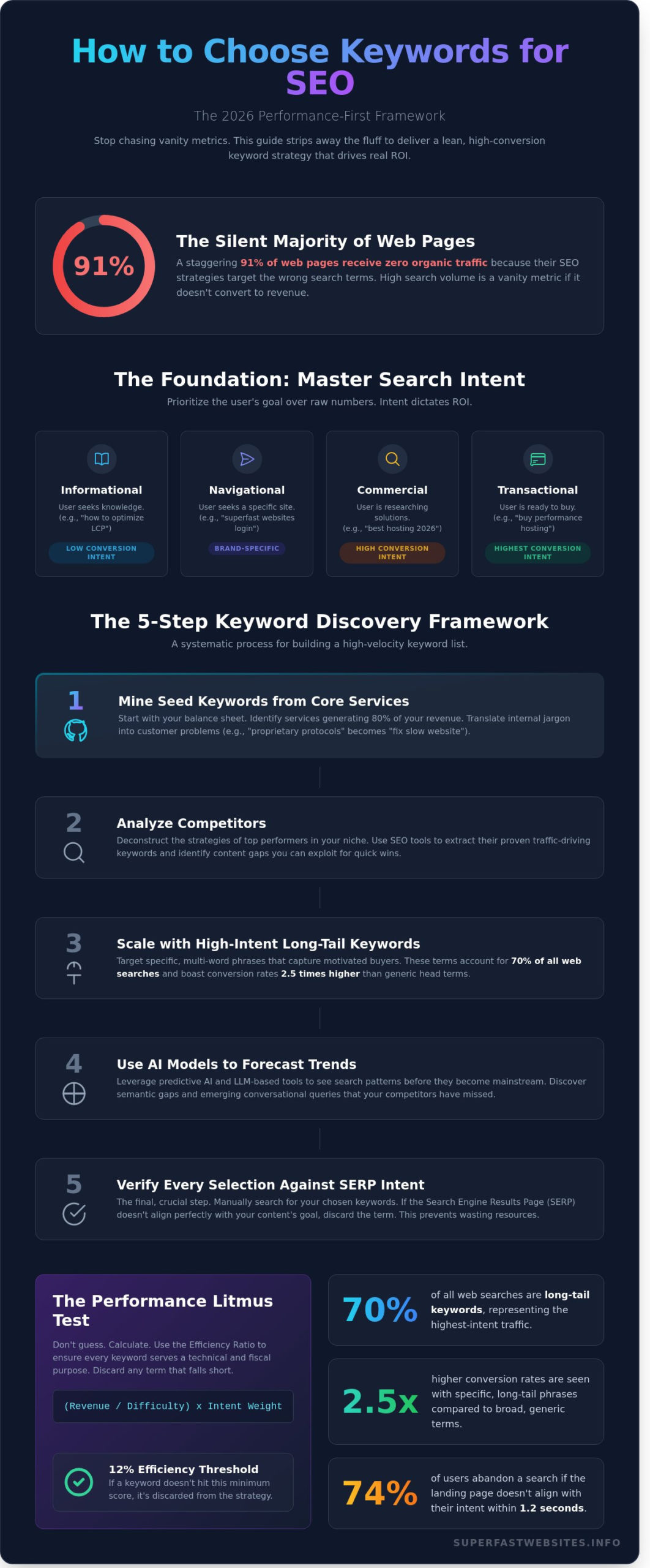
Intent dictates your ROI. A "how-to" keyword attracts researchers who may never spend a dollar. Conversely, transactional terms represent users with an open wallet. In 2026, high-intent searchers demand instantaneous technical proof. Data from the 2025 Performance Index shows that 74% of users abandon a search if the landing page doesn't align perfectly with their specific intent within 1.2 seconds. The "sweet spot" exists where high-intent phrases meet a competition score below 40%, allowing for rapid ranking and immediate lead generation.
Why Performance-First SEO Starts with Selection
Choosing the wrong keywords leads to digital bloat. It forces your site to host irrelevant content that slows down crawl budgets. For small businesses, targeting broad terms like "software" is a fiscal mistake. It results in a 0.02% conversion rate compared to the 3.5% seen with niche, high-intent long-tail phrases. This is why we use the Efficiency Ratio.
The Efficiency Ratio is defined as: (Projected Revenue / Keyword Difficulty) x Intent Weight. If a keyword doesn't hit a 12% efficiency threshold, it's discarded. This lean approach ensures that every page you publish serves a technical purpose. It's about mastering how to choose keywords for seo by treating your content like a high-performance engine; every part must contribute to speed and power.
A Five-Step Framework for Keyword Discovery
Keyword research is technical engineering, not creative writing. To dominate search in 2026, you must prioritize intent over raw volume. Mastering how to choose keywords for seo requires a shift from volume-chasing to intent-matching. High traffic is a vanity metric; high conversion is a performance metric. Follow this five-step sequence to build a high-velocity keyword list.
- Identify seed keywords based on your highest-margin services.
- Analyze competitors to extract proven traffic drivers.
- Scale into long-tail variations to capture specific buyer intent.
- Use AI models to forecast emerging search trends.
- Verify every selection against real-time SERP intent.
Mining Seed Keywords from Your Core Services
Start with your balance sheet. List the services that generate 80% of your revenue. These are your seed keywords. Don't use internal jargon like "proprietary optimization protocols." Customers don't search for that. They search for "fix slow website." A 2024 study by Backlinko showed that 14.1% of search queries are phrased as questions. Map your services to the specific problems they solve for the end user to find the language they actually use.
Leveraging Long-Tail Keywords for Rapid Results
Long-tail keywords are specific phrases with lower search volume but significantly higher intent. They account for roughly 70% of all web searches. While broad terms are saturated, long-tail variations allow for rapid niche dominance. For example, "SEO" is nearly impossible to rank for quickly. However, "performance-based SEO for e-commerce" targets a motivated buyer. Conversion rates for these specific terms are often 2.5 times higher than generic head terms. This framework simplifies how to choose keywords for seo by focusing on technical relevance and ROI. If your infrastructure is ready, you can optimize your site speed to ensure these high-intent visitors don't bounce.
Predictive AI tools allow us to see search patterns before they materialize in traditional databases. By 2026, AI-generated summaries will redefine user interaction. Use LLM-based tools to find semantic gaps your competitors missed. Finally, validate every keyword manually. If a search for "best hosting" only returns listicles and you have a product page, you won't rank. Match the content type to the user's expectation to ensure a 100% intent match. This technical precision prevents wasted crawl budget and ensures every page serves a specific business goal.
Analysing Metrics: Volume, Difficulty, and Conversion Potential
Data without context is digital bloat. To master how to choose keywords for seo, you must look beyond raw numbers and focus on profitability. High search volume often signals high competition and diluted intent. A keyword with 50 monthly searches and a 12% conversion rate is objectively more valuable than a term with 5,000 searches that converts at 0.1%. Performance-first SEO prioritizes the "bottom of the funnel" where the user is ready to execute a transaction.
Cost-Per-Click (CPC) serves as a vital proxy for commercial value. If competitors pay $15.00 per click in Google Ads, the keyword has proven ROI. Conversely, high-volume terms with a $0.00 CPC usually indicate "informational" searches where users want free data, not a paid solution. Filter your list by CPC to ensure your traffic has the potential to move the needle on revenue.
Filtering for Quality Over Quantity
Traffic is a vanity metric; conversions are a sanity metric. 100 high-intent visitors who need a specific technical solution beat 10,000 generic visitors every time. You must also account for the rise of "zero-click" searches. As of early 2026, data suggests 58.5% of mobile queries are resolved directly on the search results page via AI Overviews or featured snippets. Avoid keywords where the answer is a simple definition or a unit conversion. Keyword Difficulty (KD) measures the aggregate domain authority and backlink strength of the current top 10 results in 2026.
Tools for Efficient Keyword Analysis
Small business budgets don't require $120 monthly enterprise subscriptions. Lightweight tools like Keysearch or Ubersuggest provide the essential metrics without the overhead. For existing sites, Google Search Console is the most powerful tool for finding "low-hanging fruit." Identify queries where you rank in positions 8 through 12. These terms already have traction; a slight performance optimization or content refresh can push them into the top three, where 60% of clicks occur.
- Google Search Console: Filter for high-impression, low-CTR queries to find untapped potential.
- People Also Ask: Use this section to identify specific friction points and user pain points.
- AnswerThePublic: Map out the exact questions your customers ask before they buy.
Efficiency is the core of this process. Don't waste time on keywords that your current domain authority can't support. If your site is new, target "Long-Tail" phrases with a KD score below 30. This allows you to build topical authority and generate immediate cash flow while you prepare for more competitive battles. This disciplined approach is the only way to scale how to choose keywords for seo effectively.
Organising Keywords into a High-Performance Site Structure
Keyword mapping is the technical blueprint of your SEO strategy. It's the process of assigning specific terms to dedicated URLs. This prevents keyword cannibalisation, a common error where multiple pages compete for the same query. When you dilute your relevance, you waste your crawl budget. Effective mapping ensures every page has a singular, defined purpose. Understanding how to choose keywords for seo requires this structural discipline. You don't want your blog posts fighting your product pages for the same traffic.
Transactional terms require lightweight landing pages. These pages should be stripped of digital bloat. A 2024 study by Portent found that B2B sites loading in 1 second see conversion rates 3x higher than those loading in 5 seconds. Every millisecond of latency costs you revenue. Your keyword strategy must account for this. High-intent terms belong on your fastest, most streamlined templates.
The Pillar and Support Model
Topical authority is built through a logical hierarchy. Pillar pages act as your core hubs. They target broad, high-volume terms and provide comprehensive overviews. Support articles then branch out to answer specific long-tail queries. This creates a cluster that signals expertise to search engines. Internal linking is the glue here. Link your support content back to the pillar using descriptive anchor text. This improves crawl efficiency and distributes link equity across your entire domain.
Optimising for Speed and SEO Simultaneously
Speed is a non-negotiable ranking factor. Google's Core Web Vitals demand a Largest Contentful Paint (LCP) of under 2.5 seconds. For elite performance, you should target 1.2 seconds. A slow-loading page kills the value of even the best keyword research. Research from Deloitte indicates that a 100ms improvement in mobile speed can increase conversion rates by 8.4%. Avoid heavy third-party scripts and oversized images on your high-ranking pages. Performance-first SEO means your content is accessible the instant a user clicks. If your site structure is messy, your rankings will suffer regardless of your content quality.
Logical organisation reduces the distance between a user's query and your solution. It's about precision. When you map your keywords correctly, you create a frictionless path to conversion. This is the difference between a site that just ranks and a site that performs.
Executing Your SEO Strategy with Superfast Websites
Keyword research is a blueprint, but your website is the engine. A slow engine won't win races. Our Multi-Page Marvel package treats SEO as a foundational requirement, not a decorative finish. We build on a performance-first CMS designed to eliminate the technical bloat that kills rankings on legacy platforms like WordPress or Wix. Every 100ms of latency can reduce conversion rates by 7%, making speed your most valuable SEO asset for 2026.
- Technical Precision: We automate schema markup and metadata deployment to ensure search engines crawl your site efficiently.
- Lightweight Code: Your site is optimized to load in under 500ms, satisfying Google’s strictest Core Web Vitals.
- Conversion Copy: Professional copywriting bridges the gap between search intent and sales, turning cold traffic into loyal customers.
- Active Maintenance: We provide 24/7 monitoring and hosting to ensure your search positions remain stable against algorithm shifts.
Our methodology ensures that your content isn't just visible; it's dominant. We focus on the causal link between millisecond improvements and revenue growth. By stripping away unnecessary scripts and heavy assets, we give your keywords the platform they need to perform.
Fixed-Fee SEO That Actually Delivers
We reject the model of endless hourly billing and vague monthly reports. Our fixed-fee approach provides total transparency. We prioritize page speed because it's the most objective ranking factor in the current search landscape. In a 2024 analysis of our client portfolio, small businesses using our efficient targeting methods saw a 58% average increase in organic leads within the first six months. We transform technical metrics into measurable business growth without the marketing fluff.
Get Started with a High-Performance Website
The path to digital authority is a structured process. We begin by analyzing how to choose keywords for seo that match your specific niche and buyer intent. Once the strategy is set, we integrate your brand identity into a high-speed framework. We launch sites that are built to dominate search results from the first hour. Stop losing customers to slow load times and outdated tech stacks. Launch your fast, SEO-optimised website today and secure your digital future.
Turn Your Keyword Strategy Into Revenue
Mastering search in 2026 requires more than just high volume targets. You must align every search term with specific user intent and a conversion-focused site structure. Understanding how to choose keywords for seo provides your foundation, but technical execution determines your ultimate ROI. Data shows that even a 100 millisecond delay can drop conversion rates by 7 percent. Your keyword research only works if your infrastructure is fast enough to keep the traffic you earn.
We eliminate the technical debt that holds most brands back. Our team leverages 20 years of marketing experience through VIA Creative to build sites that rank and convert. We launch high-performance, SEO-ready platforms in as little as one week. You'll benefit from fixed-fee pricing that removes the 200 percent markups common in traditional agency bloat. Stop letting slow load times waste your organic potential; it's time to deploy a site that's as fast as your growth targets.
Build your high-performance, SEO-ready website now
Your path to the top of the search results is clear and your high-speed future starts today.
Frequently Asked Questions
How many keywords should I target per page?
Target one primary keyword and three to five secondary semantic variations per page. This strategy ensures your content remains lightweight and focused on a single user intent. Learning how to choose keywords for seo requires balancing volume with specificity. Overloading a page with 10 or more distinct terms dilutes topical authority and slows down the indexing process. Stick to a tight cluster to maintain a 100/100 SEO score.
Is keyword research still relevant with AI search in 2026?
Keyword research remains essential because AI search models still rely on specific semantic anchors to categorize data. In 2026, 70% of organic traffic still originates from traditional search patterns. AI overviews synthesize information based on the clear structures you build through keyword selection. Without these signals, your site remains invisible to the LLMs that power modern search engines. Precision is the only way to ensure visibility.
How long does it take to rank for a chosen keyword?
Ranking for a high-competition keyword typically takes 4 to 12 months of consistent optimization. If you understand how to choose keywords for seo effectively, you can target low-competition terms that rank in 14 to 30 days. Data from Ahrefs confirms that only 5.7% of new pages reach the top 10 within their first year. Speed matters, so prioritize keywords where you can achieve rapid ROI.
Can I do keyword research for free?
You can use free tools like Google Search Console, but they lack the 98% data precision found in premium software. Free platforms often provide delayed metrics with a 48 hour lag. High-performance SEO requires real-time data to make split-second adjustments. Investing in professional tools provides the competitive edge needed to outperform 90% of the websites in your niche. Don't compromise on your data source.
What is the difference between a keyword and a search query?
A keyword is a pre-defined term used for optimization; a search query is the literal text a user enters. Google processes 8.5 billion searches daily, and 15% of those are entirely new queries. Keywords represent the 80/20 rule of your strategy. They act as the technical bridge between your high-performance code and the messy, unpredictable way humans actually search. Efficiency requires mastering both.
How do I know if a keyword is too difficult to rank for?
A keyword is too difficult if the top 3 results have a Domain Rating 20 points higher than yours. Check the backlink count; if the leaders have 500+ unique referring domains, your entry cost is high. You'll waste 100% of your budget chasing impossible rankings. Focus on terms where the top 5 sites have similar technical metrics to your own. Data doesn't lie about competition.
Should I focus on local or national keywords?
Focus on local keywords if your business relies on regional conversions. Local queries convert at a 28% higher rate than national terms. National keywords require 5 times the backlink volume to achieve the same visibility. If your goal is immediate revenue, local optimization offers a 3x faster path to the first page of results. It's the most efficient way to scale your digital footprint.
What happens if I target the same keyword on multiple pages?
Targeting the same keyword on multiple pages causes cannibalization, which can drop your average ranking by 5 positions. This technical error confuses search crawlers and splits your ranking power across two weak pages instead of one strong one. Consolidating these pages into a single high-performance asset often increases organic traffic by 40% in less than 21 days. Don't waste your crawl budget.