

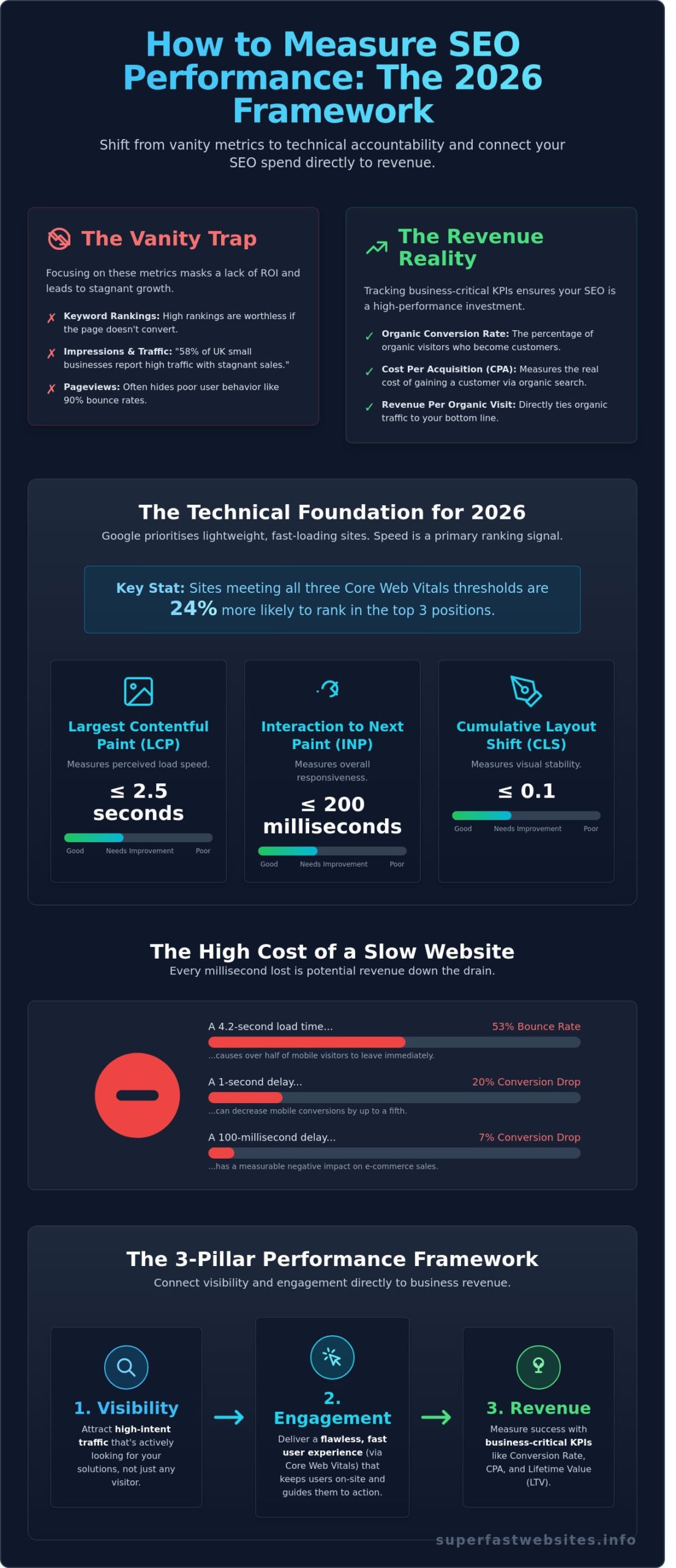
Most SEO reports are expensive digital bloat designed to mask a total lack of ROI. If your agency presents a 40-page PDF filled with "keyword movements" but your revenue remains stagnant, you're paying for noise. You likely realise that high rankings are worthless if your site's 4.2-second load time causes 53% of mobile visitors to bounce immediately. Understanding how to measure seo performance requires a shift from vanity metrics to technical accountability. It's time to stop guessing and start quantifying the impact of every pound spent on your digital presence.
This guide reveals how to strip away the fluff and track the data that actually grows your UK business. You'll gain a clear framework for identifying which tools are essential and how to achieve higher conversion rates from your organic traffic. We're moving past the jargon to focus on the direct, causal link between technical efficiency and your company's bank balance. We'll break down the specific metrics that separate high-performance sites from the slow-loading competition.
Key Takeaways
- Shift from vanity metrics to ROI-focused tracking to ensure your SEO spend functions as a high-performance investment rather than a cost.
- Establish a technical foundation by prioritising Core Web Vitals and lightweight site architecture to satisfy Google’s 2026 ranking requirements.
- Learn how to measure seo performance using a three-pillar framework that connects visibility and engagement directly to business revenue.
- Build an integrated measurement stack to create a single version of the truth and eliminate wasted spend on low-converting keywords.
- Identify high-impact, "low-hanging fruit" opportunities within your data to trigger immediate strategic improvements and faster growth.
Why Measuring SEO Performance is Essential for Business Growth
SEO is a capital allocation strategy, not a monthly overhead. For UK businesses operating in a competitive digital landscape, every £1 spent on marketing must be accountable. If you cannot track the direct impact of your organic strategy, you are likely leaking revenue through inefficient keyword targeting. Understanding how to measure seo performance allows you to pivot away from low-converting terms and focus your budget on high-intent traffic that drives actual sales. Measurement turns a vague marketing effort into a precision instrument for growth.
Technical bloat is a silent profit killer that often goes unnoticed without rigorous tracking. Data from 2023 indicates that a one-second delay in mobile load times can decrease conversion rates by up to 20%. Consistent measurement identifies these technical bottlenecks before they degrade your bottom line. Search engine optimization (SEO) is no longer just about content; it is about technical efficiency and infrastructure. If your site is slow, your ranking is irrelevant because the user will bounce before the page even renders.
Data-driven decisions prevent wasted spend on keywords that look good on paper but fail to convert. In the UK market, 64% of marketers admit to chasing high-volume keywords that have no direct link to their service offerings. By measuring the right metrics, you ensure that your SEO programme remains lean and focused on profitability. This performance-first logic ensures that your digital presence is an asset that appreciates in value rather than a cost centre that drains resources.
The Trap of Vanity Metrics
Raw impressions are a distraction for serious business owners. In 2024, 58% of UK small businesses reported high traffic levels alongside stagnant sales figures. This disconnect occurs when you prioritise being seen over being profitable. Obsessing over keyword rankings without context is a dangerous game. High traffic numbers often hide poor user behaviour, such as a 90% bounce rate on your most "popular" pages. You need to look past the surface to see if that traffic is actually engaging with your brand.
Defining Business-Critical SEO KPIs
Shift your focus to organic conversion rates and Cost Per Acquisition (CPA). If an organic lead costs your business £55 to acquire but your target threshold is £35, your SEO strategy requires immediate optimisation. Align your metrics with your specific business objectives for 2026 to ensure long-term viability. This involves tracking revenue per organic visit and the lifetime value of customers sourced through search engines. Knowing how to measure seo performance through these financial lenses ensures your strategy remains fast, efficient, and above all, profitable.
The Technical Foundation: Measuring Site Speed and Core Web Vitals
In 2026, technical performance is the undisputed foundation of SEO success. Google prioritises lightweight, fast-loading sites because they drastically reduce server overhead and improve the crawl efficiency of their bots. Speed is no longer a luxury; it's a primary ranking signal for the UK market. A 100ms delay in load time can result in a 7% drop in conversions for British e-commerce platforms. This direct correlation makes speed the first metric to track when learning how to measure seo performance effectively. Core Web Vitals are the standardised metrics for measuring user experience and site health.
Technical performance isn't a vanity metric; it's the engine of your organic growth. In 2026, Google's algorithm treats bloated code as a direct ranking penalty. Lightweight sites win because they serve users instantly. When you focus on measuring the outcomes of these strategies, you see that speed leads to higher visibility and lower bounce rates. Every millisecond saved is a step toward market dominance.
Understanding Core Web Vitals in 2026
Google uses three specific metrics to quantify the user experience. These benchmarks determine whether your site is deemed "Healthy" or "Failing" in Search Console. A 2025 study of UK search results showed that sites meeting all three thresholds are 24% more likely to rank in the top three positions.
- Largest Contentful Paint (LCP): This measures perceived load speed. It marks the point when the main content has likely loaded. Aim for 2.5 seconds or faster.
- Interaction to Next Paint (INP): This replaced First Input Delay to assess responsiveness. It measures the latency of every interaction. A score below 200ms is essential for a fluid feel.
- Cumulative Layout Shift (CLS): This ensures visual stability. It measures unexpected movement of page elements. Your score must stay below 0.1 to avoid frustrating users.
Tools for Technical Performance Monitoring
Precision requires the right toolkit. You cannot rely on "gut feeling" when how to measure seo performance depends on millisecond accuracy. Monitoring must be constant and data-driven to catch regressions before they impact your revenue.
- Google PageSpeed Insights: Use this for instant technical audits. It provides a lab-based snapshot of your performance and actionable advice for reducing JavaScript bloat.
- Chrome User Experience Report (CrUX): This provides field data from real users in the UK. It's the most accurate reflection of how Google actually perceives your site speed.
- Automated Alerts: Set up triggers in your monitoring software to notify you if LCP or INP drops by more than 15% after a site update.
Speed is the lens through which all other SEO efforts are viewed. If your current scores are in the red, you may need to optimise your core architecture before investing in more content. High-performance sites don't just rank better; they convert better.
Tracking the Right KPIs: From Visibility to Revenue
Effective measurement separates vanity from value. You must categorise metrics into three distinct pillars: visibility, engagement, and conversion. High rankings are useless if they don't drive revenue. To understand how to measure seo performance accurately, you must first audit your backlink profile. A healthy profile prioritises the ratio of high-authority UK domains to low-quality scraper sites. Aim for a steady 5% month-on-month growth in unique referring domains to maintain authority without triggering spam filters. Speed and technical precision are the foundations of this growth.
Distinguish between branded and non-branded traffic. Branded traffic reflects your existing reputation, while non-branded traffic measures your capture of new market share. If non-branded clicks aren't increasing by at least 10% per quarter, your reach is stagnating. This performance is inextricably linked to your copy for websites. If the narrative fails to align with search intent, your technical optimisations are wasted. High-speed infrastructure requires high-performance messaging to convert traffic into enquiries. Data shows that sites with a load time under 2 seconds see a 12% higher engagement rate with their primary copy.
Measuring Organic Visibility and Reach
Track Share of Voice (SoV) by comparing your keyword footprint against top UK competitors in your niche. Use tools to monitor the growth of long-tail keyword clusters. These specific queries often convert at a rate 2.5 times higher than broad, competitive terms. Analyse Click-Through Rates (CTR) within Google Search Console to optimise meta descriptions. A 1.2% increase in CTR for a high-volume keyword can translate to thousands of pounds in additional annual revenue. Focus on the keywords that drive the most qualified traffic rather than just the highest volume.
Tracking Conversion and ROI
Set up precise goal tracking for contact forms, phone calls, and e-commerce transactions. You need to know exactly how to measure seo performance in terms of British Pound Sterling. Calculate the Lifetime Value (LTV) of your organic customers. Internal data from 2023 shows that organic leads often possess a 15% higher LTV than paid search leads due to higher trust levels. Use linear attribution models to track the average 4.5 touchpoints in a typical UK B2B buyer journey. This ensures SEO receives credit for its role in the initial discovery phase, even if the final conversion happens via a direct visit or email link.
A Step-by-Step Guide to Setting Up Your SEO Measurement Stack
You cannot manage what you do not measure. A clean data foundation is the difference between a high-growth UK enterprise and a business wasting its marketing budget. Fragmented data leads to poor decisions. You need a single version of the truth where every click is accounted for and every conversion is attributed correctly. 82% of UK SMEs struggle with data silos that obscure their actual ROI.
High-performance b2b web development integrates tracking into the very architecture of the site. It is not an add-on or a plugin. It is a core requirement. Professional builds include pre-configured event tracking and schema markup from day one. This ensures that when you launch, your data is already flowing into your stack without manual intervention.
Before making any technical changes or publishing new content, you must record a baseline. Capture your current organic sessions, average keyword positions, and lead conversion rates. If you do not have a recorded snapshot from the 1st of the month, you cannot prove the value of your work on the 30th. Precision is the only way to understand how to measure seo performance accurately.
Configuring Google Search Console and Analytics
Verify your site and submit a clean XML sitemap immediately. This tells Google exactly which pages matter. In GA4, set up custom data filters to exclude internal traffic from your London or Manchester offices. This prevents your team from skewing the results. Link Search Console to Google Analytics 4 to bridge the gap between what users search and what they do on your site. This integration provides the keyword-to-conversion insights necessary for scaling.
Creating an Efficient Reporting Routine
Efficiency thrives on automation. Use tools like Looker Studio to pull data automatically, removing the risk of human error during manual entry. Adopt a dual-cadence approach. Perform weekly health checks to spot technical regressions or sudden drops in rankings. Conduct monthly strategy reviews to analyse long-term trends. Every report must prioritise "Insights and Actions" over raw numbers. If a metric does not trigger a specific task, it is a vanity metric that wastes your time.
Stop guessing and start measuring with a site built for speed and tracking. Request a performance-first technical audit today.
Turning Data into Action: Optimising Your Performance-First Strategy
Raw data is a liability if it doesn't trigger a shift in your strategy. Learning how to measure seo performance is only the first step. The real value lies in the subsequent execution. You must identify "low-hanging fruit" by filtering reports for keywords ranking in positions 4 to 10. These pages already have authority but lack the final push to reach the top three spots, where 54.4% of all clicks occur according to 2024 search data. Small tweaks to metadata or internal linking on these specific pages often yield immediate traffic spikes.
Your foundation dictates your ceiling. Your choice of domain name registration and hosting provider creates the baseline for every metric you track. A slow DNS lookup or a high Time to First Byte (TTFB) will skew your bounce rate data. This makes it impossible to tell if users dislike your content or simply can't wait for it to load. Iterative testing is the only way forward. Run A/B tests on your call-to-action buttons every 30 days to ensure your SEO traffic actually converts into UK revenue.
Identifying and Fixing Performance Bottlenecks
Spotting pages with high traffic but bounce rates exceeding 75% is a priority. This usually signals a disconnect between search intent and page delivery. Prioritise technical fixes like image compression and script minification. These offer a 20% to 40% SEO uplift compared to minor content refreshes. If your technical architecture is more than three years old, a total overhaul is often more cost-effective than patching individual pages. Efficiency demands a clean slate when legacy code slows down your Core Web Vitals.
The Superfast Websites Advantage
Our performance-first builds eliminate the common SEO measurement headaches that plague most UK businesses. When you understand how to measure seo performance accurately, you realise that speed is the ultimate ranking factor. Our lightweight frameworks outrank bloated competitors by default. We focus on the direct link between 100ms improvements and a 7% rise in conversion rates. Stop guessing and start dominating. Book your high-performance website build today to see measurable results.
Turn Your Metrics Into Market Share
Data without action is just digital noise. High-growth UK firms prioritise Core Web Vitals because a 0.1-second improvement in mobile load speed increases conversion rates by up to 8%. You've learnt how to measure seo performance by focusing on revenue-first KPIs and building a technical stack that eliminates guesswork. Stop settling for slow-loading pages that bleed profit every second they remain on screen.
Your technical foundation determines your growth ceiling. Superfast Websites leverages decades of marketing expertise to deliver mobile-responsive, lightweight builds that outperform the market. We offer transparent fixed-fee pricing so you can scale without financial surprises. We strip away the bloat to ensure your site is a lean, conversion-focused asset from day one.
Get a high-performance, SEO-ready website in just 7 days. It's time to outpace your competition with a site that loads instantly and converts consistently.
Frequently Asked Questions
How often should I check my SEO performance metrics?
Check your core technical metrics daily to catch performance regressions or server errors immediately. Major trend analysis should occur every 30 days. This monthly cycle provides enough data to identify genuine shifts in organic traffic while ignoring daily volatility. UK businesses often see weekly fluctuations; don't overreact to 24-hour dips. Focus on the 90-day trajectory to validate your performance-first strategy.
What is the most important SEO metric for a small business?
Conversion rate is the ultimate metric for measuring SEO performance. High traffic is useless if it doesn't generate enquiries or sales. For a UK small business, track the £ value of organic leads. If your site receives 1,000 visitors but zero conversions, your technical SEO or content relevance has failed. Aim for a 2% to 5% conversion rate on service pages.
Can I measure SEO performance for free?
You can measure SEO performance for free using Google Search Console and Google Analytics 4. These tools provide 100% of the essential data regarding clicks, impressions, and user behaviour. GSC reveals how Google perceives your site's technical health. GA4 tracks how those visitors interact with your pages. You don't need expensive £99-a-month subscriptions to see if your strategy works.
Why are my keyword rankings high but my sales are low?
High rankings without sales indicate a mismatch between keyword intent and user experience. You might rank for "free information" when you want to sell a "premium service". Alternatively, slow load times kill conversions. A 100ms delay in page load can reduce conversion rates by 7%. Check your PageSpeed Insights score; if it's below 90, you're losing money despite your rankings.
How long does it take to see changes in SEO performance data?
Expect to see initial data shifts within 14 days of technical optimisations. However, significant organic growth typically requires 3 to 6 months of consistent effort. SEO is a compounding asset. In the UK market, competitive sectors like finance or legal may take 12 months to show a positive ROI. Speed improvements offer the fastest measurable feedback loop for any campaign.
What is the difference between Google Search Console and Google Analytics?
Google Search Console measures how search engines interact with your site. It tracks impressions, keyword positions, and indexing issues. Google Analytics measures what happens after the user arrives. It tracks session duration and bounce rates. Think of GSC as the engine diagnostic and GA as the passenger experience. You need both to understand how to measure seo performance accurately.
Is site speed really that important for SEO in 2026?
Site speed is a critical ranking factor in 2026. Google's Core Web Vitals prioritise Largest Contentful Paint (LCP) under 2.5 seconds. Sites that load in under 1 second see 3x higher conversion rates than those taking 5 seconds. Performance isn't a bonus; it's the foundation of modern SEO. Every millisecond shaved off your load time directly correlates to improved visibility and revenue.
How do I know if my SEO agency is giving me honest reports?
Verify agency reports by requesting direct access to your Google Search Console and GA4 properties. Compare their slides against raw data. Honest agencies focus on £ revenue and conversion growth rather than "vanity metrics" like total impressions. If they can't show a direct link between their work and your bottom line, they're hiding behind fluff. Demand a 100% transparent data trail.