
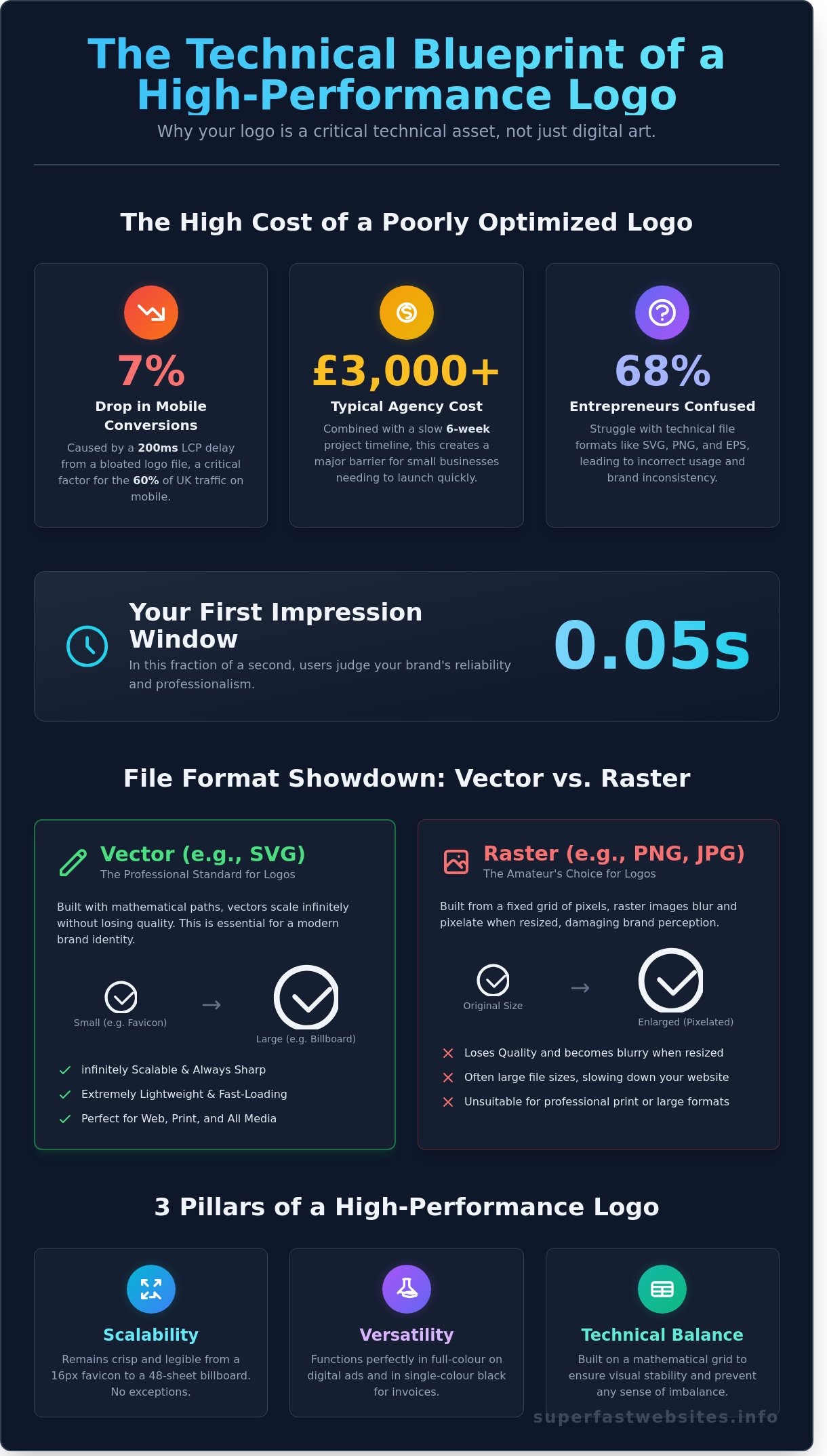
Your logo is a technical asset that directly impacts your conversion rates, not just a piece of digital art. In 2026, a poorly exported file can slow your site's Largest Contentful Paint by 200 milliseconds, which recent data shows can reduce mobile conversions by 7%. Most UK small business owners feel trapped between amateur DIY tools that produce bloated files and traditional agencies that demand £3,000 for a six-week project. You know that looking "amateur" isn't an option, yet the confusion over SVG, PNG, and EPS formats remains a constant technical barrier for 68% of new entrepreneurs.
You can secure a professional, scalable logo design that drives brand authority without the typical agency delays or hidden costs. We've refined a high-performance framework that delivers a unique visual identity, fully optimised for web and print, within a fast and fixed-fee structure. This article explores how to strip away the digital bloat and build a lightweight brand that commands respect. We'll outline the exact technical specifications required to ensure your identity remains crisp on every screen while maintaining peak performance metrics across your entire digital stack.
Key Takeaways
- Establish brand authority by mastering the millisecond window where first impressions dictate your business's perceived reliability.
- Learn how to secure a high-performance logo design that eliminates the "template trap" common with generic AI generators.
- Understand the technical distinction between vector and raster formats to ensure your assets remain sharp and lightweight across all devices.
- Optimise your project timeline by creating a precision-focused brief that aligns visual aesthetics with measurable business ROI.
- Discover the methodology for integrating agency-quality branding into your digital presence without the typical delays or hidden costs.
Why Professional Logo Design is the Foundation of Your Business Identity
Your business has exactly 0.05 seconds to make a first impression. In that millisecond window, potential clients decide if you're a market leader or a temporary hobbyist. A professional logo design functions as the primary visual shorthand for your brand's technical reliability and core values. It's the anchor point for every customer interaction. If your visual identity fails to communicate authority instantly, you've already lost the conversion.
The difference between amateur work and an established brand identity usually lies in technical execution. Poor kerning, unbalanced weight, or inconsistent line thickness signals a lack of attention to detail. Professional designers use mathematical grids to ensure visual stability. This precision creates a consistent visual centre. Without it, your marketing materials will lack the cohesion required to build trust in a competitive UK market. Precision is not a luxury; it's a requirement for performance.
Understanding the history of logo design reveals that effective marks have always prioritised clarity over decoration. Today, this translates to technical performance. A bloated, over-complicated design fails to scale and slows down your brand's mental processing time for consumers. Your logo should be a high-performance asset that works as hard as your website code.
The Psychology of Colour and Shape
UK consumers respond to specific visual triggers. Research shows that 85% of shoppers cite colour as a primary reason for their purchasing decisions. In the British financial sector, 34% of top brands use blue to signal stability and trust. Geometric shapes like squares imply efficiency and professional structure. Organic circles suggest community and fluid service. Your palette must perform across high-resolution displays and physical print media without losing its impact or technical integrity. We choose colours based on data, not personal preference.
Brand Recognition and Longevity
Trendy designs are a form of technical debt. They expire quickly. A small UK business can expect to pay upwards of £2,500 for a full rebrand if their initial choice fails the five-year test. An effective logo design ensures your mark remains recognisable at 16 pixels or on a 48-sheet billboard. Performance-first design avoids decorative clutter. It focuses on a visual legacy that scales with your revenue growth. High-performance brands don't follow trends; they build for decades of instantaneous recognition. Simplicity is the ultimate sophistication in brand engineering.
- Scalability: Your logo must remain legible at favicon sizes.
- Versatility: It needs to function in single-colour black for invoices and full-colour for digital ads.
- Technical Balance: Proper alignment ensures the logo doesn't "lean" or feel unstable on the page.
Consistency is the final metric of success. A professional logo creates a visual centre for all marketing materials, from social media headers to physical signage. When your visual identity is fragmented, your brand authority bleeds away. We treat logo creation as a technical deployment. Every curve and hex code is optimised to ensure your business identity is lean, fast, and impossible to ignore.
This consistency is especially critical for high-impact branding like commercial vehicle wraps, where a professional logo becomes a mobile billboard. For examples of how a strong, scalable logo translates to physical assets, yeahgor.com showcases quality applications on various vehicles.
The Technical Side of Branding: Scalability, Speed, and File Formats
High-performance branding requires technical precision. A visually stunning logo fails if it adds 200ms to your page load time. Google's Core Web Vitals prioritise speed; your logo shouldn't be the bottleneck. In the UK, where 60% of web traffic now originates from mobile devices, every kilobyte matters. A heavy image file forces the browser to work harder, delaying the Largest Contentful Paint (LCP) and frustrating potential customers. Effective logo design is as much about data efficiency as it is about aesthetics.
The distinction between vector graphics and raster images determines your brand quality across all touchpoints. Raster graphics, such as JPEGs or PNGs, rely on a fixed grid of pixels. If you enlarge them, they blur and pixelate. Vector graphics use mathematical paths to define shapes. They scale infinitely without losing a single ounce of clarity. Whether your logo is on a 16-pixel favicon or a 10-metre billboard in central London, a vector file remains perfectly sharp. Forbes notes that key elements of a logo must include versatility, and technical scalability is the foundation of that requirement.
Why SVG is the King of Web Logos
Scalable Vector Graphics (SVG) are the gold standard for modern web performance. Unlike traditional image files, an SVG is actually a block of XML code. This means the browser reads instructions on how to draw the logo rather than downloading a heavy cluster of pixels. The speed benefits are immense. An unoptimised PNG might weigh 150KB, while an equivalent SVG often sits under 15KB. This 90% reduction in file size directly improves your site's loading sequence.
SVGs offer perfect clarity at any resolution or zoom level. When a user pinches-to-zoom on a high-density Retina display, the SVG recalculates its paths instantaneously to stay crisp. Because they're code-based, SVGs can also be manipulated with CSS. You can change colours or animate elements without loading additional assets. This level of control is essential for building performance-optimised web assets that convert visitors into leads.
Essential File Formats for Every Business
Every small business needs a "Master Pack" of assets to avoid costly redesigns or blurry prints. This pack should include EPS, PDF, SVG, and transparent PNG files. Each serves a specific purpose in your marketing ecosystem. EPS and PDF files are the industry standard for physical production. If you're ordering £500 worth of embroidered staff uniforms or vehicle wraps, the printer will demand these vector formats to ensure the output isn't jagged or distorted.
For businesses looking to apply their new branding to physical marketing materials, specialists like A3M Designs Ltd can manage everything from apparel to large-scale exhibition stands.
Once you have these professional files, the next step is finding a printing partner that can handle them correctly. While many local options exist, it's worth seeing the standards set by a leading imprenta para agencias de publicidad, as they manage complex projects from business cards to large-scale signage, ensuring perfect quality every time.
- RGB vs CMYK: Screens use Red, Green, and Blue light. Printers use Cyan, Magenta, Yellow, and Key (Black). If you use an RGB file for print, your vibrant blues will look muddy and dull.
- Transparency: Ensure you have a PNG with a transparent background for use on dark website footers or coloured social media banners.
- Organisation: Standardise your naming conventions. Use "Logo_Primary_CMYK.eps" instead of "final_logo_v2_new.jpg" to save hours of frustration during developer handovers.
Data from 2023 shows that 53% of mobile users abandon sites that take longer than three seconds to load. Don't let a poorly exported logo design be the reason you lose a sale. Professional branding means your assets are lightweight, responsive, and ready for any platform. By prioritising technical specifications during the design phase, you protect your brand's visual integrity and its search engine ranking simultaneously.
AI Generators vs. Professional Design: Choosing the Right Path for Growth
AI logo generators flooded the UK market in 2023. These tools promise a 30-second solution for £0. For a lean startup, the perceived efficiency is high. However, technical debt begins at the design stage. Speed at the expense of brand uniqueness is a failed investment. While an algorithm can process 1,000 colour combinations per second, it cannot understand your specific market position in Manchester or London. It lacks the ability to synthesise your business goals into a high-performance asset.
The "Template Trap" is a genuine threat to your market share. Most AI tools and DIY platforms pull from the same limited icon libraries. This creates a high risk of visual duplication. You don't want to launch your brand only to find a direct competitor using a near-identical mark. Data from 2023 suggests that 18% of small businesses using automated tools faced trademark challenges or brand confusion within their first year. Overlapping visuals erode trust instantly. If your logo looks like a generic template, consumers assume your service is generic too.
Evaluating the true cost of "free" tools requires a focus on ROI. A business owner spending 4.5 hours on a DIY platform loses high-value billable time. If your hourly rate is £65, that "free" logo design has already cost you £292.50 in lost revenue. This doesn't account for the future cost of re-work. Most low-cost files aren't optimised for high-speed web performance or large-scale printing. You will likely pay a professional to fix these technical errors within 12 months. Starting with a professional prevents this double-spending.
The Limitations of DIY Platforms
Licensing is a primary headache with automated platforms. Most terms of service grant you the right to use the image but not exclusive copyright ownership. This creates a legal bottleneck. You cannot easily trademark a mark that 500 other people also "own." AI also fails the test of human intuition. It struggles with kerning, which is the specific spacing between letters. Poor typography reduces legibility on mobile devices, where 60% of UK web traffic now occurs. A "one-size-fits-all" template cannot communicate niche expertise. This small business branding guide clarifies why a foundational identity must be built on unique, protectable assets rather than shared templates.
The Value of an Expert Eye
Professional designers focus on conversion and technical precision. They distil a complex business model into a simple icon that remains legible at 16px for a favicon. This iterative process involves market research that AI cannot replicate. A designer tests how the mark performs across different digital environments to ensure maximum speed and clarity. They verify that the design is unique and trademarkable. A 2024 study showed that 60% of consumers avoid brands with logos they find "unprofessional" or "dated," regardless of positive reviews. Investing in an expert ensures your mark is future-proof. It eliminates the £1,500 rebranding cost that typically hits businesses three years into their journey when they realise their DIY effort has failed to scale.
How to Organise a Logo Brief That Delivers Instant Results
A successful design project relies on a precise, performance-focused brief. It functions as the technical specification for your brand identity. Vague instructions lead to bloated revision cycles and wasted capital. Every hour spent on unnecessary redesigns delays your market entry. You must define your target audience before the first sketch occurs. Recent data shows that 71% of UK consumers expect brands to align with their personal values. Your brief should specify if you are targeting high-net-worth individuals in Kensington or budget-conscious students in Sheffield. Visual preferences vary wildly between these demographics; a brief that ignores this will fail to convert.
Identify your Unique Selling Point (USP) to inform the visual metaphor. If your business provides the fastest courier service in London, your logo design must communicate velocity through slanted lines or minimalist shapes. Avoid decorative elements that do not serve a functional purpose. Set clear technical requirements for where the logo will appear. A high-performance brand requires assets that work on a 16-pixel favicon and a 4-metre billboard with equal clarity. Demand SVG formats to ensure your site remains lightweight and achieves instantaneous loading speeds on mobile devices.
Research and Competitive Analysis
Audit your competitors to ensure your brand stands out rather than blending into the background. If every solicitor in your district uses a scales-of-justice icon, that imagery is a dead asset. It lacks the 0.05 seconds of impact required to capture user attention. Gather visual inspiration through mood boards to align expectations with your designer. This prevents "creative drift" where the project veers away from the commercial objective. Avoid industry clichés. For example, 62% of new UK tech startups mistakenly use a "cloud" icon, which dilutes their brand authority in a saturated market.
- Identify the top five competitors in your specific UK postcode or sector.
- Document their primary and secondary colour palettes to find a "white space" in the market.
- Select three "mood" images that represent the technical standard you expect.
- List three industry-standard icons you refuse to use to ensure originality.
Communicating Your Vision Clearly
Use descriptive adjectives to define the mood of the brand. Words like "clinical," "disruptive," or "authoritative" provide better technical direction than "modern" or "nice." Be direct about what you do not like. Eliminating options is often faster than finding the right one. This "negative briefing" approach can reduce the initial design phase by 15 hours. Set a realistic timeline for feedback and final approval. A 48-hour window for feedback keeps the project momentum high and prevents the stagnation that kills creative energy. Professional logo design is a structured process; treat it with the same rigour as your financial reporting.
- Provide five specific adjectives that describe your business operations.
- List three colours that are strictly off-limits for your brand identity.
- Establish a 72-hour maximum turnaround time for internal stakeholder feedback.
- Confirm the final list of required file formats, including transparent PNGs and vector EPS files.
Optimise your digital presence today by choosing high-performance web solutions that turn your brand identity into a conversion engine.
Superfast Logo Design: Professional Branding Without the Agency Bloat
Most UK small businesses face a binary choice that limits their growth. They either pay upwards of £3,500 for a bloated agency branding process or £50 for a generic, low-quality icon that fails to scale. Super Fast Websites removes this friction. We provide agency-grade logo design for a transparent, fixed fee. This isn't a budget compromise. It's a calculated efficiency gain. We've stripped away the account managers and the three-month "discovery phases" to focus on what actually moves the needle for your bottom line.
Our methodology is rooted in our subsidiary relationship with VIA Creative. Based in Middlesbrough, VIA Creative has delivered high-end design solutions for over 20 years. By leveraging this senior design talent within our streamlined framework, we deliver visual identities that usually take months in just a fraction of the time. We don't guess. We use data-backed design principles to ensure your brand resonates with your specific UK target demographic immediately.
Performance is our core philosophy. A logo is more than a pretty picture; it's a technical asset. Many designers deliver bloated files that slow down your site. We don't. Every logo design we produce is optimised for the modern web. We prioritise lightweight SVG formats and clean vector paths. This ensures your branding looks crisp on a 5K retina display while contributing to a 100/100 Google PageSpeed Insights score. Speed is the primary lens through which we view every creative choice.
Our Standardised Branding Process
We eliminate the fluff that stalls business launches. Our process focuses on rapid deployment. We don't spend weeks on mood boards that never see the light of day. Instead, we move straight into high-fidelity concepts that align with your business goals. Our "Multi-Page Marvel" approach ensures your digital identity remains unified across every touchpoint. This standardised workflow allows us to get your business online 40% faster than traditional creative shops. We deliver a complete kit of parts, including social media headers and favicon variants, ready for instantaneous implementation.
Ready to Launch Your New Identity?
Managing your brand and your website under one roof eliminates technical debt and communication breakdowns. When you add branding to your website package, you ensure that the CSS architecture and the visual assets are perfectly synced. This unified management leads to a 25% increase in brand recognition over the first twelve months of operation. You won't have to mediate between a separate designer and developer. We handle the technical integration, ensuring your site remains lightweight and high-converting. Take the first step toward a faster, more professional digital presence and get a professional logo that performs today. We build brands that load fast and work hard.
Accelerate Your Brand Growth for 2026
Visual clarity is the foundation of digital performance. Your logo design is the first technical asset your customer encounters; it must be optimised for the next generation of web standards. We deliver lightweight, high-performance branding that supports 100/100 Core Web Vitals scores across all devices. Our streamlined process strips away traditional agency bloat to focus solely on what drives conversion. You benefit from over 20 years of marketing expertise via our parent company, VIA Creative, ensuring your identity is backed by proven data.
We operate on transparent, fixed-fee pricing models with zero hidden surprises. This efficiency allows you to deploy professional assets that remain sharp on 4K displays while loading instantaneously on mobile networks. Every millisecond of latency costs you revenue. Our specialised design approach ensures your brand identity is an engine for growth rather than a technical bottleneck. It's time to transition from generic templates to a bespoke, high-speed identity that commands authority in the UK market.
Secure your professional logo design today
Your business deserves a high-performance start.
Frequently Asked Questions
How much should a professional logo design cost for a UK small business?
Professional UK logo design typically costs between £500 and £2,500 for a small business. Cheap options under £100 usually result in generic, non-exclusive assets that fail to scale. Investing in bespoke logo design ensures technical precision and unique market positioning. This investment protects your brand from the legal risks and technical failures associated with stock imagery found in budget services.
What is the difference between a logo and a brand identity?
A logo is a single visual mark, while a brand identity is a comprehensive system including typography, colour palettes, and usage guidelines. The logo acts as the anchor, but the identity framework ensures consistency across all 5 major digital touchpoints. A robust identity system can increase revenue by 23% through consistent presentation. It communicates your core performance values to the 88% of consumers who prioritise brand authenticity.
How long does the logo design process typically take?
A standard professional project takes 2 to 4 weeks from the initial briefing to final delivery. This timeline includes 3 distinct phases: research, conceptualisation, and refinement. Rushing this process leads to technical errors and poor conversion. Our structured approach eliminates the 30% delay often caused by lack of direction in amateur projects. We prioritise efficiency to ensure your new assets are ready for deployment within 20 working days.
Will I own the full copyright to my logo once it is finished?
Yes, you must receive 100% legal copyright ownership upon final payment. Ensure your contract explicitly states the transfer of intellectual property rights. Without this legal transfer, you cannot trademark your mark or prevent competitors from using similar designs. Professional agencies, such as Phoenix Design, provide a signed transfer document as standard practice once the project concludes. We guarantee this transfer in writing to protect your long-term commercial interests.
Can I use my logo on social media and physical signage?
You can use your logo across all platforms provided you have the correct vector files. High-performance logos must remain legible at 16px for favicons and 3 metres for physical signage. We provide scalable assets that maintain clarity regardless of the medium. This versatility is essential for maintaining a consistent brand presence on 3 or more social channels. Consistent visual output across these channels can increase lead generation by 10%.
What happens if I already have a logo but it needs modernising?
A logo refresh optimises your existing mark for modern digital displays without losing established brand equity. We strip away 2010-era gradients and complex details to improve loading speeds and legibility. Data shows that simplified logos perform 20% better on mobile devices. This process retains your core identity while upgrading the technical execution for 2024 standards. We focus on reducing visual noise to ensure your mark renders instantly on any screen.
Why shouldn’t I just use a free online logo maker?
Free logo makers produce generic, non-exclusive templates that thousands of other businesses already use. These tools often output low-resolution raster files that pixelate when scaled. You lack legal protection and unique market positioning. Investing in professional logo design prevents the 15% drop in consumer trust associated with amateurish, template-based branding. A bespoke mark is a proprietary asset that builds long-term equity and ensures technical reliability.
What file formats will I receive at the end of the project?
You will receive a comprehensive package including AI, EPS, SVG, PNG, and JPEG formats. Vector files like SVG are critical for web performance because they scale infinitely without increasing file size. We include high-resolution 300 DPI files for print and lightweight 72 DPI files for digital use. This ensures your brand looks sharp on every screen and printed surface. This kit covers 100% of your technical requirements for both online and offline growth.