
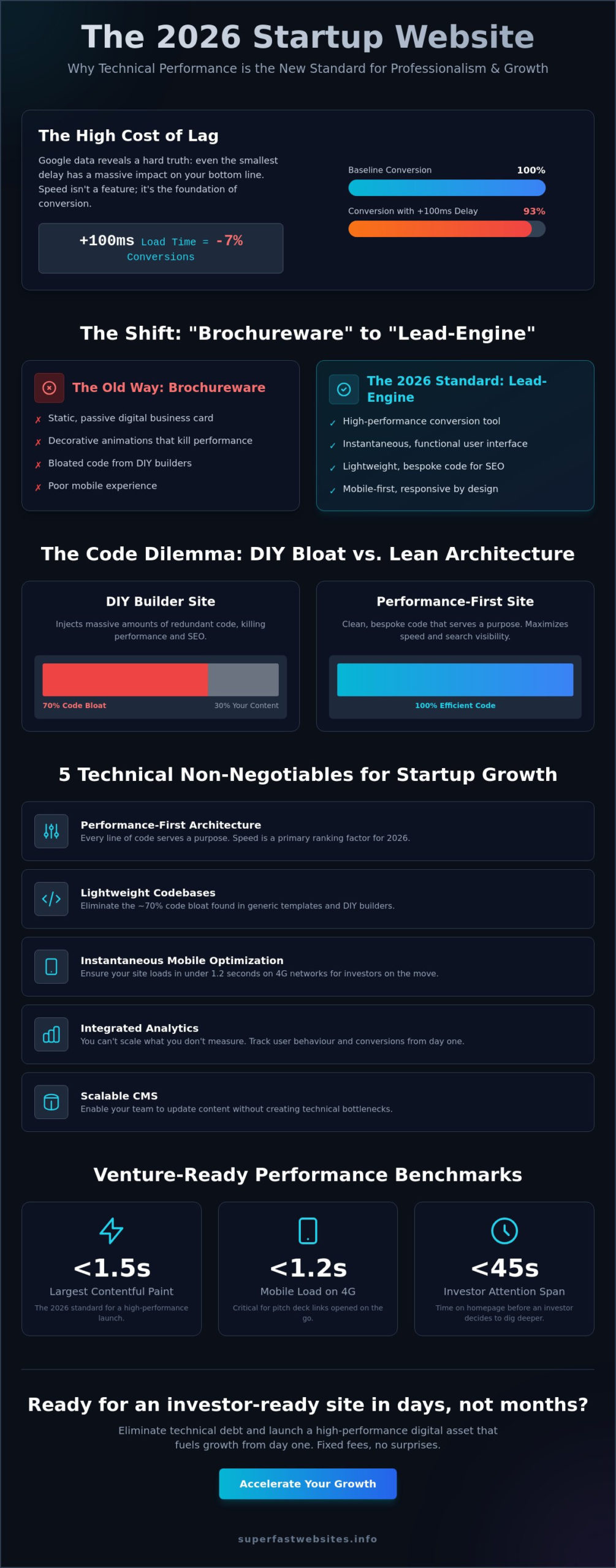
Google data shows that a 100-millisecond delay in mobile load time reduces conversion rates by up to 7%. For a UK founder, this latency is more than a technical lag; it's a silent leak in your marketing budget. You need a professional website for startups that commands authority the moment a page loads. You're likely tired of DIY builders that produce bloated code or agencies that demand three months and £15,000 for a basic landing page. You shouldn't have to choose between a rapid launch and elite technical performance.
We agree that speed is the ultimate competitive advantage in the 2026 digital economy. This guide details how to deploy a high-performance site in under 10 days that satisfies both Google's Core Web Vitals and the scrutiny of your next investor. We'll examine the technical stack required for a sub-second LCP (Largest Contentful Paint), from lightweight frameworks to scalable architecture, ensuring your digital presence grows as fast as your revenue.
Key Takeaways
- Define 2026 professionalism through instantaneous load times and mobile-first responsiveness rather than decorative animations.
- Secure maximum SEO visibility by implementing lightweight codebases that avoid the performance-killing bloat of standard DIY builders.
- Calculate the true ROI of founder time to understand why a professional website for startups outperforms cheap, time-intensive alternatives.
- Deploy an investor-ready digital asset in just seven days using a structured, performance-focused launch roadmap.
- Eliminate agency fee anxiety with fixed-fee models designed to deliver elite technical results without hidden costs or budget creep.
What defines a professional website for startups in 2026?
A professional website for startups in 2026 is a high-performance digital asset designed for rapid conversion and investor credibility. The era of static digital business cards is over. In the current UK venture market, your site must function as a precision tool that facilitates growth rather than a passive display of information. Professionalism is now measured by instantaneous load times and mobile-first responsiveness. Heavy, complex animations that drain battery life and increase latency are being replaced by streamlined, functional interfaces.
Startups must understand the fundamental shift from "brochureware" to "lead-engines." A site that merely exists is a liability. Before seeking capital, founders should clarify What is a Startup? in the context of scalability. If your digital infrastructure cannot scale alongside your user base, it fails the professionalism test. Building a professional website for startups requires moving beyond basic templates to create a custom, lightweight framework that prioritises the user's time and objectives.
Your Minimum Viable Product (MVP) requires a Minimum Viable Site (MVS) to survive the initial market entry. An MVS is not a "cheap" site. It is a focused, high-speed version of your brand that eliminates digital bloat. It provides the essential data points investors need while ensuring the technical foundation is robust enough for future expansion.
The "Venture-Ready" aesthetic
Technical authority is signalled through clean typography and high-contrast layouts. UK investors often spend less than 45 seconds on a startup's homepage before deciding whether to dig deeper. Social proof, such as logos of early partners or verified growth metrics, must be integrated into the primary scroll. Venture-Ready Design is a precise equilibrium where minimalist aesthetics meet high-performance functionality to project immediate technical authority. Every pixel must justify its existence through its impact on trust or conversion.
Why speed is the primary trust signal
Speed is the most objective measure of a startup's technical competence. Data from 2025 indicates that a 100-millisecond delay in load time can result in a 7% drop in conversion rates. If your site feels sluggish, savvy investors assume your underlying product architecture is equally flawed. Slow sites signal a lack of attention to detail and a disregard for user experience.
The 2026 standard for a high-performance launch is strict. Your Largest Contentful Paint (LCP) must be under 1.5 seconds. Achieving this requires a performance-first logic that strips away unnecessary third-party scripts and unoptimised assets. In a competitive landscape, your load speed is the first and most lasting impression you make on the market.
The 5 technical non-negotiables for startup growth
Startups live or die by momentum. A slow site kills that momentum instantly. A professional website for startups must be built on five core pillars to ensure it functions as a growth engine rather than a digital weight. We prioritize a performance-first architecture. This ensures your site achieves maximum SEO visibility from the moment it goes live. Every millisecond saved correlates to a measurable increase in user retention.
Your technical stack dictates your ceiling. We focus on these five non-negotiables:
- Performance-first architecture: Every line of code serves a purpose. Speed is the primary ranking factor for 2026.
- Lightweight codebases: We eliminate the 70% code bloat typically found in generic templates.
- Instantaneous mobile optimisation: Pitch deck links are often opened on mobile devices during transit. Your site must load in under 1.2 seconds on 4G networks.
- Integrated analytics: You cannot scale what you do not measure. We embed tracking for early-stage user behaviour and conversion metrics.
- Scalable CMS: Your internal team needs the ability to update content without technical bottlenecks.
If you want a site that outpaces the competition, explore our high-performance web solutions to see how speed drives ROI.
Lightweight code vs. DIY bloat
Most startups choose "drag-and-drop" builders for perceived convenience. This choice often leads to technical debt. These platforms inject massive amounts of redundant CSS and JavaScript. This bloat makes it nearly impossible to pass Google's Core Web Vitals. Clean, bespoke code improves search engine crawl budgets. This means Google indexes your new domain faster and more efficiently. For those building complex lead engines, our guide on B2B web development explains how to convert this technical efficiency into a lead-generation machine.
Security and SSL as standard
UK startups are prime targets for digital vulnerabilities. Cyber threats against small UK businesses rose by 15% in the last year alone. Security is no longer an add-on but a baseline requirement. SSL certificates are the bare minimum. Without them, browsers display "Not Secure" warnings that drive away 85% of potential visitors. Beyond encryption, you must include the essential pages for your business website to establish legal and professional credibility. This includes clear privacy policies and terms of service that comply with UK GDPR standards. A professional website for startups must protect both user data and brand reputation simultaneously.
DIY Builders vs. Managed Professional Services
Startups often fall into the trap of "low-cost" drag-and-drop builders. While a £20 monthly subscription looks attractive on a balance sheet, it represents a performance ceiling. A professional website for startups isn't just about aesthetics; it's about conversion architecture. DIY tools produce bloated code that slows down mobile load times by up to 3.5 seconds compared to clean, managed frameworks. This delay directly impacts your bottom line, as 40% of users abandon a site that takes more than three seconds to load.
Founder time is your most expensive asset. If a founder spends 45 hours building and troubleshooting a DIY site, and their time is valued at £150 per hour, that "cheap" website has already cost the company £6,750 in lost productivity. Outsourcing to a managed service shifts this burden to specialists. It allows the leadership team to focus on product-market fit and investor relations while experts handle the technical deployment. As a subsidiary of VIA Creative, Superfast Websites integrates high-level brand strategy with technical precision, ensuring your site aligns with professional UK market expectations from day one.
The hidden cost of technical debt
Technical debt accumulates every time a shortcut is taken. DIY platforms often use proprietary code that makes it impossible to export your data cleanly. When designing a website for growth, scalability must be baked into the initial code. Migrating a bloated DIY site to a professional framework in year two typically costs 200% more than building it correctly the first time. You risk losing hard-won SEO equity and backlink profiles during the transition. A professional website for startups prevents this "rebuild fatigue" by providing a scalable foundation that evolves with your Series A and Series B funding rounds.
Expert support vs. Community forums
Startups cannot rely on community forums when a site goes down during a critical pitch or a high-traffic launch. Managed services provide 24/7 technical maintenance and proactive monitoring. We use high-performance cloud hosting rather than budget shared servers that often suffer from "noisy neighbour" syndrome, where other sites on the server drain your resources. Reliability is a non-negotiable metric. A 99.9% uptime guarantee ensures your digital storefront remains open when it matters most. Professional support means having a dedicated team to resolve issues in minutes, not days spent waiting for a support ticket response from a generic global provider.
The Startup Launch Roadmap: From concept to live in 7 days
Speed to market is a competitive advantage. For a professional website for startups, a protracted development cycle is a liability. You need a 168-hour sprint from domain acquisition to live production. This roadmap prioritises technical performance over aesthetic bloat, ensuring your site remains lightweight and conversion-ready from day one.
- Step 1: Secure domain name registration and high-performance hosting. Use UK-based NVMe servers to ensure a Time to First Byte (TTFB) under 180ms.
- Step 2: Finalise your site architecture. Determine if your MVP requires a single-page flow or a hierarchical structure.
- Step 3: Deploy your brand assets and conversion-led copy. Every word must serve a specific user action.
- Step 4: Execute the technical optimisation sequence. This includes CSS minification, WebP image conversion, and script deferral.
- Step 5: Run the 2026 launch protocol. This involves rigorous mobile responsiveness testing and achieving a minimum Lighthouse score of 95 across all metrics.
Choosing the right structure
The "One Page Wonder" is the superior choice for pre-launch startups or single-product MVPs. It eliminates navigation friction, keeping users on a linear path toward your call to action. Data shows that single-page layouts can increase conversion rates by 30% for early-stage ventures. If your startup requires deep educational content or multiple service categories, the "Multi-Page Marvel" is necessary. This structure supports a robust SEO strategy, allowing you to rank for specific long-tail keywords relevant to the UK market.
Content that converts
Clarity outperforms cleverness. Investing in professional copywriting ensures your value proposition is understood within 3 seconds of page load. Your homepage must answer what you do, who you do it for, and why it matters before the user scrolls. Modern startup workflows now rely on AI integration to handle real-time data processing and customer intent mapping, ensuring your site evolves as fast as your business. A professional website for startups isn't a static digital brochure; it's a high-velocity sales engine.
A 100ms delay in load time can result in a 7% drop in conversions. We don't tolerate lag. Our deployment sequence ensures your site is optimised for the 2026 web standards, focusing on Interaction to Next Paint (INP) metrics that Google prioritises for ranking. Don't let technical debt kill your launch momentum.
Accelerate your growth with Super Fast Websites
Startups don't have time for the traditional agency model. Traditional agencies are slow, expensive, and often deliver bloated code that hinders your SEO from day one. We've spent 20 years refining our process to eliminate these bottlenecks. Our approach replaces "agency fee anxiety" with a transparent, fixed-fee structure. You'll never see a surprise invoice or an unexplained hourly charge. We focus on performance-first logic, ensuring every line of code serves a specific conversion goal. Speed isn't just a metric; it's our core philosophy.
Our 7-day rapid deployment programme is built for founders who need to move fast. We use a lightweight, modern technology stack that consistently outperforms standard WordPress or Wix templates. This isn't just a website; it's a high-velocity growth engine. By prioritizing speed, we help you capture traffic that competitors lose to slow load times. In the 2026 digital economy, a one-second delay can cost you 7% in conversions. We don't accept that risk. We deliver a professional website for startups that functions as a precision tool for lead generation.
Transparent pricing for lean startups
Predictable budgets are essential for managing a lean startup's burn rate. Our fixed-price tiers allow for precise financial planning without the fear of scope creep. "The Multi-Page Marvel" package offers a comprehensive solution for businesses ready to scale. It includes custom performance optimization, mobile-first design, and essential SEO architecture. Beyond the launch, our hosting and maintenance subscriptions provide ongoing value. We don't just host your files; we actively manage your site's technical health to maintain peak performance levels as your traffic grows. This ensures your site stays fast, secure, and compliant with UK regulations.
Ready to launch?
The path to a professional website for startups begins with a simple kick-off brief. We've stripped away the fluff to focus on your core business objectives and technical requirements. Once the brief is submitted, our team initiates the 7-day sprint. The immediate impact on your 2026 growth will be measurable through improved search rankings and higher user engagement. Don't let a sluggish site hold your business back. Contact us today to secure a high-performance site that's engineered for speed and built to convert. Your competitors won't know what hit them.
Own the 2026 Performance Standard
The digital landscape in 2026 doesn't reward mediocrity. A 100ms delay in load time can slash conversion rates by 7% according to established industry benchmarks. You've identified that technical non-negotiables like lightweight code and instant server response aren't just features; they're essential revenue drivers. Startups that bypass the bloat of DIY builders for a high-performance foundation gain an immediate advantage in search rankings and user retention.
Securing a professional website for startups shouldn't take months of development or drain your capital through hidden agency fees. Super Fast Websites is a subsidiary of VIA Creative, bringing over 20 years of design authority to every build. We've stripped away the traditional agency bloat to offer fixed-fee pricing and a streamlined workflow. This allows us to deliver launch-ready, high-performance sites in as little as seven days. Our process is designed for the UK market, ensuring your business meets modern standards without the typical overhead.
Don't let technical debt stall your momentum before you've even launched. Launch your professional startup website in 7 days with Super Fast Websites. It's time to build your growth on a foundation of pure speed.
Frequently Asked Questions
How much does a professional website for startups cost in 2026?
A professional website for startups in the UK typically costs between £5,000 and £15,000 for a high-performance build. This price range covers custom technical architecture, performance optimisation, and conversion-focused design. Costs vary based on the complexity of integrations and the specific technology stack used to ensure sub-second load times.
How long does it take to build a startup website from scratch?
A standard high-performance startup site requires 4 to 8 weeks from initial discovery to final deployment. This timeline accounts for technical planning, development sprints, and rigorous performance testing. Complex projects involving bespoke API integrations or custom web applications may extend to 12 weeks to ensure total stability and speed.
Should a startup use a one-page or multi-page website?
You should choose a multi-page structure if you intend to scale your organic traffic through SEO. While one-page sites are quick to deploy, they limit your ability to rank for diverse keywords. A multi-page professional website for startups allows for dedicated landing pages, which can increase conversion rates by 20% compared to cluttered single-page layouts.
What are the most important SEO features for a new startup site?
Core Web Vitals, server-side rendering, and automated schema markup are the most critical technical SEO features. Google's current benchmarks require a Largest Contentful Paint (LCP) of under 2.5 seconds for competitive ranking. Your site must use semantic HTML5 and lightweight code to ensure search engine crawlers can index your content instantly without errors.
Can I update my startup website myself after it launches?
Yes, you can manage your content through a headless CMS or an integrated administrative dashboard. This architecture separates your data from the high-performance code, allowing you to edit text and images without risking site speed. Your team maintains full control over marketing updates while the technical infrastructure remains secure and optimised.
Do I need a custom logo and copy before starting my web project?
You must have your brand identity and core messaging finalised before the development phase begins. 85% of web project delays are caused by missing content or late design assets. Providing these elements early allows the developer to build a professional website for startups that is mathematically aligned with your specific conversion goals and brand aesthetics.
What is the best hosting for a fast startup website?
Managed cloud hosting on platforms like AWS, Vercel, or Google Cloud provides the best performance for UK startups. These providers offer edge computing and UK-based servers that reduce latency by up to 50ms. Avoid cheap shared hosting; it lacks the resources to handle traffic spikes and will degrade your site's loading speed and SEO score.
Is it better to hire an agency or a freelancer for a startup site?
Hire an agency if you need a multidisciplinary team focused on performance, security, and scalable growth. A 2024 industry report found that agency-led builds have a 30% higher success rate in meeting technical KPIs compared to individual contractors. Agencies provide collective accountability and a broader range of technical expertise for high-stakes launches.