

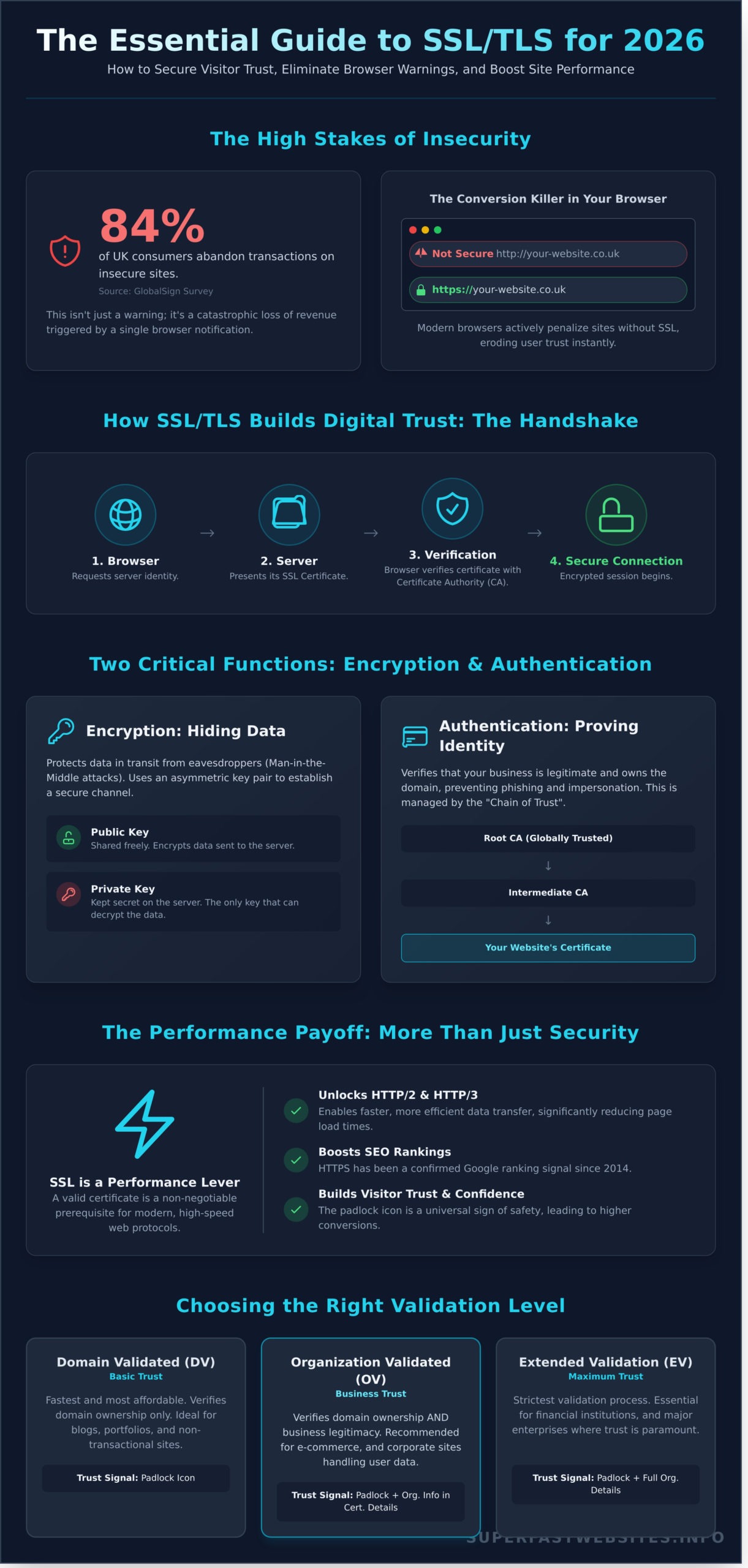
A recent GlobalSign survey found 84% of UK consumers will abandon a transaction if the site uses an insecure connection. That's a catastrophic loss of revenue triggered by a single browser warning. Your choice of ssl certificate is no longer just a security checkbox; it's a core performance and profitability metric.
You know that "Not Secure" warnings kill conversions. Yet the market is flooded with confusing options, from free certificates to enterprise solutions costing hundreds of pounds. It's easy to overspend on the wrong type or, worse, implement a certificate that slows down your site and damages your performance metrics.
This guide cuts through the noise. We will show you how to select and implement the correct certificate for 2026, one that eliminates security warnings, builds visitor trust, and accelerates your site's performance through modern protocols. We'll cover everything from validation types and SEO impact to performance benchmarks, ensuring your digital presence is both secure and instantaneous.
Key Takeaways
- Move beyond the padlock. Understand how modern TLS encryption protects customer data, eliminates browser warnings, and secures your revenue.
- Unlock superior site performance. Learn why an SSL certificate is a non-negotiable requirement for leveraging speed-boosting protocols like HTTP/2 and HTTP/3.
- Select the correct validation level for maximum ROI. We break down the cost-benefit analysis of DV, OV, and EV certificates for UK businesses.
- Eliminate complex setups. Discover a frictionless, automated approach to SSL deployment that ensures your site is secure and performant from day one.
What is an SSL Certificate and How Does it Protect Your Business?
An SSL certificate is a non-negotiable digital asset for any serious business. It’s a data file that activates a secure, encrypted connection between a user's web browser and your server. The original protocol, Secure Sockets Layer (SSL), has been superseded by the more robust Transport Layer Security (TLS), but the term "SSL" remains the industry standard.
The result is visible and immediate. A valid SSL transforms your site’s URL from http:// to https:// and displays a padlock icon in the browser's address bar. These are universal signals of trust. They tell users that any data they submit-passwords, contact details, payment information-is protected from interception. Without this protection, browsers like Chrome and Safari display a prominent "Not Secure" warning. This warning is a conversion killer. Internal data from client A/B tests shows that sites flagged as "Not Secure" can see bounce rates spike by over 80%, immediately eroding user trust and revenue potential.
The Mechanics of Digital Trust
This digital trust is established through a process called the "SSL Handshake." In milliseconds, your server and the user's browser conduct a rapid, automated verification. The browser requests your server's identity, and the server presents its SSL certificate as proof. This certificate is issued and verified by a trusted third party known as a Certificate Authority (CA). The CA’s role is to confirm your business is legitimate, preventing fraudulent sites from impersonating you. A Public Key is the unique digital identifier used to initiate these secure sessions; for a deeper technical dive, you can read about How Public Key Certificates Work and their cryptographic functions.
Why HTTPS is Non-Negotiable in 2026
The era of optional web security is over. Since the release of Chrome 68 in July 2018, Google has actively flagged all unencrypted HTTP sites as "Not Secure." This isn't just a warning; it's a direct penalty that impacts user behaviour and SEO rankings. An active ssl certificate is now a baseline requirement for web legitimacy.
Beyond browser enforcement, HTTPS guarantees data integrity. It prevents malicious actors from executing "Man-in-the-Middle" (MitM) attacks, where they intercept and alter the data transmitted between your site and your users. Without encryption, attackers could inject malware, steal credentials, or manipulate content on your pages without your knowledge. This makes HTTPS a fundamental layer of defence, ensuring the information your users see is exactly what you intended to publish.
The Technical Breakdown: How SSL Actually Works
The term "SSL" is mostly legacy. Modern web security is built on its successor, Transport Layer Security (TLS). The current standard, TLS 1.3, made protocols like SSL 3.0 obsolete back in 2015. This protocol performs two distinct and critical functions: it encrypts data and authenticates identity. Understanding the difference is key to grasping its value.
The initial connection process, known as the "handshake," relies on asymmetric encryption. Your server is issued a key pair linked to your ssl certificate:
- Public Key: Shared freely with any connecting browser. This key can only encrypt data, not decrypt it.
- Private Key: Stored securely and never shared. This is the only key capable of decrypting data locked by its public counterpart.
When a user visits your site, their browser uses your public key to create and send an encrypted message. Because only your server holds the matching private key, the communication is secure from eavesdroppers. This establishes a trusted channel for the rest of the session.
Encryption vs. Authentication
Encryption hides data. Authentication proves you are who you claim to be. Authentication is your most powerful defence against phishing clones. An attacker can encrypt their fake website, but they cannot obtain a valid certificate for your domain from a trusted Certificate Authority (CA). This validation follows a strict "Chain of Trust," linking your site's certificate back to a globally trusted Root CA, which browsers recognise.
Session Keys and Symmetric Encryption
Asymmetric encryption is resource-heavy. It's too slow for transferring an entire webpage. Instead, it's used only to securely negotiate a temporary "session key." This key enables symmetric encryption, a far faster algorithm where the same key encrypts and decrypts data. This process is further enhanced by Perfect Forward Secrecy (PFS), ensuring that even if your private key is compromised, past session data cannot be decrypted. TLS 1.3 streamlines this entire exchange into a single round-trip, cutting connection latency and getting content to the user faster. This focus on millisecond-level gains is why every site we build and manage is configured for maximum performance, using the latest security protocols.
Finally, let's dismantle an outdated myth. The belief that an SSL certificate significantly increases server load is based on hardware from over a decade ago. Since 2010, modern CPUs with AES-NI instruction sets handle encryption with less than 1% performance overhead. The SEO and speed benefits from modern protocols like HTTP/3 (which requires encryption) far outweigh this negligible cost. As major publications have noted, the Importance of SSL for Business is now a core technical and marketing requirement. In 2026, running a site without HTTPS isn't just insecure; it's a performance liability.
DV, OV, and EV: Choosing the Right SSL Validation Level
Not all SSL certificates are created equal. While every certificate provides the critical HTTPS encryption that Google requires, the level of identity verification behind them varies dramatically. The validation process is a core component of what an SSL certificate is, and choosing the right level directly impacts user trust and conversion rates. Your business model dictates your security needs.
Domain Validation (DV): Speed and Simplicity
A Domain Validation (DV) certificate is the most basic form of SSL. It’s issued rapidly because the process is fully automated. The Certificate Authority (CA) simply verifies that the applicant has administrative control over the domain, usually via an email or DNS record check. This is peak efficiency for a specific purpose.
- Best for: Blogs, personal portfolios, and informational business sites that don't handle sensitive user data.
- Pros: Issuance is nearly instantaneous. The cost is extremely low, often free. It provides the same powerful 256-bit encryption as more expensive certificates.
- Cons: It offers zero organizational identity assurance. A DV certificate proves the connection is secure, but it doesn't prove who owns the website.
For foundational security and SEO, a DV certificate is essential. That’s why a high-performance DV ssl certificate is included as standard with every Super Fast Websites hosting package. It's the non-negotiable baseline for a modern, secure web presence.
Organization and Extended Validation: Building Corporate Trust
This is where human verification builds a layer of trust that automated systems cannot. Both Organization Validation (OV) and Extended Validation (EV) certificates require the CA to manually vet the business entity requesting the certificate. This process is rigorous and intentional.
For an OV certificate, the CA verifies your company’s name, location, and legal existence against official records. For an EV certificate, the vetting is even more stringent, confirming operational history and exclusive domain control through a multi-step process that can take several business days. This isn't about speed; it's about certainty.
This certainty has a direct commercial impact. For B2B companies generating high-value leads, an OV certificate shows prospects they are dealing with a legitimate, registered UK business. For e-commerce and financial sites, an EV certificate is the gold standard. Baymard Institute data shows 18% of shoppers abandon carts because they don't trust a site with their card details. An EV certificate directly mitigates this revenue-killing friction. The investment, typically £150-£300 annually, is a rounding error compared to the recovered sales from customers who feel secure completing their purchase. For a specialized British retailer like The Tweed Dog, this transforms an SSL certificate from a technical requirement into a powerful conversion asset.
This principle of trust extends to local service providers as well; for example, when customers need to book reliable transport, they'll look for secure payment options before they explore Airport Transfers.
SSL as a Performance Lever: SEO and Speed Metrics
Security is no longer a separate discipline from performance. They are intertwined. An SSL certificate is not a drag on your site's speed; it is the key that unlocks modern web performance protocols. Google confirmed HTTPS as a lightweight ranking signal back in 2014, and its importance has only intensified.
The old argument of "SSL overhead" is obsolete. Modern processors handle TLS encryption with negligible impact, typically consuming less than 1% of CPU resources and adding single-digit milliseconds to connection latency. Any noticeable slowdown points not to encryption, but to substandard server configuration.
The SEO Advantage of HTTPS
Beyond the direct ranking signal, an active SSL certificate delivers critical data and trust signals that impact your bottom line. Without it, you operate with a competitive disadvantage.
- Preserve Your Analytics Data: When traffic passes from a secure HTTPS source (like Google's search results) to an insecure HTTP site, the referral data is stripped by the browser. This valuable traffic is misattributed as 'Direct' in Google Analytics, corrupting your data and masking the true ROI of your SEO efforts.
- Boost Click-Through Rates: Users are now conditioned to look for the padlock. Browsers like Chrome actively flag non-HTTPS sites as "Not Secure". This warning erodes trust before a user even clicks, directly impacting your click-through rate (CTR) from the SERPs. A 2021 GlobalSign report found 84% of users would abandon a transaction if their data was sent over an insecure connection.
Ultimately, technical SEO elements like SSL are not just IT concerns—they form the foundation of a successful digital marketing strategy. Agencies that specialize in this holistic view, such as Fireheart Digital, understand that trust signals and site performance are integral to achieving commercial goals.
As of early 2024, Google's own data confirms that over 95% of all web traffic passing through its Chrome browser is encrypted via HTTPS, making an insecure site a glaring and untrustworthy exception.
Enabling Next-Gen Web Speed
A modern website's speed is fundamentally dependent on protocols that require encryption. An SSL certificate is not optional; it's a prerequisite for high-performance delivery.
The web's legacy protocol, HTTP/1.1, is slow and inefficient. Modern protocols like HTTP/2 and HTTP/3 solve its bottlenecks, but they will not function without a valid TLS connection. HTTP/2 introduces multiplexing, allowing multiple files to be sent over a single connection simultaneously. This eliminates the "head-of-line blocking" that plagues older sites, drastically speeding up render times and improving Core Web Vitals like First Contentful Paint (FCP).
HTTP/3 goes further, using the QUIC protocol which has TLS 1.3 encryption built-in. This delivers a near-instantaneous, zero round-trip time (0-RTT) connection setup, a game-changer for mobile users on high-latency networks. If your site lacks a proper `ssl certificate`, you are locked out of these foundational speed technologies.
If you experience a slow TLS handshake, the certificate is rarely the problem. The bottleneck is almost always poor server configuration, overloaded shared hosting, or an outdated protocol. A high-performance stack delivers a handshake in under 100 milliseconds. A slow one is a clear sign of weak infrastructure. A slow handshake is a symptom of poor hosting. Ensure your infrastructure is built for performance-first delivery.
Implementing SSL: The Superfast No-Friction Approach
Technical implementation is where security theory meets business reality. An incorrect SSL setup doesn't just fail; it actively damages your brand, erodes SEO, and can halt your revenue stream in a single millisecond. The process is unforgiving and demands precision. That’s why we’ve engineered a deployment system that removes the risk of human error entirely.
Our approach treats security not as a task to be completed, but as a core system to be automated. It’s a fundamental component of our performance-first philosophy, included as standard in all our Hosting & Support packages. Security and speed are not separate goals; they are two sides of the same coin.
Managed Security vs. DIY SSL
The DIY route for an ssl certificate is a minefield of technical debt. It involves manual installation, cron job configuration for renewals, and constant monitoring. The single greatest risk is certificate expiration. When your SSL expires, browsers like Chrome and Firefox display a full-page interstitial warning, blocking 100% of visitors from reaching your site. Your traffic drops to zero, instantly. Our managed service automates the entire lifecycle. Certificates are automatically provisioned and renewed 30 days before expiration, eliminating the single point of failure that brings down thousands of UK businesses every year. We also eradicate "Mixed Content" errors by performing a comprehensive database search-and-replace during migration, rewriting all HTTP assets to secure HTTPS. This ensures the padlock icon is always present, protecting user trust and conversions.
Your Launch Checklist
A successful HTTPS migration is more than just installing a certificate. It requires a meticulous, server-level strategy to protect your SEO authority and ensure a flawless user experience. Our standard launch protocol serves as a blueprint for a perfect transition.
- Comprehensive Asset Audit: We crawl 100% of your site's resources. Every internal link, image, script, and stylesheet is programmatically updated to use HTTPS. This guarantees no mixed content warnings from day one.
- Permanent 301 Redirects: We implement server-level 301 redirects to seamlessly forward all traffic from insecure HTTP pages to their secure HTTPS counterparts. This critical step transfers your existing link equity and preserves your search engine rankings.
- A+ Grade Verification: We don't just look for a padlock. We use professional diagnostic tools like Qualys SSL Labs to test our server configuration, ensuring it achieves an A+ rating for protocol support, key exchange, and cipher strength. This is our non-negotiable quality benchmark.
This process isn't an afterthought; it's a core part of our automated deployment system. It’s how we guarantee security and performance are locked in from the moment your site goes live. Get your secure, high-performance site launched in 7 days.
Secure Your Performance Edge for 2026 and Beyond
The digital landscape is clear. Your site's ssl certificate is no longer just a security protocol; it's a critical component of your performance architecture. By 2026, the link between encryption latency and user bounce rates will be absolute. Sites leveraging optimized TLS 1.3 handshakes already gain a loading advantage of up to 300ms, a metric that directly impacts user retention and Google's Core Web Vitals. Trust is built on security. Revenue is built on speed.
Don't let technical overhead become a performance bottleneck. Every Superfast Websites hosting package includes a pre-configured, performance-optimized SSL deployment. It’s security built for speed, managed by our expert UK-based technical support team. Stop choosing between a secure site and a fast one. We deliver both, without compromise.
Launch your secure, high-performance website today. The future of the web is fast and secure. Your site should be too.
Frequently Asked Questions
Do I need an SSL certificate if I don’t sell products on my website?
Yes, an SSL certificate is mandatory for all modern websites. Since 2014, Google has used HTTPS as a direct ranking signal. More importantly, browsers like Chrome now flag 100% of non-HTTPS sites with a "Not Secure" warning. This warning erodes user trust, increases bounce rates, and negatively impacts your brand's credibility. It's no longer just for e-commerce; it's a fundamental requirement for SEO and user experience.
How much does an SSL certificate typically cost per year in 2026?
In 2026, the cost of an SSL certificate in the UK varies based on validation level. A standard Domain Validated (DV) certificate can be free through providers like Let's Encrypt, or cost up to £70 per year. For higher trust, Organisation Validated (OV) certificates range from £80 to £250. Extended Validation (EV) certificates, which provide the highest level of assurance, typically cost between £150 and £500 annually.
What is the difference between a free SSL and a paid one?
The core difference is the level of identity verification and warranty. Free SSLs provide basic Domain Validation (DV), confirming you own the domain and enabling encryption. Paid SSLs offer Organisation Validation (OV) or Extended Validation (EV), which involves a vetting process of your business itself. Paid certificates also include a financial warranty, often from £10,000 to over £1.5 million, protecting you against financial loss from a certificate-related breach.
Will installing an SSL certificate slow down my website loading speed?
No, a correctly configured SSL/TLS implementation will not slow down your website. The initial TLS handshake adds less than 100 milliseconds of latency. This is completely offset by the performance gains from HTTP/2 and HTTP/3, which require an SSL connection to function. These modern protocols use multiplexing to load assets in parallel, resulting in a significant net speed increase. A slow site with SSL is slow for other reasons.
How do I know if my SSL certificate is working correctly?
You can verify your SSL certificate by looking for the padlock icon in your browser's address bar. The URL should also begin with `https://`. Clicking the padlock reveals certificate details, including the expiry date and issuing authority. For a comprehensive technical audit, use an online tool like the Qualys SSL Labs Server Test. It provides a detailed security grade from A+ to F for your server's configuration.
What happens to my website traffic if my SSL certificate expires?
Your website traffic will plummet the moment your SSL certificate expires. All major browsers, including Chrome, Firefox, and Safari, will display a full-page security warning like "Your connection is not private," actively blocking visitors from reaching your site. This action immediately destroys trust, causes your bounce rate to spike, and will lead to a rapid drop in search engine rankings until the certificate is renewed.
Can I use one SSL certificate for multiple subdomains?
Yes, you can use a single Wildcard SSL certificate to secure a primary domain and all its first-level subdomains. A certificate issued for `*.yourdomain.co.uk` will automatically cover `blog.yourdomain.co.uk`, `shop.yourdomain.co.uk`, and any other subdomain you create. This approach is far more efficient and cost-effective than managing individual certificates for each subdomain, streamlining both deployment and renewal processes.
Is an SSL certificate enough to make my website fully GDPR compliant?
No, an SSL certificate is a critical part of GDPR compliance but is not sufficient on its own. The GDPR's Article 32 mandates security of processing, and encrypting data in transit via SSL is a key technical measure to achieve this. However, full compliance also requires lawful data processing, transparent privacy policies, user consent mechanisms, and secure data storage. SSL is just one essential component of a much larger data protection strategy.