

Your brand book is killing your conversions. You've invested thousands of pounds into what you believe is a website style guide, but it's likely a print document in disguise. It encourages heavy assets and complex design choices that add hundreds of milliseconds to your load time. That 'brand consistency' is actively costing you revenue.
This article provides a different blueprint: a performance-first framework built for speed. We'll show you how to strip away the bloat and build a truly lightweight system that enforces brand authority with every instantaneous page load. Get ready to learn the core components of a lean guide and implement a roadmap for immediate performance gains.
Key Takeaways
- Understand how a standardized design system directly translates into optimized code and faster load times.
- Discover the core elements that drive 90% of your site's design, allowing you to bypass bloated brand books.
- Learn a step-by-step process to build a lean website style guide that enforces consistency and eliminates code redundancy.
- Adopt a "performance-first" logic where every design choice is measured against its impact on speed and conversions.
What is a Website Style Guide and Why Does Performance Depend on It?
A website style guide is not a marketing document. It's a living technical blueprint that governs every component of your digital presence. It dictates the precise rules for typography, colour palettes, spacing, and interactive elements. While general definitions can answer What is a Style Guide?, a performance-first guide goes further. It enforces efficiency at the code level.
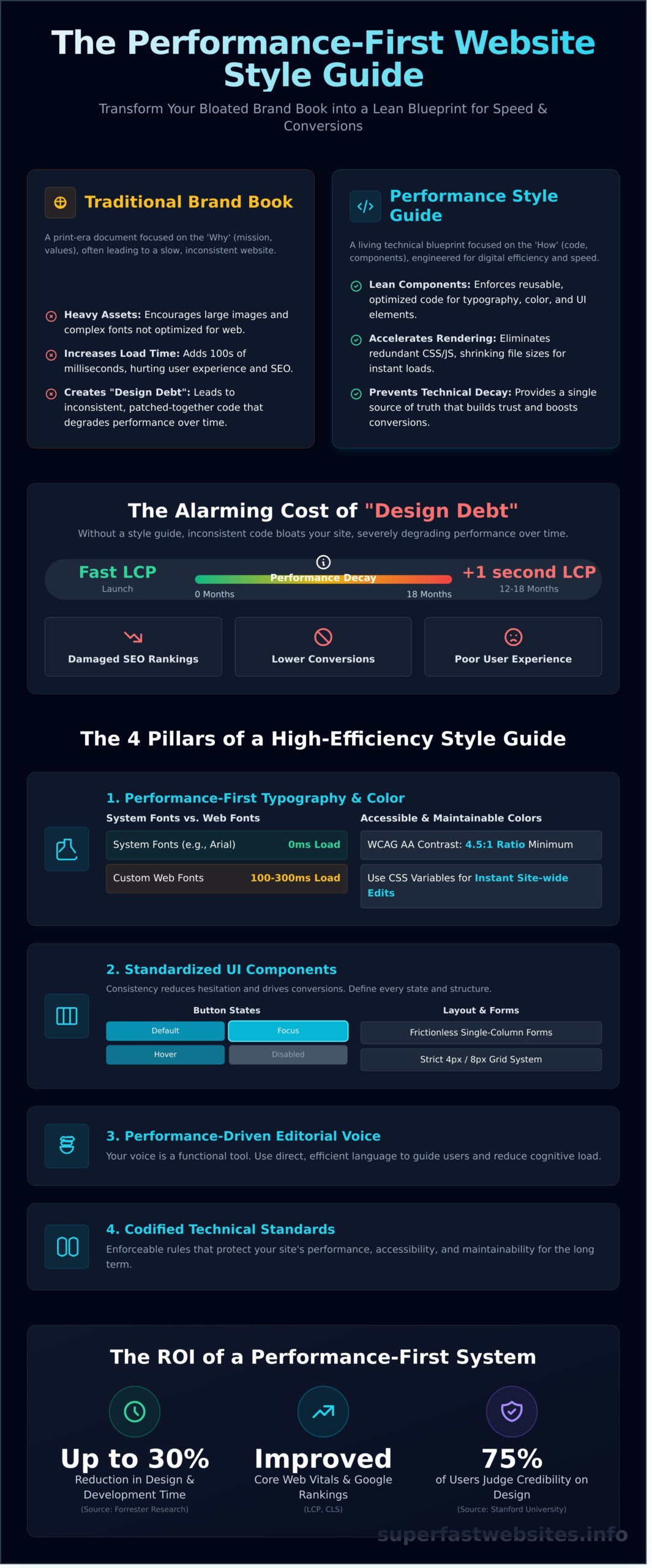
Performance is engineered through standardisation. When developers have a single, authoritative source for UI components, they don't create new, slightly different CSS classes for every button or form field. This systematic approach directly optimises your code. It eliminates redundant CSS and Javascript, shrinking file sizes and accelerating browser rendering times. Without this discipline, your website accumulates "Design Debt."
Design Debt is the gradual degradation of your site's performance caused by inconsistent, patched-together code. Each new feature adds another layer of conflicting styles, bloating your stylesheets and slowing down page loads. Over 12-18 months, this bloat can increase your Largest Contentful Paint (LCP) by over a second, directly damaging your SEO rankings and user experience. A style guide is the only effective defence against this technical decay.
This consistency also has a powerful psychological impact. A visually coherent website feels stable, professional, and trustworthy. Inconsistent buttons, shifting layouts, and clashing colours create subconscious friction, making users hesitate. Stanford University research found that 75% of users judge a company's credibility based on its website design. Consistent design builds the trust required to drive conversions, from completing a checkout to submitting a lead form.
Style Guide vs. Brand Book: Clearing the Confusion
Many UK businesses confuse a brand book with a style guide. They are not interchangeable. A brand book defines the 'Why' of your business: mission, values, and high-level logo usage. A website style guide defines the 'How' for your digital assets: the exact hex codes, CSS class names, pixel-perfect spacing, and defined interaction states for every UI component. By 2026, having both will be non-negotiable for maintaining a competitive, professional digital presence.
The ROI of a Performance-First Style Guide
Implementing a rigorous style guide delivers a measurable return on investment. It's a strategic asset that pays dividends through pure efficiency. This isn't about aesthetics; it's about eliminating waste and maximising speed. Key performance indicators include:
- Reduced Development Costs: Industry analysis from Forrester Research shows mature design systems reduce design and development time by up to 30%, freeing up hundreds of hours for innovation instead of rework.
- Improved Core Web Vitals: By enforcing the use of lean, reusable code, you eliminate the CSS bloat that harms LCP and Cumulative Layout Shift (CLS), directly improving your Google search rankings.
A performance-first style guide is a performance blueprint for digital growth.
The 4 Core Pillars of a High-Efficiency Style Guide
A simple document is not enough. A high-performance website style guide is a technical blueprint for efficiency, conversion, and brand consistency. It eliminates ambiguity and enforces standards that directly impact your bottom line. Forget decorative PDFs; this is an active, enforceable rulebook. The system is built on four non-negotiable pillars.
Typography and Color for the Modern Web
Every design choice must justify its performance cost. For typography, this means a critical decision between system fonts and web fonts. System fonts like Arial are pre-installed on user devices, requiring zero network requests and loading instantaneously. A single custom web font can add 100-300ms to your load time. Your colour palette must also perform. Define primary and secondary colours with strict WCAG 2.1 AA contrast ratios (at least 4.5:1 for normal text) to ensure accessibility. Implement these colours using CSS variables. This simple technique allows a site-wide colour change to be a single-line edit, executed in milliseconds.
Standardizing UI Components for Conversion
Inconsistent UI creates hesitation. Hesitation kills conversion. Your style guide must define the behaviour of every interactive element. For Call-to-Action (CTA) buttons, define every state: default, hover, active, focus, and disabled. This provides immediate visual feedback, increasing user confidence and click-through rates. Form design rules must be ruthless in reducing friction. Mandate single-column layouts, minimal fields, and clear, accessible labels. A consistent grid system, based on a 4px or 8px baseline, isn't an aesthetic choice; it’s a mathematical framework for visual harmony and predictable developer handoff.
Your editorial voice is a functional tool, not marketing fluff. It should be direct, professional, and efficient, mirroring the Super Fast philosophy. Every headline and paragraph must guide the user to their goal with zero friction. We strip away vague language to reduce cognitive load, making interactions faster and more intuitive. This isn't just about tone; it's about performance-driven communication.
Finally, codify your technical standards. These are the rules that protect your site's performance and accessibility. Mandate that all JPEG images are compressed to a quality of 75 and served in WebP format. Define your responsive breakpoints (e.g., 600px, 900px, 1200px) to guarantee a flawless experience on every device, a critical factor for Google's mobile-first indexing. Your guide must enforce WCAG 2.1 Level AA compliance as a baseline. This is a legal and commercial imperative under the UK's Equality Act 2010. For a prime example of how these standards are documented at scale, review a comprehensive enterprise style guide from a major government body. This level of rigour is what separates a basic template from a high-performance digital asset. It’s the foundation of every performance-optimised website we build.
Lean vs. Enterprise Style Guides: Which Does Your Business Need?
Enterprise businesses often operate with 100-page brand bibles. This is the "NASA" approach. It's meticulous, comprehensive, and completely toxic to startup momentum. For an SME, this level of documentation isn't just unnecessary; it's a performance bottleneck. It slows down design, confuses developers, and prioritises abstract brand theory over functional, high-speed user experience. Your goal isn't a museum piece. It's a conversion tool.
A lean approach delivers superior results. Focus on the five elements that drive 90% of your site's look and feel. A lightweight website style guide defines only what is essential for consistency and speed. Anything more is digital bloat. The core components are your typography hierarchy, primary and secondary colour palettes, a consistent spacing system (like an 8-point grid), button states, and form element styles. Documenting these five pillars creates a robust foundation without the drag of an enterprise-level manual.
The most common mistakes stem from over-complication. Choosing five font weights for your body copy doesn't make you look sophisticated; it adds hundreds of kilobytes to your page weight and slows down rendering. A complex, bespoke iconography set requires extra HTTP requests and file downloads. Limit your primary typeface to two weights (e.g., 400 for regular, 700 for bold) and use system-native SVGs for icons. Efficiency is a design choice.
The objection is always time. "We don't have time to create a style guide." This thinking is a false economy. Skipping this step doesn't save time; it defers cost. Without a guide, developers build redundant components, designers create inconsistent UIs, and your CSS file bloats with overrides. The technical debt incurred can cost an additional £5,000 to £10,000 in rework and maintenance over a site's first two years. You pay for a style guide whether you write one or not.
The Minimum Viable Style Guide (MVSG)
An MVSG is a one-page document built for action. For developers to use it effectively, document styles with exact values: hex codes for colours (#1A2B3C), pixel or rem units for spacing (16px), and numerical weights for fonts (700). This clarity eliminates guesswork. At Superfast, we use MVSGs to deliver projects like The Multi-Page Marvel in just seven days.
- Typography: Font family, sizes (H1-H6, P), weights, and line-height.
- Colour Palette: Primary, secondary, accent, and neutral colours with HEX/RGB values.
- Spacing System: Define base units for margins and padding (e.g., 8px, 16px, 32px).
- Buttons & CTAs: Styles for primary, secondary, and tertiary buttons in default, hover, and active states.
- Form Elements: Design for input fields, labels, and error states.
Common Pitfalls in Website Documentation
Poor documentation breeds "Zombie Styles"-CSS rules that exist in your stylesheet but serve no active purpose on the site. These unused selectors accumulate over time, adding unnecessary weight. It's also critical to distinguish consistency from uniformity. A consistent experience means a button's function is predictable everywhere, not that every single button must look identical. This is a core tenet behind the Core Pillars of a Style Guide, where usability dictates form. In fact, unchecked code from inconsistent design updates is a primary cause of bloat; redundant CSS from abandoned styles can increase total page weight by up to 50kb, directly impacting your load time and Core Web Vitals.
How to Create Your Website Style Guide in 5 Steps
Creating a high-performance website style guide is a systematic process, not an abstract design exercise. It’s about codifying efficiency to eliminate inconsistency and reduce code bloat. Follow these five steps to build a framework that ensures your digital presence is fast, cohesive, and effective.
Step 1 & 2: The Audit and Foundation
Begin with a technical audit of your existing assets. Use your browser's "Inspect" tool to scan pages for inconsistencies. Document every variation in hex codes, font sizes, and margins. You will likely find multiple shades of grey or several near-identical font styles, each adding unnecessary bytes to your CSS file. Your goal is to consolidate this chaos into a single source of truth. Select a "Performance Palette" limited to 5-7 colours that meet WCAG AA contrast standards (a ratio of at least 4.5:1 for normal text) to ensure accessibility and fast rendering. Finalise your typography by defining a clear hierarchy for H1 through H6 tags, specifying font family, weight, size, and line height for each. This creates a predictable user experience and strengthens your on-page SEO structure. Additionally, identify and eliminate "Zombie Styles" - CSS rules that are no longer used but still contribute to file size.
Step 3: Build the Component Library
Your component library defines the reusable building blocks of your site. This is where efficiency scales. For every interactive element - buttons, forms, navigation bars, and cards - create a master version. Document its structure, states (hover, active, focus), and spacing rules. A standardised primary button, for example, prevents developers from writing custom CSS for each new instance. This reduces the final stylesheet size, which directly correlates with a faster page load time. Every component must justify its existence through function and performance.
Step 4 & 5: Voice and Implementation
A style guide is incomplete without content rules. Craft an "Editorial House Style" that dictates your brand's voice, tone, and grammar. For maximum impact and readability, mandate the use of plain English and active voice. Aim for a Flesch-Kincaid reading level of Grade 8 or lower to ensure your message is understood instantly. This alignment of clear language with clean design is critical; it’s a core part of our Professional Copywriting service, where we match efficient code with efficient messaging. Finally, document everything and make it accessible. Host your guide on a private page on your website or a shared platform like Notion. A simple PDF is a start, but it becomes outdated quickly. A living document is the only way to maintain consistency.
A robust style guide is the blueprint for a consistent and high-performing website. It translates brand standards into technical rules that eliminate waste. A style guide ensures consistency. Our development process builds these performance principles directly into your site's foundation. Discover our performance-first approach.
The Superfast Approach: Designing for Speed and Scale
A conventional website style guide focuses on brand aesthetics. Our approach is different. For us, a style guide is a performance blueprint. It’s the architectural plan that allows for radical efficiency, ensuring every component is not only visually consistent but also technically lightweight. This is how we build and deploy enterprise-grade websites in a fraction of the standard time.
Our methodology is built on performance-first logic. Every design decision is interrogated for its impact on speed. Before an element is added to our framework, it must justify its existence in kilobytes and milliseconds. We don't ask, "Does it look good?" We ask, "Does its value outweigh its performance cost?" This ruthless optimisation is why our sites consistently achieve a Google PageSpeed score of over 95.
This principle of achieving maximum results with minimum waste isn't confined to web development. It's the same mindset driving innovations in other sectors, such as the high-efficiency, 20-minute workouts pioneered by SpeedFit.
SEO isn't an afterthought; it’s coded directly into the style guide. Technical and on-page ranking factors are defined as immovable standards from day one. This integration includes:
- Semantic HTML Structure: The guide mandates correct usage of heading tags (
<h1>to<h6>), ensuring a logical document outline for search engine crawlers. - Image Optimisation Protocols: All images must be served in WebP format, lazy-loaded by default, and adhere to strict file size limits. Alt text is a required field, not an option.
- Core Web Vitals Compliance: Component styles for fonts, buttons, and interactive elements are pre-optimised to guarantee minimal layout shift (CLS) and fast interaction times (FID/INP).
Why Rapid Deployment Requires Rigorous Standards
Our "Multi-Page Marvel" package leverages these pre-optimised foundations to eliminate indecision and technical debt. We don’t start from a blank canvas. We start with a high-performance chassis, ready for your brand. This allows for a fixed-fee design process with no hidden costs or delays. The result is a complete, high-performance website delivered in just seven days. Predictable outcomes require disciplined systems. Get your high-performance website launched in 7 days.
A static document is only the beginning. The ultimate goal is to evolve your website style guide into a dynamic design system. This isn’t a PDF; it's a living library of code components. When a button style is updated in the central system, that change is instantly reflected across every page of your site. This is how you scale your digital presence without introducing performance bottlenecks or brand inconsistencies.
Future-Proofing Your Design
A component-based system ensures your site can evolve. Need to update your primary call-to-action colour? Change one line of code in the system, not 50 individual pages. By 2026, we project AI-driven tools will audit new content against your design system in real-time, automatically flagging any deviation from established standards. This is the future of brand governance. Your style guide isn't a document; it's your most valuable digital asset, protecting your investment and guaranteeing performance for years to come.
From Style Guide to High-Speed Conversions
Your brand consistency and site speed are not separate goals. They are intrinsically linked. A performance-first website style guide transforms design rules into a technical blueprint for sub-second load times. It ensures every choice, from font loading protocols to image compression standards, is engineered to eliminate digital bloat and drive revenue growth.
Building this framework is a complex process. We've already perfected it. Backed by decades of marketing experience from our parent agency, VIA Creative, we deliver mobile-responsive and SEO-optimised sites that load in under 500ms. Our process is built on transparent, fixed-fee pricing, so you'll never see surprise agency costs on your invoice. It's the fastest path from concept to a high-performance digital asset.
Launch your performance-optimised website in just 7 days with Superfast Websites. Don't settle for a slow web; build an asset that converts.
Frequently Asked Questions
What is the difference between a brand guide and a website style guide?
A brand guide defines your entire corporate identity, while a website style guide focuses only on its digital application. The brand guide includes your mission, tone of voice, and offline assets. A website style guide is a technical document for developers. It specifies UI components, HEX colour codes, and typography rules to ensure digital consistency and performance.
What should be included in a website style guide for a small business?
A small business website style guide must include your core visual rules. This means defining logo usage, a primary colour palette with exact HEX codes, and typography standards for headings and body text. You should also specify styles for buttons, links, and basic form fields. These elements form the foundation of a consistent and professional user interface, which builds trust and improves user experience.
How does a style guide improve my website’s SEO and loading speed?
A style guide improves speed and SEO by enforcing code efficiency. It prevents CSS bloat by creating a reusable, lightweight system of styles instead of redundant code on every page. This directly reduces file sizes and improves load times. A 100ms improvement in site speed can increase conversion rates by 7%. Consistent HTML structure defined in the guide also improves semantic SEO for better rankings.
Do I need a style guide if I am using a website template?
Yes, you still need a style guide when using a template. The template is a starting point, not a system for maintaining your brand's unique identity. Your style guide documents how you customise that template with your specific colours, fonts, and component styles. It prevents inconsistency as you add new pages or blog posts, ensuring every element aligns with your brand and doesn't look like a generic theme.
How often should I update my website style guide?
You should review and update your website style guide at least once a year. A major update is also required after any significant website redesign or brand refresh. Treat it as a living document; add new UI components or patterns as they are built. An outdated guide causes confusion and defeats its purpose. A disciplined update schedule is critical for maintaining a cohesive and high-performance digital presence.
Can I create a style guide myself or do I need a professional designer?
You can create a basic style guide yourself if your brand identity is already defined. Document your existing logo, primary colours, and fonts in a simple document. For a full rebrand or a complex website with many components, a professional designer is a necessary investment. In the UK, a professional guide can cost between £500 and £2,000, but a simple self-made version is a high-impact start. To see how an agency specializing in high-performance platforms handles this, you can visit WordPress og WooCommerce Ekspert Webbureau og Service.
What are the best tools for creating a digital style guide in 2026?
The best tools for creating a digital style guide in 2026 are Figma for collaborative design systems and Notion for flexible documentation. Figma is the industry standard for designers, allowing for interactive component libraries that sync directly with development. For a simpler, code-free approach, Notion or even a well-structured Google Doc is a fast, lightweight, and effective solution for small teams. To see comparisons of these and other tech solutions, you can visit SuggestMeTech.
Is a style guide necessary for a one-page website?
Yes, a style guide is necessary even for a one-page website. Consistency is critical for user experience and brand perception, regardless of page count. A simple guide ensures your heading hierarchy, colour palette, and button styles are uniform from the header to the footer. It also creates an essential foundation for future marketing assets or website expansion, saving you time and ensuring brand integrity from day one.