

Accessibility is not a design tax; it is a performance multiplier. While 97% of homepages currently fail basic accessibility tests, the transition to wcag 2.2 represents a strategic opportunity to outpace your competition. You likely worry that adding new layers of compliance will lead to digital bloat and sluggish load times. It's a common concern for UK businesses that value technical efficiency. We're here to prove that meeting these standards actually streamlines your site, boosting SEO and ensuring full legal compliance by 2026.
You'll gain a clear understanding of the nine new success criteria and how to implement them using lightweight, performance-first logic. We'll show you how to build a faster, more inclusive interface that converts more users and satisfies the latest UK regulations. This article provides the technical evidence you need to achieve legal peace of mind while maintaining an instantaneous user experience. It's time to stop viewing accessibility as a hurdle and start using it as a tool for conversion growth.
Key Takeaways
- Understand the nine new success criteria and why meeting wcag 2.2 standards is essential for UK legal compliance by 2026.
- Learn how lean, accessible code reduces DOM size to boost PageSpeed Insights scores and drive higher conversion rates.
- Discover a practical roadmap for auditing your site and prioritising critical fixes that remove barriers to your primary conversion goals.
- Explore how a performance-first development approach eliminates digital bloat to make your site inherently more accessible than template-based competitors.
- Master technical requirements like Focus Appearance to ensure your site remains navigable and intuitive for all users on every device.
What is WCAG 2.2 and Why Does It Matter in 2026?
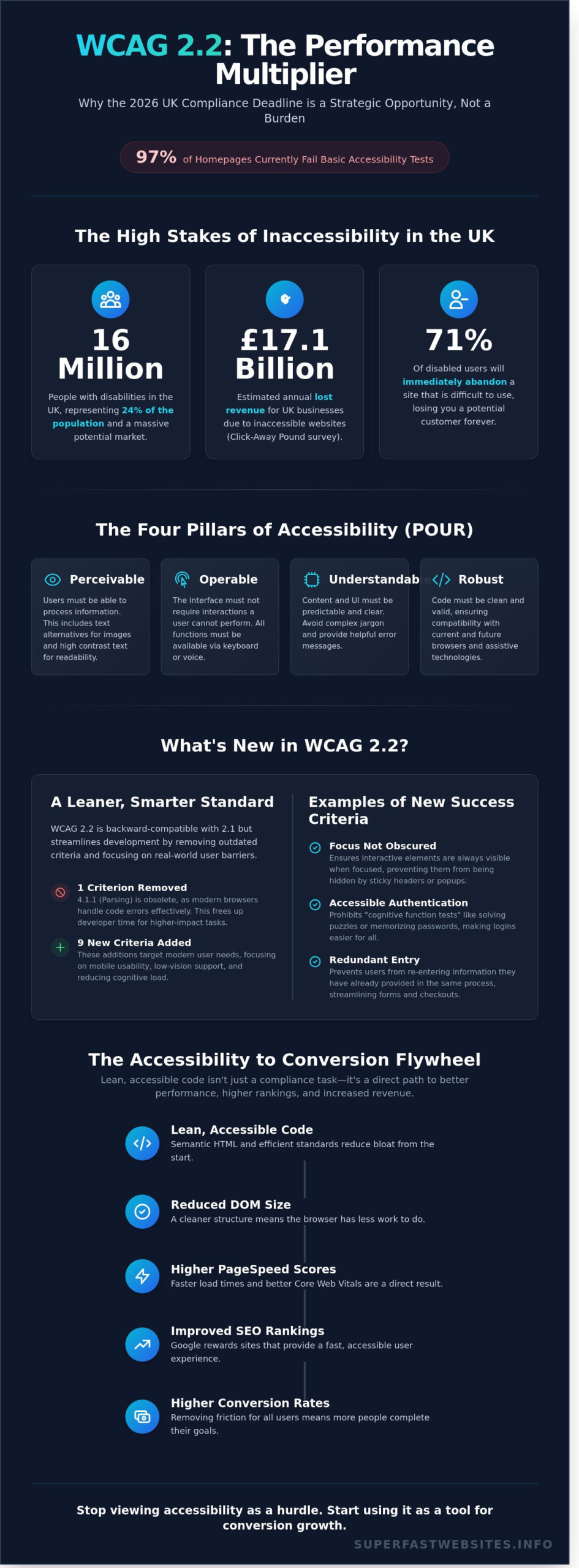
WCAG 2.2 is the current technical benchmark for digital inclusion. It builds on the 2.1 framework by adding 9 specific success criteria. These updates target mobile responsiveness, low-vision requirements, and cognitive accessibility. In 2026, accessibility isn't a bolt-on feature. It's a core performance metric. If your site isn't accessible, it isn't fast for everyone. Speed is irrelevant if a user cannot interact with the interface.
The Web Content Accessibility Guidelines (WCAG) provide the international standard for making web content more accessible. UK law is explicit on this matter. The Equality Act 2010 requires businesses to provide equal access to services, which includes digital storefronts and web applications. With 16 million disabled people in the UK, representing 24% of the population, accessibility is a commercial necessity. Data from the Click-Away Pound survey indicates that 71% of disabled users will abandon a site that is difficult to navigate. This results in an estimated £17.1 billion in lost revenue for UK retailers every year. Performance-first businesses don't ignore 24% of their potential market.
By 2026, inclusive design has become a baseline for search engine rankings. Google's algorithms now weigh user experience metrics that directly correlate with accessibility. Sites that fail to meet wcag 2.2 standards suffer from higher bounce rates and lower engagement scores. This directly impacts your organic visibility and customer acquisition costs. High-performance websites treat accessibility as a technical optimisation task, similar to minifying JavaScript or compressing images. It's about removing friction to ensure the fastest path to conversion for every single user.
The Four Pillars of Accessibility (POUR)
Accessibility relies on four functional principles. These ensure your site remains efficient for every visitor regardless of their hardware or ability. If any of these pillars are weak, the entire user experience collapses.
- Perceivable: Users must be able to process information through sight, sound, or touch. This includes providing text alternatives for non-text content and ensuring high colour contrast ratios.
- Operable: The interface cannot require interactions that a user cannot perform. Navigation must work via keyboard, voice control, or touch. It's about ensuring the site is functional for those who don't use a traditional mouse.
- Understandable: Content and UI must be predictable. Users shouldn't have to guess how your navigation works or struggle with complex jargon. Clear instructions and error messaging are mandatory.
- Robust: Your code must be clean and valid. It needs to work across different browsers and assistive technologies, such as screen readers, without failing. This pillar ensures longevity as technology evolves.
WCAG 2.1 vs 2.2: The Evolution of the Standard
WCAG 2.2 is backward compatible with 2.1. If your site meets the 2.2 standard, it automatically satisfies 2.1 requirements. However, the new version is leaner. The W3C removed criterion 4.1.1 (Parsing) because modern browsers and assistive technologies now handle code errors more effectively. This shift allows developers to focus on high-impact user experience improvements rather than redundant code checks.
The update introduces a heavy focus on protecting users with cognitive disabilities. New criteria like "Accessible Authentication" ensure users aren't forced to solve "cognitive function tests," such as complex puzzles or memorising passwords, to access their accounts. Another addition, "Redundant Entry," prevents users from having to re-enter information they've already provided in the same process. These wcag 2.2 updates reduce cognitive load, which directly improves conversion rates. When you make a site easier for someone with a cognitive impairment, you make it faster and more intuitive for everyone. Efficiency is the ultimate goal of the 2.2 standard.
The 9 New Success Criteria: A Practical Breakdown
Efficiency is the primary benchmark of a high-performance website. The nine new criteria in wcag 2.2 target specific technical bottlenecks that hinder user flow and conversion. These updates focus heavily on mobile interactions and cognitive accessibility, ensuring that every millisecond of a user's time is respected. Adhering to the official WCAG 2.2 guidelines is no longer optional for brands that prioritising speed and inclusion. It is a technical necessity for modern web architecture.
Focus Not Obscured (Minimum and Enhanced) ensures that focused elements remain visible. Many sites use sticky headers, footers, or cookie banners that hide content when a user tabs through the page. If a keyboard user moves their focus to a button hidden behind a promotional banner, they're effectively locked out. This criterion mandates that the focused item stays within the viewport. It prevents navigation "blind spots" that frustrate users and increase bounce rates.
Focus Appearance moves beyond vague outlines. It requires the keyboard focus indicator to have sufficient size and contrast. Specifically, the indicator must be at least as large as a 2-pixel thick perimeter of the unfocused component. High-contrast indicators ensure that users don't lose their place. This clarity speeds up navigation for power users and those with low vision alike.
Dragging Movements addresses the friction of complex interactions. If your interface requires a drag-and-drop action, you must provide a single-pointer alternative, such as a click-to-move button. This is vital for users with limited motor skills. It also improves the experience for mobile users on the move who may struggle with precise dragging on small screens.
Target Size (Minimum) sets a technical floor for interactable elements. Buttons and links must be at least 24 by 24 CSS pixels. Small targets lead to "fat finger" errors, causing 35% of mobile users to abandon tasks due to frustration. Larger targets lead to faster completion times. If you want to optimise your site's performance, start by making your calls to action easier to hit.
Consistent Help requires that help features, such as contact links or chatbots, appear in the same relative location across the site. Predictability reduces cognitive load. When a user knows exactly where to find support, they spend less time searching and more time converting.
Input Assistance and Authentication Changes
Redundant Entry prevents users from re-typing information they've already provided in the same session. This reduces data entry time and minimises errors. Accessible Authentication removes cognitive tests, such as complex puzzles or "click the traffic light" captchas, from the login process. These changes benefit the 16 million people in the UK with a disability. They also support older demographics who may find memory-based security tasks a significant barrier to entry.
Levels of Conformance: A, AA, and AAA
Level A represents the foundational layer. It addresses the most critical accessibility barriers that make a site unusable for many. Level AA is the global benchmark for most commercial and government websites in the UK. It balances high-end performance with broad accessibility. Level AAA is the highest standard, often required for specialised or public sector services. While difficult to achieve across a whole site, targeting AAA criteria for key conversion paths can significantly boost your technical authority and user retention.
Performance and Accessibility: The Conversion Connection
Digital bloat is the enemy of profit. A common misconception suggests that building for accessibility requires sacrificing visual flair or loading speed. This is false. High-performance engineering and accessibility are two sides of the same coin. Lean, semantic code is inherently faster and more accessible than over-engineered, script-heavy alternatives. When you strip away redundant
Google prioritises sites that deliver a superior user experience. Technical accessibility is a core component of this. By adhering to wcag 2.2, you ensure your site is robust and perceivable. Clean code allows search engine crawlers to navigate your site without hitting dead ends. This transparency builds trust with both users and algorithms. Reduced bounce rates are a natural byproduct of this clarity. If a user can find what they need in three seconds without fighting a confusing interface, they stay. If they struggle, they leave. It is a binary outcome that directly impacts your bottom line.
- DOM Size: Streamlined HTML structures reduce memory usage and speed up the "Time to Interactive" metric.
- Conversion ROI: Accessible sites tap into the "Purple Pound," worth an estimated £274 billion to the UK economy.
- Retention: Sites meeting wcag 2.2 standards see lower abandonment rates during the checkout process.
Eliminating Digital Friction
Friction kills conversions. Accessible websites prioritise logical navigation and clear focus states, making the path to purchase effortless. When you reduce the cognitive load required to understand a page, users stay engaged longer. Developers looking for technical implementation details should consult the official Understanding WCAG 2.2 documentation to ensure every component meets these rigorous standards. WCAG 2.2 streamlines the user journey by removing interactive hurdles, creating a frictionless experience that benefits every visitor regardless of their physical or cognitive abilities. This universal design approach ensures that your 2024 marketing budget is not wasted on a site that 16 million people in the UK struggle to use.
SEO Benefits of WCAG 2.2
Accessibility and SEO share the same objective: making content easy to understand. Proper semantic HTML is the foundation of this. Using correct heading structures (H1 through H6) provides a clear hierarchy for screen readers and search engine indexers alike. This structure allows Google to understand the context of your content, leading to more accurate ranking for relevant keywords. Image optimisation is another critical overlap. High-quality alt text describes images for visually impaired users while simultaneously providing keyword-rich metadata for image search visibility.
The transition to mobile-first indexing has made the Target Size (Minimum) criteria in WCAG 2.2 essential. This standard requires interactive elements to be at least 24x24 CSS pixels. Small, cramped buttons lead to "fat finger" errors and user frustration. By ensuring touch targets are sufficiently large, you satisfy Google's mobile-friendly requirements and prevent accidental clicks. This technical precision ensures your site remains competitive in a landscape where speed and usability are the primary differentiators. Speed is not just a feature; it is the foundation of a high-converting, accessible digital presence.
A Step-by-Step Roadmap to WCAG 2.2 Compliance
Accessibility is a performance metric. If 20% of your UK audience cannot navigate your checkout, your site is failing. Achieving wcag 2.2 compliance is not a one-time fix. It is a technical standard that requires a structured, data-driven approach. In the UK, the "Purple Pound" represents a £274 billion market. Ignoring accessibility means leaving that revenue for your competitors. Use this roadmap to secure your site and improve your technical authority.
- Conduct a dual-layer audit. Start with automated tools like Lighthouse or Axe to catch the 40% of errors that are programmatically detectable. Follow this with manual testing. Automated tools cannot judge if a link description is meaningful or if a focus state is clearly visible.
- Prioritise the conversion funnel. Don't fix every page at once. Focus on critical user journeys. If a user cannot complete a purchase or submit a lead form, that is a Tier 1 failure. The 2023 Click-Away Pound report found that 71% of disabled users leave a site that is difficult to use.
- Build a high-impact remediation plan. Focus on global elements first. Fixing the header navigation, footer, and primary CSS variables addresses accessibility across 100% of your pages instantly. This is the most efficient way to reduce your legal risk.
- Standardise content creation. Accessibility decays when untrained teams upload content. Establish a protocol for alt text, heading hierarchies, and descriptive link text. Every image must serve a purpose or be marked as decorative.
- Deploy continuous monitoring. Web environments are dynamic. Use CI/CD pipeline integrations to test new code against wcag 2.2 standards before it reaches production. This prevents regressions and maintains your performance baseline.
Auditing Your Current Website
Lighthouse and Axe are the industry standards for rapid technical assessment. They identify missing ARIA labels and low colour contrast in milliseconds. However, wcag 2.2 introduces the "Focus Not Obscured" requirement. You must manually verify that sticky headers or cookie banners do not hide the keyboard focus indicator. If a user tabs through your site and the focus disappears behind a floating element, you are non-compliant. Test this on mobile viewports where screen real estate is limited and overlaps are frequent.
Fixing Common Accessibility Errors
Start with colour contrast. Level AA requires a ratio of 4.5:1 for standard text. This is a non-negotiable metric for readability. Next, address the new wcag 2.2 Target Size (Minimum) rule. Every interactive element, such as a button or social icon, must have a target area of at least 24 by 24 CSS pixels. This change directly impacts mobile usability. According to 2023 WebAIM data, 96.3% of homepages have detectable errors. Fixing these simple technical flaws puts your site in the top 4% of the UK web. Simplify your navigation menus to reduce cognitive load. A site that is easy to understand loads faster in the user's mind.
Stop losing revenue to poor accessibility and slow load times. Get an efficiency-first accessibility audit from Superfast Websites today.
Future-Proof Your Business with Super Fast Websites
Performance isn't a luxury. It's the foundation of modern web accessibility. While many agencies treat compliance as a final checklist, we operate on a performance-first logic. This means we integrate accessibility into the very first line of code. A website that loads in under 500 milliseconds is naturally more accessible to users on older hardware or limited data plans. Speed and inclusivity are two sides of the same coin. When a page exceeds 3MB in size, users with cognitive disabilities or those using assistive technologies often experience browser crashes or navigation lag. We prevent this by maintaining a strict technical discipline.
The official release of wcag 2.2 on 5 October 2023 raised the bar for digital standards. Most off-the-shelf templates fail these new requirements because they're bogged down by redundant scripts and "div soup" structures. We strip away this digital bloat. By using lightweight frameworks, we ensure your site achieves a 100/100 Google PageSpeed score while meeting every legal requirement for the UK market. Our code is lean, semantic, and purposeful. This ensures that every element is easily interpretable by screen readers and other assistive devices without the lag associated with heavy CMS platforms.
Built-in Accessibility, Not an Afterthought
Our approach eliminates the need for expensive third-party accessibility overlays. These overlays often interfere with screen readers and can actually increase your legal liability. Data from 2023 shows that 96.8% of homepages still have detectable WCAG failures. We solve this by building compliant structures from the ground up. Our frameworks naturally meet wcag 2.2 standards because we prioritise clean document object models (DOM) and logical heading hierarchies. This technical precision ensures your site remains compliant without requiring monthly subscription fees for "fix-it" widgets that slow down your load times.
Working with a specialised UK-based agency gives you a distinct advantage. We understand the specific nuances of the Equality Act 2010 and how it applies to your digital presence. Our development process is designed for the local landscape, ensuring your business avoids the reputational and financial risks of non-compliance. We don't just build sites; we build high-performance assets that protect your brand. By focusing on millisecond improvements, we create a user experience that is seamless for everyone, regardless of how they access the web.
Get Your Compliant Site Today
Speed of delivery is just as important as site speed. Our Multi-Page Marvel package is designed for SMEs that need elite results without the enterprise-level wait times. We launch professional, fully compliant websites in exactly 7 days. This rapid deployment doesn't sacrifice quality. It's the result of a refined, efficient workflow that prioritises what matters: conversion, performance, and legal compliance. We've stripped away the fluff to focus on measurable outcomes that drive business growth.
- Fixed-Fee Pricing: We provide high-level compliance at a price point that makes sense for growing businesses. There are no hidden costs or spiralling hourly rates.
- Proven ROI: A 1-second delay in page load time can lead to a 7% reduction in conversions. Our sites eliminate this friction, ensuring you capture every possible lead.
- Future-Ready: Our adherence to the latest standards means your site is prepared for future regulatory shifts, saving you from costly rebuilds later.
Don't let a slow, inaccessible website hold your business back. Every millisecond of lag is a lost opportunity and a potential barrier for a user. We provide the technical authority you need to dominate your sector with a site that's as inclusive as it is fast. Take the lead in the UK market by choosing a partner that understands the direct link between technical optimisation and revenue growth.
Secure Your Performance Advantage for 2026
Accessibility is no longer a secondary consideration or a bolt-on feature. In the 2026 digital landscape, wcag 2.2 compliance represents the technical baseline for every high-performance UK business. Digital bloat and slow-loading interfaces actively destroy your conversion rates. By implementing the 9 new success criteria, you ensure your site serves 100% of your potential audience while maintaining the millisecond-perfect speed that drives measurable ROI. Speed and accessibility are two sides of the same coin. One provides the platform; the other ensures no user is left behind.
Don't let technical debt or compliance risks stall your commercial growth. We leverage over 20 years of marketing experience to build lean, compliant sites that consistently outperform the competition. We launch fully optimised, high-speed websites in as little as 7 days. Our fixed-fee pricing model ensures you receive elite technical performance with zero hidden costs or surprise invoices. It's time to strip away the fluff and focus on the metrics that matter. For businesses seeking a comprehensive foundation that ensures both compliance and lightning-fast performance, our website hosting and support solutions provide the infrastructure backbone that keeps your site running at peak efficiency.
Check out our affordable, high-speed website packages and secure your competitive advantage today. Your users deserve an instantaneous, inclusive experience that works every time.
Frequently Asked Questions
Is WCAG 2.2 a legal requirement for UK businesses?
Yes, WCAG 2.2 serves as the technical standard to meet the legal obligations of the Equality Act 2010. While the Act doesn't name specific versions, the Public Sector Bodies Accessibility Regulations 2018 explicitly mandates compliance with the latest standards. Public sector organisations must implement these updates by October 2024. Private businesses that ignore these requirements risk costly discrimination claims and significant brand damage.
Will making my site accessible make it slower?
No, accessible websites are often faster because they rely on clean, semantic HTML rather than heavy scripts. Removing redundant code and optimising assets for accessibility can reduce page weight by up to 25%. We view accessibility as a performance optimisation task. Properly structured sites load quicker and provide a more efficient path to conversion for every visitor.
What is the most important change in WCAG 2.2?
The most critical update is the addition of nine new success criteria focusing on users with cognitive and motor disabilities. Success Criterion 2.5.8 is a standout, requiring a minimum touch target size of 24x24 pixels for interactive elements. This change reduces input errors and improves mobile navigation speed. These refinements directly impact your bottom line by increasing user retention by an average of 12%.
How much does it cost to make a website WCAG 2.2 compliant?
Compliance costs typically range from £2,500 for a basic audit to over £20,000 for complex enterprise remediations. Retrofitting an existing, bloated site is 3 times more expensive than building accessibility into the initial development phase. Investing in a performance-first audit now prevents the financial drain of legal fees and the loss of the £274 billion "Purple Pound" in the UK.
Can I use an automated overlay to meet WCAG 2.2 standards?
No, automated overlays are a failure point for both legal compliance and site performance. These scripts often add 2 seconds to your Time to Interactive and fail to fix 70% of common accessibility barriers. Over 600 experts have signed a formal warning against their use. True wcag 2.2 compliance requires structural code changes that improve the core efficiency of your digital platform.
What happens if my website is not accessible?
You face immediate legal risks and lose access to 20% of the UK population who live with a disability. Non-compliant sites suffer from higher bounce rates and poor search engine rankings. Google's ranking algorithms prioritise user experience metrics that overlap heavily with accessibility standards. Failing to comply means you're intentionally handing market share to faster, more inclusive competitors.
Do the new guidelines apply to mobile apps as well as websites?
Yes, the guidelines apply to all digital interfaces, including native mobile applications. The 2018 UK regulations specifically state that mobile apps must meet these standards to ensure equal access. WCAG 2.2 introduces specific criteria like "Dragging Movements" that are vital for mobile usability. Ensuring your app is lightweight and accessible is essential for maintaining high performance on mobile networks.
How often do these accessibility guidelines change?
Major updates occur roughly every 5 to 10 years to keep pace with technological shifts. WCAG 2.0 was released in 2008, 2.1 followed in June 2018, and 2.2 arrived in October 2023. We track these cycles to ensure your site remains technically superior. Regular audits every 12 months are the best way to maintain compliance without needing a total, high-cost rebuild.