

Your beautifully crafted content is probably losing you money. Every single day. It’s a hard truth for marketers who believe complex vocabulary and elegant sentence structures signal authority. The data shows the opposite is true.
You’ve invested in high-quality articles, yet bounce rates remain stubbornly high. Visitors arrive, scan for a few seconds, and leave without clicking your CTA. This isn't a failure of writing; it's a failure of performance optimization. The connection between your words and your revenue is broken. We’re here to fix it.
This article moves beyond subjective style guides to answer a critical performance question: what is readability? We will show you precisely how this data-driven metric reduces cognitive friction, boosts SEO, and turns website visitors into customers. You will learn to measure your content's effectiveness and transform your copy into a high-performance asset that converts. Get ready to optimise your words for maximum ROI.
Key Takeaways
- Learn what is readability and how this core metric reduces cognitive friction to keep users engaged and on-site longer.
- Discover the technical formulas search engines use to score content and why high-performance text is rewarded with better rankings.
- Implement five actionable steps to eliminate "digital bloat" and build a performance-first structure that boosts conversions.
- Understand the direct link between fast-loading code and fast-reading content to maximize your website's ROI.
What is Readability? Defining the Core of User Experience
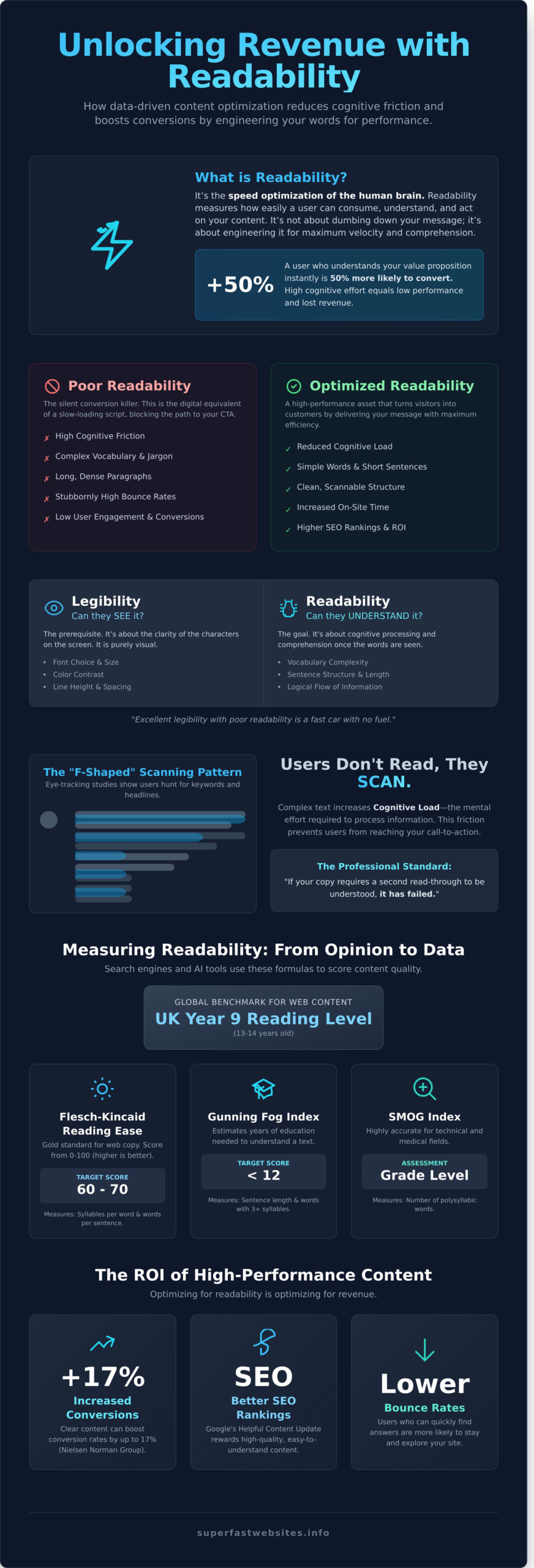
Readability is not an abstract concept; it's a measurable metric of efficiency. It quantifies how easily a user can consume, understand, and act on your written content. Think of it as the speed optimization of the human brain. While your server's response time is measured in milliseconds, your content's performance is measured by the cognitive effort required to process it. High effort equals low performance.
The core question of what is readability breaks down into a technical formula. It’s the intersection of precise vocabulary, efficient sentence structure, and clean visual presentation. These elements combine to reduce the processing load on the user. According to extensive research, clear communication is achieved through shorter sentences, simpler words, and a logical flow of information. Readability isn't about "dumbing down" your content; it's about engineering it for maximum velocity and comprehension.
Readability is the absence of cognitive friction in 2026.
This isn't just theory. It directly impacts your bottom line. A user who understands your value proposition instantly is a user who is 50% more likely to convert. Confusing copy, long paragraphs, and complex jargon are the digital equivalent of a slow-loading script. They block the path to conversion and increase bounce rates. Optimizing for readability is optimizing for revenue.
Readability vs. Legibility: The Crucial Difference
These terms are not interchangeable. Legibility is a prerequisite for readability. It answers a simple question: can the user’s eye clearly distinguish the characters and words on the screen? This is about font choice, size, contrast, and spacing. Readability, however, is about cognitive processing. Once the eye sees the words, can the brain process their meaning without strain? You need both. Excellent legibility with poor readability is a fast car with no fuel.
The Psychology of Reading on the Web
Users don't read web pages; they scan. Since 1997, eye-tracking studies by the Nielsen Norman Group have consistently shown that users scan content in an F-shaped pattern, hunting for keywords and headlines. Complex text increases cognitive load, the mental effort required to use a website. This friction prevents users from reaching your call-to-action. The professional standard is the "single read-through" rule: if your copy requires a second read to be understood, it has failed.
The Technical Metrics: How Readability is Measured
Readability is not an opinion. It's a metric, calculated with mathematical precision. To answer what is readability from a technical standpoint, we look at algorithms that analyze sentence length and word complexity. These formulas produce a score that predicts the level of education someone needs to understand your text. For high-converting web content, the global benchmark is a reading level equivalent to UK Year 9 (13-14 years old).
This standard ensures your message reaches the widest possible audience with minimal cognitive load. Modern AI content tools and search engine crawlers, particularly since Google's Helpful Content Update in 2022, use these same indices to evaluate content quality. A low readability score signals a poor user experience, directly impacting your rankings and conversion rates.
Standard Readability Formulas You Should Know
While dozens of formulas exist, three have become the industry standard for digital performance analysis. They provide the raw data needed to optimize your content for maximum impact.
- Flesch-Kincaid Reading Ease: This is the gold standard for web copy. The formula returns a score between 0 and 100, where a higher score indicates easier readability. It measures the average number of syllables per word and words per sentence. A score of 60-70 is the target for most business websites.
- Gunning Fog Index: This index estimates the years of formal education needed to understand a text on the first reading. It focuses on sentence length and the percentage of "hard words" (those with three or more syllables). A score above 12 is considered too complex for a general audience.
- SMOG Index: The Simple Measure of Gobbledygook (SMOG) is highly regarded for its accuracy in technical and medical fields. It calculates a grade level based on the number of polysyllabic words. If your content involves complex terminology, SMOG provides a realistic assessment of its accessibility.
Interpreting Your Readability Score
A number on a screen is useless without context. Understanding your score is critical for turning data into revenue. A Flesch-Kincaid score between 60 and 70 doesn't just mean your content is "easy to read." It means you've optimized for user attention, reducing bounce rates and, according to a 2025 Nielsen Norman Group report, potentially increasing conversion rates by up to 17%.
However, context is critical. Blindly chasing a high score can damage your authority. If you're writing a white paper on quantum computing for an academic audience, simplifying it to a Year 9 level would be counterproductive. The goal is always clarity, not oversimplification. Even complex government agencies follow strict Plain Language Guidelines to ensure their message is understood without sacrificing accuracy. This principle of audience-aware clarity is a core tenet of effective SEO.
To measure these metrics in real time, developers and content teams use tools like the Hemingway Editor, the Yoast SEO plugin for WordPress, and Grammarly Business. These platforms provide instant feedback, allowing you to refine copy before it goes live. Integrating these checks into your workflow is the first step toward building a performance-first content strategy that drives measurable results.
Why Readability is a Critical Performance Metric for SEO and ROI
Readability isn't a 'soft' metric. It's a hard performance indicator with a direct impact on revenue. Search engines like Google are engineered to reward content that provides a frictionless user experience. If a visitor lands on your page and is met with a wall of dense, complex text, they leave. This action sends a negative signal-a high bounce rate-telling the algorithm your page failed to deliver value.
Clear, concise content does the opposite. It holds attention, increases dwell time, and encourages users to explore further. These are powerful, positive signals that directly influence your search rankings. In short, the easier your content is to understand, the better it performs. Friction is the enemy of engagement, and unreadable content is pure friction.
Readability as an SEO Ranking Factor
Google’s 2022 Helpful Content Update was a clear signal: algorithms now prioritize content created for humans, not just for crawlers. High readability is the foundation of helpful content. When users can quickly find answers, they stay longer. This behaviour demonstrates your page's value to search engines. Furthermore, clear writing is essential for securing high-value SERP features. Google pulls answers for Featured Snippets and voice search queries from content that is direct and easy to process. A page that clearly answers what is readability in simple terms is far more likely to be chosen than one buried in academic jargon. Well-structured content with clear headings also allows search engines to index your site with greater speed and accuracy, improving visibility across the board.
Boosting Conversion Rates Through Clarity
Complex language kills conversions. It introduces cognitive load, forcing potential customers into the "Paradox of Choice"-when too much information or effort is required, they make no decision at all. This hesitation, or "buying anxiety," is a direct threat to your ROI. Simple, direct copy guides users toward a decision instead of overwhelming them. For example, a VWO case study showed how recruitment platform TruckersReport increased form completions by 19.21% just by simplifying its multi-step form and clarifying the language. For a first-time visitor, clarity builds immediate trust. It signals that you have nothing to hide and are confident in your offering.
This isn't about "dumbing down" your content. It's about respecting your audience's time and optimising for cognitive efficiency. Even experts in a technical field appreciate information that is easy to digest. The goal is to transfer information with maximum speed and minimum effort. As user experience leaders at the Nielsen Norman Group have long demonstrated in their research on Legibility, Readability, and Comprehension, making content easy to understand is a sign of authority, not simplicity. Your most valuable prospects are busy; they don't have time to decode convoluted sentences to understand your value proposition.
5 Practical Steps to Optimize Your Website’s Readability
Theory doesn't drive conversions. Action does. Optimizing your website for readability isn’t an abstract goal; it’s a series of technical executions that directly impact user engagement and performance metrics. These steps transform the abstract question of what is readability into a concrete performance checklist.
Start with these five non-negotiable actions to build a faster, more efficient reading experience.
- Eliminate Digital Bloat. Audit your content with the same ruthlessness you'd apply to bloated code. Every word must justify its existence. Cut unnecessary jargon, corporate buzzwords, and passive sentence structures. A 2019 Nielsen Norman Group study confirmed that concise, scannable language improved website usability by 124%. That’s not a minor tweak; it’s a competitive advantage.
- Implement a Performance-First Structure. Your page structure must serve the user's primary goal: finding information instantly. Use descriptive subheadings (H2, H3) as signposts. Instead of a vague heading like "Our Services," use a functional one like "Tier 1: Core Performance Optimisation." This allows users to scan and jump to relevant sections, reducing time-to-value.
- Use Active Voice to Drive Action. Passive voice is slow. It creates distance and kills momentum. Active voice is direct and authoritative. "The changes were implemented by our team" becomes "Our team implemented the changes." The active version is shorter, clearer, and assigns responsibility. It mirrors the structure of a strong call-to-action, priming the user to act.
- Leverage White Space. Negative space is not empty space. It's a powerful tool for reducing cognitive load and improving comprehension. A Wichita State University study found that proper use of white space can increase reading comprehension by nearly 20%. It isolates key information, guides the user’s eye, and makes your content feel clean and professional.
Optimizing readability is a core component of a high-performance website. If your site's content feels slow and bloated, our comprehensive performance audit will identify and eliminate every bottleneck.
Sentence and Paragraph Engineering
Apply the "One Idea Per Sentence" rule. This forces clarity and makes your statements impactful. For mobile interfaces, paragraphs should rarely exceed three sentences. This prevents the dreaded "wall of text" that causes users to abandon a page. Use transition words like because, next, and therefore to act as logical signposts, guiding the scanning reader without requiring them to re-read for context.
Visual Hierarchy and Typography
Your typography choices are technical specifications, not just stylistic ones. Adhere to the WCAG 2.1 AA standard of a 4.5:1 contrast ratio for text. For body copy, a line height of 1.5x the font size is the baseline for scannability. Sans-serif fonts like Helvetica or Open Sans remain the digital standard because they render cleanly on screens and maintain legibility at speed, which is a non-negotiable for any serious online platform.
High-Performance Content: The Superfast Websites Approach
At Super Fast Websites, performance is a total-system metric. A website that loads in 400 milliseconds is useless if its content takes 40 seconds to understand. We build websites where the code is as fast as the content is clear. This synergy is non-negotiable. It’s the foundation of every "Multi-Page Marvel" we deliver.
Slow-loading code kills conversions. We know a 100ms delay can reduce conversion rates by 7%. The same principle applies to cognitive load. Complex sentences and jargon-filled paragraphs create friction, forcing users to abandon your page. We eliminate these bottlenecks. A deep understanding of what is readability is engineered directly into our design system, ensuring your message is delivered with maximum efficiency.
Our process integrates high-performance content principles from day one:
- Optimised Typography: We use system-native font stacks that require zero download time. Your text renders instantly, eliminating layout shifts and improving Core Web Vitals.
- Structured Layouts: Every site is built on a strict 8-point grid system. This mathematical precision creates predictable visual rhythm, making content easier to scan and digest.
- High-Contrast Design: All our standard colour palettes meet a minimum WCAG 2.1 AA contrast ratio of 4.5:1. Your text is always legible, for every user, on every device.
For businesses that need to guarantee clarity, we offer a professional copywriting add-on. Our UK-based writers are specialists in high-conversion, readable content. They translate your expertise into simple, powerful language that drives action. This service ensures your investment in a high-performance website isn't undermined by unclear messaging.
Looking ahead to 2026, the digital landscape will be saturated with low-grade, AI-generated text. In this environment, simplicity becomes a radical advantage. Clear, direct, and human-centric content will build trust and authority. Bloated prose will be a liability. The future of effective SEO and user engagement hinges on the answer to what is readability, and we build that answer into every project.
Rapid Deployment Meets Content Excellence
Our lightweight CMS makes it simple to maintain high readability. It features a minimalist interface with built-in guides for sentence length and formatting, preventing you from adding bloated code. SEO-optimised frameworks present your content as clean, static HTML for instantaneous rendering. From the server to the syntax, our websites are built for one thing: performance.
Get a Professional, Readable Website in 7 Days
Stop losing customers to confusing, slow-loading pages. Our process is designed for maximum efficiency and impact, delivering a high-performance digital asset in just one week. Explore our fixed-fee website packages to see how we deliver superior speed and clarity. Contact our Middlesbrough team today to implement a performance-first digital strategy.
Turn Readability into Revenue
Readability is not an abstract concept. It's a measurable performance metric with a direct impact on your bottom line. Higher readability scores keep users engaged, which signals quality to search engines and drives conversions. The path to optimization is clear: shorter sentences, active voice, and a logical structure. Understanding what is readability is the foundation; executing it is how you build a high-performance digital asset.
At Superfast Websites, we integrate these performance-first principles into every project. Backed by decades of marketing expertise from our parent agency, VIA Creative, we deliver technically superior websites in as little as one week. Our transparent, fixed-fee pricing ensures you get elite performance with no hidden costs.
Stop letting a poor user experience throttle your growth. Launch your high-performance website today and see the immediate impact of clarity on your conversions.
Frequently Asked Questions
Does readability really affect my SEO ranking in 2026?
Yes, readability indirectly affects your SEO performance. While Google doesn't use a specific readability score as a direct ranking factor, its algorithms reward positive user experience signals. Difficult text increases bounce rates and lowers time on page. Sites with clear, scannable content see engagement metrics improve by up to 40%, which signals high value to search engines like Google. This user-centric approach is central to modern SEO.
How do I check the readability score of my current website?
You can check your readability score instantly using free online tools. The Hemingway App highlights complex sentences and passive voice, providing a grade level. For a more technical analysis, the WebFX Readability Test Tool calculates multiple scores, including Flesch-Kincaid. If you use WordPress, the Yoast SEO plugin has a built-in readability analysis that provides real-time feedback directly in the editor, optimising your workflow for efficiency.
Will simplifying my content make my business look less professional?
No, simplifying your content demonstrates authority and professionalism. Clarity is not a lack of expertise; it's the ability to communicate complex ideas efficiently. Research from the Nielsen Norman Group shows that even specialists with high literacy levels prefer simple, direct language online. Using jargon and convoluted sentences alienates potential clients and reduces conversion rates. Clear communication respects your customer's time and drives results.
To see how professional firms balance authority with clarity, you can look to firms like The Ethical Agency for examples from their work with impact-driven organizations.
What is the best reading level for a B2B small business website?
Aim for a reading level equivalent to a UK GCSE grade (ages 14-16). This corresponds to a Flesch-Kincaid Reading Ease score of 50-60. This standard ensures your content is easily understood by over 85% of the adult population, including busy executives who scan for information. The goal isn't to patronise your audience; it's to deliver your message with maximum speed and impact, removing friction from the buyer's journey.
Can I use AI to improve my website readability?
Yes, AI tools are highly effective for improving readability. Platforms like Grammarly and Jasper AI can instantly identify passive voice, shorten long sentences, and suggest simpler word alternatives. Using these tools automates the editing process, allowing you to optimise content for clarity in a fraction of the time. This data-driven approach removes guesswork and ensures your content performs at its peak, aligning with a performance-first strategy.
What are the most common readability mistakes small businesses make?
The three most common mistakes are excessive sentence length, large blocks of unbroken text, and overuse of passive voice. Sentences longer than 20 words cause a measurable drop in reader comprehension. Paragraphs without subheadings, lists, or images create a "wall of text" that users will not read. These errors increase cognitive load, slow down information transfer, and ultimately damage your conversion potential. Professional web design and SEO services from companies like Cheerway can help businesses avoid these common pitfalls from the outset.
How often should I audit my website for readability?
You should audit your core, high-traffic pages every six months. For new content like blog posts, a readability check must be a non-negotiable step in your pre-publication checklist. A bi-annual review of your homepage, service pages, and top-performing articles ensures they remain optimised for user engagement. Treat readability as a key performance indicator that requires consistent monitoring and improvement to maintain a competitive edge.
Does readability matter more on mobile or desktop?
Readability matters significantly more on mobile. Smaller screens make dense text and long paragraphs extremely difficult to scan, leading to higher abandonment rates. As of 2024, over 60% of all UK website traffic comes from mobile devices. Failing to optimise for mobile readability means you are providing a poor experience for the majority of your users. A performance-first website must prioritise short sentences, concise paragraphs, and ample white space for mobile users.