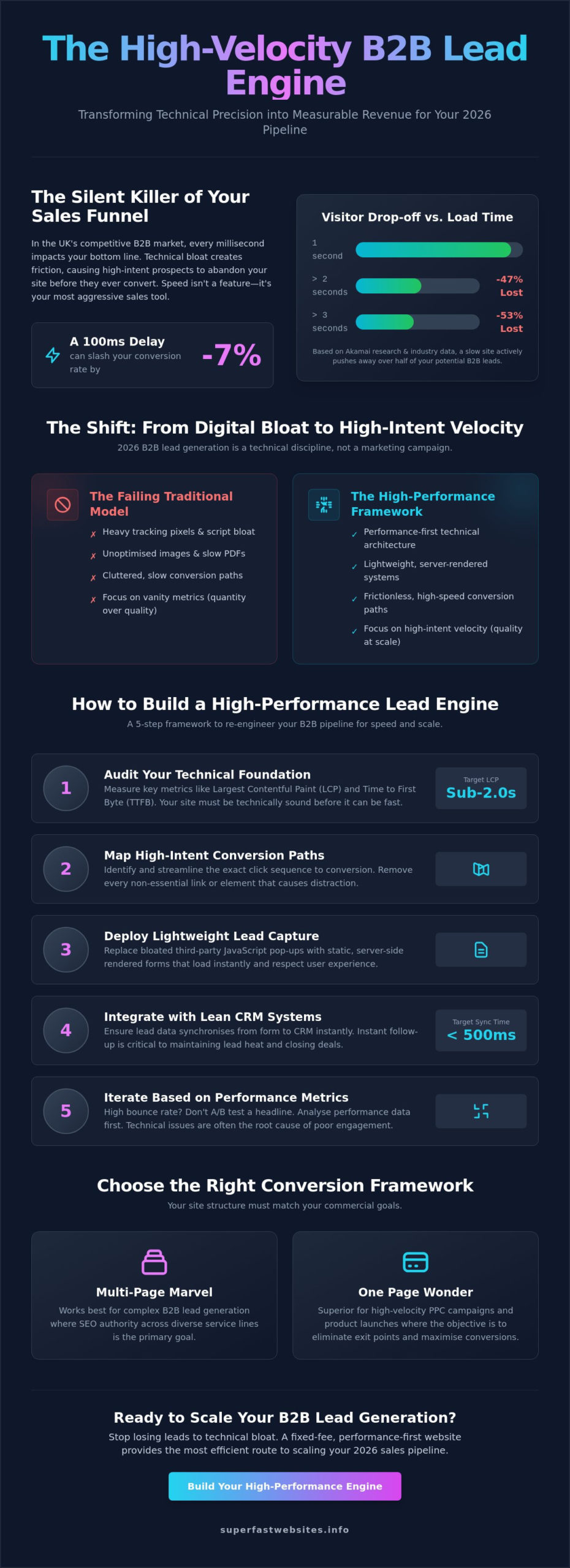
A 100-millisecond delay in page load time can slash your conversion rates by 7% according to Akamai research. In the competitive UK market, technical bloat is the silent killer of your b2b lead generation strategy. You're likely investing thousands in targeted campaigns only to lose 53% of potential prospects because your landing pages fail to load within three seconds. When every millisecond correlates to a drop in your bottom line, speed is no longer a luxury; it's your most aggressive sales tool.
It's exhausting to watch high-intent traffic bounce because of a slow interface or a cluttered conversion path. You already understand that a bloated website creates friction, yet most firms still settle for mediocre performance. This guide shows you how to build a high-velocity engine that transforms technical precision into measurable revenue. We will explore the performance-first framework required to streamline your 2026 pipeline; we'll focus on automated workflows, higher conversion rates, and the specific speed-to-lead metrics that drive growth. You'll learn how to strip away the legacy code slowing you down and replace it with a lightweight system designed for rapid scale.
Key Takeaways
- Learn how to transition from quantity-based metrics to high-intent velocity using a technical b2b lead generation framework.
- Identify the specific technical bottlenecks and script bloat currently sabotaging your site’s conversion potential.
- Compare the ROI of performance-led inbound vs. outbound to achieve a significantly lower cost-per-acquisition for your UK business.
- Optimise your conversion path by deploying lightweight, high-performance forms that turn technical speed into measurable revenue.
- Discover how a fixed-fee, performance-first website model provides the most efficient route to scaling a 2026 sales pipeline.
What is B2B Lead Generation in 2026?
B2B lead generation in 2026 is a technical architecture designed to harvest high-intent interest at scale. It's no longer about casting a wide net or chasing vanity metrics. The industry has shifted toward high-intent velocity. To understand what is lead generation in this performance-first era, you must treat your website as a precision instrument. The cold call is obsolete. Your website has replaced it as the primary engine for growth. There's a direct, measurable correlation between millisecond performance and lead volume. A 100-millisecond delay can slash conversion rates by 7%. For a UK firm aiming for a £1 million pipeline, that's a £70,000 penalty for poor technical execution. Speed is the new gatekeeper of the B2B funnel.
The Anatomy of a Modern B2B Lead
Modern leads are defined by data, not assumptions. Identifying your Ideal Customer Profile (ICP) now requires real-time firmographic analysis and intent monitoring. You don't guess who your buyer is; you track their digital footprint. It's vital to distinguish between a simple inquiry and a truly qualified lead. An inquiry might be a casual researcher, but a qualified lead is a decision-maker with a budget. A B2B lead is a data-verified business entity with active intent. By filtering for these signals, you ensure your b2b lead generation efforts produce high-velocity results rather than just a bloated database.
Why Traditional Lead Gen is Failing
Traditional lead generation is failing because it's built on a foundation of digital bloat. Heavy tracking pixels, unoptimised images, and slow-loading gated PDFs create massive friction. 2026 buyers don't have time for marketing fluff. They want answers instantly. If your landing page takes more than 2 seconds to load, you've already lost the attention of 47% of your visitors. This friction is a silent killer of ROI. In the UK's competitive B2B landscape, slow sites signal a lack of technical authority. High-intent buyers always choose the path of least resistance. If your site is slow, you're subsidising your competitor's growth. Every second of delay is a direct hit to your bottom line. Effective b2b lead generation requires a lean, performance-first approach that respects the buyer's time and delivers value without the wait.
How to Build a High-Performance Lead Engine
Lead generation isn't a creative exercise. It's a technical discipline. If your site takes longer than 2.5 seconds to load, you've already lost 40% of your potential prospects. A high-performance engine treats every millisecond as a revenue leak. Building a resilient b2b lead generation pipeline requires a shift from aesthetic-driven design to performance-first engineering. Follow these five steps to harden your infrastructure.
- Step 1: Audit your technical foundation. Use tools like Google PageSpeed Insights to measure your Largest Contentful Paint (LCP). Aim for sub-2.0 seconds. Ensure your mobile responsiveness isn't just "functional" but optimized for thumb-driven navigation.
- Step 2: Map high-intent conversion paths. Identify the exact sequence of clicks that leads to a demo request. Remove every non-essential internal link that distracts from this path.
- Step 3: Deploy lightweight lead capture. Avoid heavy, third-party JavaScript pop-ups that bloat your code. Use static, server-side rendered forms that load instantly.
- Step 4: Integrate with lean CRM systems. Ensure your lead data moves from the form to your CRM in under 500ms. Instantaneous follow-up is the only way to maintain lead heat.
- Step 5: Iterate based on performance metrics. If a page has a high bounce rate, don't change the hero image. Check the Time to First Byte (TTFB) and script execution times first.
Defining Your Conversion Framework
Your site structure must match your commercial goals. A "Multi-Page Marvel" works best for complex b2b lead generation where SEO authority is vital across diverse service lines. Conversely, a "One Page Wonder" is superior for high-velocity PPC campaigns where you need to eliminate exit points. Both frameworks require a relentless focus on UX to reduce the time-to-conversion. This technical precision is at the heart of modern b2b web development strategies. Every element on the page must justify its weight in bytes.
Qualifying Leads with Precision
Speed is useless if you're accelerating low-quality traffic into your sales pipeline. You need technical triggers to identify high-intent visitors before they even fill out a form. Monitor scroll depth and engagement with technical documentation as proxies for intent. Automation should handle the MQL to SQL handoff without human intervention, but the quality of that handoff depends on the words you use. High-performance copy for websites acts as a filter, using specific industry terminology to repel tyre-kickers while attracting decision-makers. This ensures your sales team only spends time on leads with a high probability of closing. If you want to see how these technical foundations impact your bottom line, you should audit your current site speed today.
Inbound vs. Outbound: A Technical Comparison
B2B lead generation efficiency depends on your technical foundation. While outbound sales provide immediate targeting, performance-led inbound offers superior long-term ROI. Industry data indicates that inbound leads cost 50% less per acquisition than outbound methods. This gap is widening as we approach 2026 because automation and AI-driven content saturation make cold outreach more expensive and less effective. High-performance infrastructure is the only way to counteract these rising costs.
Scaling both channels requires a robust technical stack. You can't run a global campaign on a bloated legacy CMS. You need a lightweight architecture that ensures sub-second response times. Speed and SEO are inseparable. Search engines reward fast sites with higher visibility, directly lowering your lead costs by reducing the need for paid clicks. Every 100ms delay in load time can decrease conversion rates by 7%. In a B2B context, where a single lead might be worth £10,000 or more, those milliseconds dictate your profit margins.
- Inbound ROI: Driven by compounding organic authority and lower long-term maintenance costs.
- Outbound ROI: Dependent on high-touch labor and expensive database subscriptions.
- Technical Synergy: A fast site improves the Quality Score of paid ads, reducing cost-per-click (CPC).
The Inbound Advantage: Speed and Trust
A fast-loading site builds immediate technical authority. If your site takes four seconds to load, you've lost the prospect's trust before they've even read your headline. Core Web Vitals are now the baseline for b2b lead generation success. Google’s Largest Contentful Paint (LCP) must trigger in under 2.5 seconds to maintain search visibility. We apply ecom web development principles to B2B sites. This means treating every service page like a high-performance product page. It ensures the transaction of information is as seamless as a retail purchase.
Modern Outbound: Precision over Volume
Outbound isn't dead; it's just more demanding. Modern outbound focuses on precision over sheer volume. You need targeted landing pages that match the specific pain points of your outreach. When a prospect clicks a link in a cold email, they expect an instantaneous experience. If the page lags, they bounce. Your outbound strategy needs a high-performance destination to convert cold traffic into warm leads. A lightweight, dedicated landing page can increase outbound conversion rates by 15% compared to sending traffic to a generic homepage. Technical efficiency is the bridge between a click and a consultation.
Optimising the Technical Conversion Path
Technical performance is the silent killer of b2b lead generation. You can have the best whitepaper in the UK, but if your site takes five seconds to load, your prospect is gone. Most B2B platforms are weighed down by legacy tracking pixels and heavy JavaScript. These elements create a "death by a thousand scripts" scenario. You must audit every third-party integration. If a script does not directly contribute to a conversion, delete it immediately. Performance-first architecture prioritises the critical rendering path, ensuring your value proposition appears in under 500 milliseconds.
Modern AI does not have to be heavy. Use edge-based personalisation to tailor the journey based on the visitor's industry or company size. This happens at the server level, keeping the browser experience instantaneous. With 60% of B2B research now happening on mobile devices, performance is the only way to stay competitive. A mobile user on a patchy 4G connection in Manchester will not wait for a 3MB hero image to render. They will bounce to a competitor who respects their time.
Frictionless Lead Capture
Your form is a barrier, not a bridge. Every additional form field reduces conversion by up to 10%. Stop asking for job titles, company sizes, and phone numbers in the initial stage. Use "One-Click" social sign-ons, particularly LinkedIn, for gated content. This captures verified data without forcing the user to type on a small screen. High-performance b2b lead generation relies on the absolute minimum amount of friction to move a prospect through the funnel.
- Eliminate non-essential fields to boost completion rates.
- Implement clear, high-contrast CTA buttons that are easy to tap on mobile.
- Use address autocomplete tools to save users time.
Speed as a Trust Signal
In the B2B sector, site speed is a proxy for operational excellence. A slow site suggests a slow business. If your website lags, a prospect assumes your service delivery will lag too. Psychological studies show that instantaneous transitions create a sense of control and reliability. You must also measure your "Speed-to-Lead" response time. Research by LeadConnect indicates that 78% of customers buy from the company that responds to their enquiry first. Aim for a response within five minutes to capitalise on the initial intent while the prospect is still on your site.
Stop losing high-value leads to slow-loading pages and bloated forms. Optimise your technical performance with Superfast Websites and turn your site into a high-velocity conversion engine.
Scaling B2B Lead Gen with Superfast Websites
Traditional B2B web development is often a slow, expensive process that prioritises aesthetics over measurable results. Our fixed-fee model eliminates this inefficiency. We don't bill for endless meetings or design revisions that fail to impact the bottom line. Instead, we focus on a 7-day deployment of a high-performance lead engine designed for the 2026 market. This speed to market allows UK businesses to start capturing data and generating revenue while competitors remain stuck in the wireframing stage.
The "Multi-Page Marvel" is our flagship technical framework. It's built to handle the complexities of modern b2b lead generation without the digital bloat that kills conversion rates. We eliminate heavy third-party scripts and redundant CSS that slow down the user journey. Every millisecond saved on load time directly correlates to higher engagement. Industry data indicates that websites loading in under two seconds see conversion rates significantly higher than those taking four seconds or more. We target sub-second performance to ensure your pipeline remains full and your bounce rate remains low.
- Fixed-Fee Transparency: No hidden costs or scope creep; just a high-speed engine delivered on time.
- Bloat-Free Code: We strip away unnecessary plugins to ensure maximum browser rendering speed.
- Conversion Focus: Every technical choice is made to move the user closer to a lead form or contact point.
Performance-First Web Infrastructure
We build on lightweight, SEO-optimised frameworks that search engines reward. This technical foundation ensures your site ranks higher and costs less to maintain over its lifecycle. Our architecture is flexible enough to support advanced functionality, including ecommerce solutions development if your B2B model requires direct transactions or complex catalogue management. We treat speed as a core business metric, not a technical afterthought. Launch your high-performance lead engine today to secure your competitive advantage.
Long-term Growth and Support
A lead engine requires consistent maintenance to stay at peak performance. Our managed hosting environment is specifically tuned for speed and security, providing a stable base for your b2b lead generation efforts. We handle the technical heavy lifting, from server-level optimisations to secure domain name registration for UK businesses. This proactive approach ensures your site isn't derailed by downtime or slow server responses. We future-proof your digital presence, ensuring your infrastructure is ready for the technical demands of 2026. Efficiency is a continuous standard of operation, not a one-time event.
Future-Proof Your 2026 Revenue Pipeline
The landscape of b2b lead generation is shifting toward technical dominance. By 2026, the gap between high-performance engines and legacy systems will be insurmountable. You've learned that speed isn't just a metric; it's the foundation of your entire conversion path. Every millisecond saved is a friction point removed for your prospects. Success requires a lean, lightweight approach that prioritizes user intent over digital bloat.
Superfast Websites delivers this edge by leveraging decades of marketing experience through VIA Creative. We strip away the unnecessary fluff that slows down your growth. Our model is built on fixed-fee, transparent pricing to ensure you stay in control of your budget. We don't believe in long, drawn-out development cycles. We launch high-performance websites in as little as one week, giving you the agility to dominate your market instantly.
Build your high-performance B2B lead engine in 7 days
It's time to stop losing leads to slow-loading interfaces and start scaling with precision. Your high-performance future starts today.
Frequently Asked Questions
How long does it take to see results from B2B lead generation?
Results typically appear within 3 to 6 months for organic strategies, while paid performance channels deliver leads in under 48 hours. A 2024 survey by HubSpot suggests that UK firms focusing on high-intent keywords see a 20 percent increase in conversion speed. Success depends on your technical infrastructure. If your landing pages load in over 2 seconds, you lose 40 percent of your traffic before the lead form even renders.
Is B2B lead generation different from B2C?
B2B lead generation differs from B2C through its extended sales cycles and complex decision-making units. Gartner reports that the average B2B purchase involves 6 to 10 stakeholders. You aren't selling to a single consumer; you're selling to a committee. This requires a performance-first approach to content that addresses technical requirements and ROI metrics across multiple touchpoints over a 6 to 12 month period.
What is the best channel for B2B lead generation in 2026?
LinkedIn remains the dominant channel for b2b lead generation in 2026, specifically through its expanded AI-targeting capabilities. For UK tech sectors, 80 percent of social leads originate here. However, the most efficient channel is actually your own high-performance website. Converting organic traffic through a sub-second page load speed outperforms third-party platforms by 3 to 1 in long-term ROI and data ownership.
How much should a B2B lead cost?
The average cost per lead (CPL) for UK B2B companies ranges from £40 to £200 depending on the industry and platform. Software sectors often see costs at the higher end of that scale. According to 2024 industry benchmarks, UK manufacturing firms average £65 per lead. You should focus on the cost per acquisition (CPA) rather than just the initial lead price to ensure your pipeline remains profitable.
Do I need a CRM for lead generation?
A CRM is an essential requirement for managing a modern B2B pipeline. Without a central database like Salesforce or HubSpot, you'll lose 79 percent of leads because they aren't nurtured correctly. A CRM tracks every millisecond of the customer journey. It allows your team to respond to inquiries within the critical 5-minute window, which increases conversion rates by 391 percent compared to later responses.
How do I improve my B2B lead quality?
Improve lead quality by implementing strict lead scoring and technical qualifying questions on your forms. Remove low-intent traffic by tightening your ad targeting and using LinkedIn's firmographic filters. Data from 2024 indicates that adding three qualifying fields to a form reduces total volume by 15 percent but increases the final sales conversion rate by 25 percent. Focus on high-intent signals rather than raw traffic volume.
Is cold emailing still effective for B2B lead gen?
Cold emailing is highly effective when you prioritize technical deliverability and 1-to-1 personalization. It's not about volume; it's about precision. In the UK, you must comply with PECR and GDPR regulations, ensuring every outreach has a legitimate interest. Campaigns with personalized subject lines see 50 percent higher open rates. If your technical setup includes proper SPF, DKIM, and DMARC records, your inbox placement will exceed 95 percent.
Can a small business compete in B2B lead generation?
Small businesses compete by leveraging speed and technical agility that larger corporations lack. A lightweight, high-performance website allows a small UK firm to outrank slower, bloated enterprise sites in search results. By focusing on a specific niche and responding to leads in under 60 seconds, you can capture market share from competitors who take days to reply. Efficiency is the ultimate equalizer in b2b lead generation.