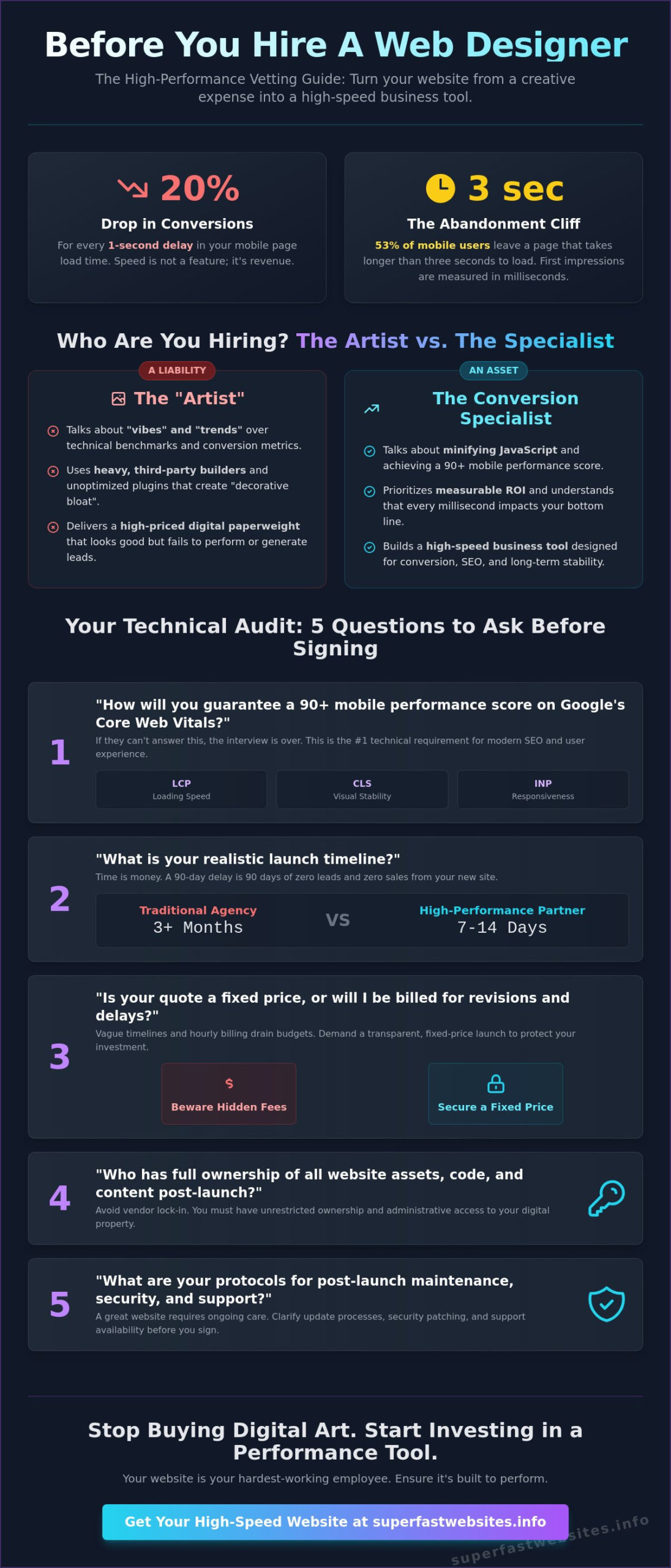
A one second delay in your mobile load time can impact your conversion rates by up to 20%. In a 2026 market where 53% of mobile users abandon a page after just three seconds, your choice of partner is a financial decision, not an aesthetic one. Knowing exactly what to ask a web designer before hiring is the only way to avoid the trap of "artistic fluff" that tanks your performance. You likely feel the anxiety of being stuck in an expensive development loop or getting hit with hidden fees after an initial $5,000 quote.
It is natural to feel confused by technical requirements like SSL certificates or the April 2026 WCAG 2.1 Level AA deadlines. You deserve a partner who prioritizes measurable ROI and technical authority over decorative bloat. This guide provides the specific framework you need to interview potential partners with confidence. We will examine the critical technical and commercial questions that separate slow-moving agencies from high-performance experts. You will learn how to secure a fast, fixed-price launch that treats your website as a high-speed business tool.
Key Takeaways
- Shift your perspective from aesthetic preferences to a technical audit that treats your website as a high-performance business tool.
- Identify exactly what to ask a web designer before hiring to guarantee your site meets Google’s strict Core Web Vitals targets from day one.
- Uncover the logistical red flags that separate transparent, fixed-fee partners from agencies that bill for every minor revision or delay.
- Protect your long-term investment by confirming full asset ownership and clear maintenance protocols before signing a contract.
- Understand how a performance-first vetting process eliminates development friction and secures a faster, high-conversion launch.
The High Cost of the Wrong Choice: Why Vetting Matters
Hiring a web designer is a high-stakes technical investment. Most business owners treat the web design process as a creative collaboration. This is a strategic error. An interview is not a chat about color palettes; it is a technical audit. If you don't know exactly what to ask a web designer before hiring, you risk entering an "infinite loop" of development. These vague timelines drain small business budgets and delay market entry. A successful hire prioritizes speed, conversion, and clarity over artistic fluff. Performance-first logic is the only way to guarantee a measurable return on investment.
Vetting for Performance vs. Aesthetics
A beautiful website that loads slowly is a liability. It doesn't matter how professional your logo looks if your page takes five seconds to render. Data from 2026 shows that 53% of mobile users abandon a site if it takes longer than three seconds to load. During the interview, you must distinguish between "artists" and "conversion specialists". Artists talk about vibes and trends. Specialists talk about minifying JavaScript and optimizing server response times. Technical authority creates business reliability. You need a partner who understands that every millisecond of delay is a direct hit to your bottom line. Knowing what to ask a web designer before hiring ensures you don't end up with a high-priced digital paperweight; for an example of how strategic design helps brands stand out, check out PurpleCow Digital Marketing.
The ROI of a Rapid Launch
Speed is a competitive advantage. Consider the opportunity cost of a traditional 3-month development cycle versus a streamlined 7-day launch. While a slow agency is still tweaking font sizes, a high-performance partner has already put your business in front of customers. Momentum is critical for startups and small business marketing efforts. A 90-day delay isn't just lost time; it is 90 days of zero leads and zero sales. Efficiency is the core of a profitable digital strategy. Set clear expectations for a project kick-off that moves quickly from a technical problem to a high-speed solution. Your goal is a fast, fixed-price launch that respects your budget and your time.
Performance-First Questions: Vetting for Speed and SEO
Visual appeal is a commodity; performance is a competitive edge. In 2026, 47% of people expect a website to load in under two seconds. If your site lags, your brand loses credibility instantly. Knowing exactly what to ask a web designer before hiring prevents you from buying a slow, bloated asset. You need a partner who views code as a tool for revenue, not just a canvas for art. Technical authority is built on measurable data, not subjective design opinions.
Start by asking: "How do you ensure the site hits Google’s Core Web Vitals targets?" This is the most critical question in your vetting process. Google’s 2026 algorithm prioritizes technical metrics like Largest Contentful Paint (LCP) and Cumulative Layout Shift (CLS). When hiring a web developer, verify their understanding of these benchmarks. If they can't provide a strategy for achieving a 90+ mobile performance score, they aren't the right fit for a growth-focused business.
Follow up with a question about mobile responsiveness on low-bandwidth connections. A site that performs well on an office fiber line might fail on a 4G network. Ask if they use lightweight code or heavy, third-party builders. Bloated builders often inject unnecessary scripts that kill loading speeds. Technical SEO isn't a plugin you install at the end. It must be baked into the site's architecture from the first line of code. If you want an efficient digital presence, these technical foundations are non-negotiable.
Core Web Vitals and Mobile Performance
Google prioritizes instantaneous loading because users demand it. In 2026, a one-second delay in mobile load times can slash conversion rates by 20%. Ask potential partners about their image optimization and server-side performance strategies. Modern web development requires serving Next-Gen image formats and utilizing edge caching. If a designer relies on "bloatware" or unoptimized plugins, your mobile search rankings will plummet. Every byte of unnecessary data is a barrier between you and a customer. Knowing what to ask a web designer before hiring helps you filter out those who ignore these vital metrics.
Standardised Frameworks vs. Custom Chaos
Custom-coded "special" sites often become a nightmare of technical debt. They are difficult to patch, expensive to update, and prone to breaking during browser updates. A proven, standardised CMS offers the stability and security necessary for long-term growth. Vetting for clean, lightweight architecture supports rapid scaling. It ensures your site remains fast as you add pages or features. This approach eliminates the friction of custom-built errors and keeps your maintenance costs predictable. Choosing a standardized, high-performance framework is the only logical path for businesses that value reliability and speed.
Logistics and Launch: Questions About Timelines and Fees
Time is your most expensive resource. A slow development cycle doesn't just delay your launch; it actively kills your market momentum. When determining what to ask a web designer before hiring, you must move beyond design aesthetics and focus on the commercial contract. Forbes lists several essential questions to ask a web designer to ensure business alignment. You need to know exactly when the site goes live and precisely what it will cost. Anything less than total transparency is a red flag.
Hourly billing is a trap. In 2026, US agencies bill between $125 and $300 per hour for senior development work. This model incentivizes slow progress and inefficient communication. If a designer takes longer to fix a bug, they earn more. You pay for their inefficiency. A performance-first partner offers fixed-fee packages. This provides small businesses with the budget predictability they need to scale. Ask: "Is this a fixed-fee project or will I be billed for every revision?" Get the answer in writing before you pay a deposit.
Hidden costs often lurk in the fine print of a quote. Verify if the price includes SSL certificates, hosting, and domain name registration. These are technical essentials, not optional extras. If these are not included, your initial quote is a fiction. Transparent, tiered pricing ensures you know your total cost of ownership from day one. Knowing what to ask a web designer before hiring helps you avoid the "scope creep" that often doubles the final price of a project.
Fixed Pricing vs. The Hourly Billing Trap
Hourly models create a conflict of interest. Upfront, all-inclusive website packages provide peace of mind and protect your capital. Look for partners who offer a "done-for-you" service. This should include logo design and professional copywriting as standard. Spotting hidden extras is easy; if the price isn't all-in, it's probably going to grow. Efficient processes shouldn't cost more; they should cost less because they eliminate wasted hours.
Launch Cycles: Why 7 Days is the New Standard
The era of the three-month build is over. High-performance partners use standardized frameworks to deliver results in a fraction of the time. This isn't about using generic templates. It's about using a "standardised high-performance" build that prioritizes speed. You can secure The Multi-Page Marvel: A Fast Website in 7 Days without sacrificing quality. Vetting for speed ensures you start generating ROI while your competitors are still stuck in the design phase.
Post-Launch Reality: Questions About Support and Ownership
Launching your site is only the first phase of your digital investment. Ongoing costs for hosting, security, and maintenance in 2026 typically range from $3,600 to $24,000 per year. If you don't account for these figures during the vetting process, your total cost of ownership over three years can easily double your initial build price. One of the most critical things regarding what to ask a web designer before hiring is who retains control of the technical assets once the final invoice is paid. You must ensure you aren't locked into a proprietary system that makes your business a "digital tenant" rather than a landlord.
Ownership is not a given in the web industry. Some agencies use restrictive contracts that prevent you from moving your site to a different host without rebuilding it from scratch. This creates a "hostage" situation that limits your business agility. Ask: "Do I have full ownership of the domain and content upon launch?" Clear intellectual property terms are non-negotiable. You need a partner who provides a lightweight, portable framework that you can manage independently if necessary. If you want to secure your long-term digital independence, choose a partner that prioritises client ownership.
Technical support is the backbone of your site's reliability. Security updates and software patches must be handled proactively to prevent downtime. In 2026, the U.S. Department of Justice mandates that many public entities meet WCAG 2.1 Level AA standards by April 24, 2026. Smaller entities have until April 26, 2027. Your maintenance package should guarantee compliance with these evolving regulations. Ask for a specific service level agreement (SLA) that defines response times for critical technical issues. Reliability is built on these technical details, not on vague promises of "support."
Ownership Rights and Domain Control
There is a critical distinction between renting a site and owning the assets. You must have direct control over your domain name registration and hosting accounts. If a designer registers your domain in their name, they effectively own your brand's digital address. Vetting for transparency in contract terms regarding intellectual property protects your capital. Ensure that all files, databases, and professional copywriting are legally yours from day one. Knowing what to ask a web designer before hiring prevents costly legal or technical hurdles later.
Hosting, Security, and SSL Management
Secure cloud hosting is non-negotiable for business credibility and SEO performance. SSL certificates are no longer optional; they are a fundamental requirement for user trust and search rankings. Ask how the designer handles SSL certificate provision and renewal. A failed certificate can trigger browser warnings that drive away 100% of your traffic. Your maintenance package should cover automated backups, 24/7 uptime monitoring, and instantaneous security patches. This level of technical authority ensures your site remains a high-performance tool that supports business growth without interruption.
The Superfast Solution: Answering the Tough Questions
You have identified the risks of slow builds, hidden fees, and technical debt. Knowing what to ask a web designer before hiring gives you a vetting framework, but you still need a partner who provides the right answers. Superfast Websites was built to eliminate the friction that defines traditional agencies. We don't just answer the tough questions; we render them obsolete through technical efficiency. Our "Performance-First" philosophy ensures every line of code serves a commercial purpose. We prioritize speed and conversion because 2026 data proves millisecond improvements drive revenue growth.
Traditional agencies often hide behind vague timelines and hourly rates. We replace that uncertainty with transparent, fixed-fee packages tailored specifically for the UK SME market. Our 7-day launch guarantee isn't a marketing gimmick. It is the result of a highly optimized, standardized workflow that respects your time and capital. We have stripped away the bloat to focus on what matters: delivering a high-speed asset that works. You get a fixed price, a fixed timeline, and a website that hits Google's Core Web Vitals targets from the moment it goes live.
The vetting process often reveals a lack of technical authority in the industry. Many designers can make a site look good, but few can make it perform under pressure. When you consider what to ask a web designer before hiring, the answer should always lead back to measurable ROI. Our process includes everything from domain name registration to SSL certificate provision, ensuring you have a secure, professional presence without managing multiple vendors. We handle the technical heavy lifting so you can focus on running your business.
Lightweight Design, Heavyweight Results
Our development framework is engineered for instantaneous loading. We combine decades of marketing expertise with modern, AI-assisted coding to build lightweight architectures that scale. This approach avoids the technical debt of custom-coded chaos. Instead, we create scalable lead generation tools that support your growth. Learn more about our approach to B2B Web Development: Building High-Performance Lead Engines. We treat your site as a business tool, not a digital brochure.
Start Your Performance Journey Today
Choosing the right package is simple and direct. Whether you need the One Page Wonder for a focused launch or the Multi-Page Marvel for a comprehensive presence, our onboarding is streamlined for efficiency. You provide the brief; we handle the logo design, professional copywriting, and SEO integration. We move from initial deposit to a live, optimized site in exactly one week. Don't let your business sit in a three-month development queue. Get your high-performance website launched now and start outperforming your competition today.
Secure Your High-Performance Digital Future
Armed with the knowledge of what to ask a web designer before hiring, you're now equipped to bypass the "slow agency" trap. Your website is a business tool; its value is measured in milliseconds and conversion rates. You've learned to prioritize technical benchmarks like Google's Core Web Vitals and to demand total transparency regarding asset ownership. Choosing a partner who offers fixed-fee pricing and UK-based technical support ensures your budget remains predictable while your performance stays elite.
Superfast Websites delivers technical authority with zero hidden costs. We eliminate the friction of traditional three-month development cycles by providing a streamlined process that hits every performance target. Our websites are built for speed and strict 2026 technical compliance from day one. It's time to stop settling for artistic fluff and start investing in measurable results. Launch your performance-first website in just 7 days. Your journey toward a faster, more profitable digital presence starts with a single, efficient decision.
Frequently Asked Questions
What is the most important question to ask a web designer?
The most critical question is: "How do you prove that this site will generate a measurable ROI through technical performance?" You need a partner who prioritizes speed and conversion metrics over subjective aesthetics. This is the core of what to ask a web designer before hiring. If they cannot explain how their technical choices link directly to your revenue growth, they are building a liability, not an asset.
Should I provide the copywriting for my new website?
You can provide your own text, but we include professional copywriting in our high-performance packages to ensure your message converts. Effective web copy must balance user engagement with strict technical SEO requirements. Most business owners lack the specific training to write for 2026 search algorithms. Delegating this task to experts ensures your site remains lightweight and focused on driving instantaneous user action.
How much should a small business website cost in 2026?
A professional 5-10 page website for a small business typically costs between $3,000 and $8,000 in 2026. Basic sites with 5-8 pages range from $2,000 to $5,000; while custom business sites with up to 20 pages can reach $15,000. These figures represent the initial build. You must also budget for the total cost of ownership, as ongoing maintenance and hosting can range from $3,600 to $24,000 annually.
Do I need to pay for hosting and maintenance separately?
Yes, hosting and maintenance are ongoing operational expenses that are separate from the initial design fee. These services ensure your site remains secure, updated, and compliant with 2026 standards. We provide integrated hosting and support packages to eliminate the friction of managing multiple technical vendors. This approach guarantees that your SSL certificates and security patches are handled with uncompromising efficiency and technical authority.
How long does it typically take to build a professional website?
While traditional agencies often take three to four months, our performance-first process delivers a live site in exactly seven days. The standard industry timeline is often inflated by inefficient communication and bloated development cycles. We use a standardized framework to bypass these delays. This rapid launch allows your business to start capturing leads while your competitors are still stuck in a long development loop.
Will my website be mobile-friendly and SEO-optimised?
Every site we build is mobile-first and has technical SEO baked into its core architecture. In 2026, mobile responsiveness is the baseline, not a feature. We optimize for Core Web Vitals to ensure your site ranks highly in both traditional search and AI-driven platforms. This technical authority ensures your brand remains visible and resilient against frequent algorithm updates while maintaining elite loading speeds.
What happens if I want to update my website myself later?
We provide a user-friendly CMS that allows you to make instantaneous updates without touching the underlying code. You will have the technical autonomy to change text, images, and blog posts as your business evolves. We also offer ongoing support if you prefer to delegate these updates to our technical team. This flexibility ensures your site remains a dynamic business tool rather than a static, outdated brochure.
Do I own my website and domain name if I hire a designer?
You retain 100% ownership of your domain name and website content upon final payment. We handle domain name registration and SSL certificate provision in your name to ensure you are the legal owner of your digital assets. This is a critical detail regarding what to ask a web designer before hiring. Avoiding proprietary lock-in systems is essential for your long-term digital independence and business agility.