
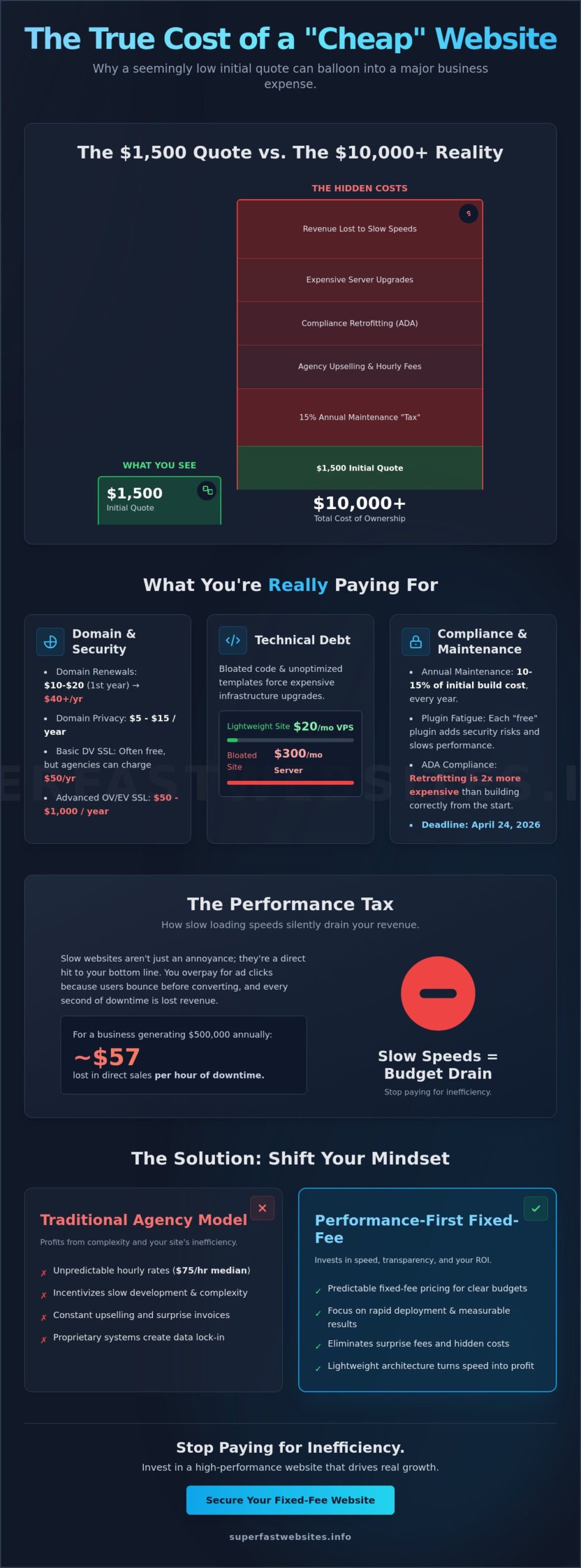
The $1,500 budget website often ends up costing small businesses over $10,000 once you factor in the 15% annual maintenance tax and the revenue lost to slow loading speeds. You've likely felt the sting of the hidden costs of building a website through unexpected monthly invoices and proprietary systems that keep your data hostage. It's a common trap in an industry that prioritizes flashy design over technical efficiency. Speed isn't just a feature; it's the foundation of your bottom line.
I'll show you how to strip away digital bloat and secure a high performance site that generates real ROI. We'll identify every surprise fee, from the $1,000 Extended Validation SSL certificates to the April 24, 2026 ADA compliance mandates that recently forced major infrastructure updates. This guide provides a clear roadmap to predictable fixed-fee pricing and a lightweight architecture that turns every millisecond of speed into profit. You'll finally understand exactly what's a one-time investment and what's a recurring necessity. Stop paying for inefficiency and start investing in performance.
Key Takeaways
- Distinguish between essential recurring fees and predatory agency markups to protect your operating margins.
- Identify how technical debt and unoptimized code force you into expensive server requirements that drain your monthly budget.
- Quantify the direct link between site speed and advertising efficiency to stop overpaying for every click.
- Eliminate the hidden costs of building a website by adopting a fixed-fee model that guarantees budget predictability.
- Understand why high-performance copywriting is a technical necessity for converting traffic into measurable revenue.
The Illusion of 'Cheap': Why Initial Quotes Often Lie
A design quote is a baseline, not a total cost of ownership. The hidden costs of building a website include any expense not explicitly detailed in that initial proposal. These range from essential infrastructure like domain renewals to predatory agency markups on standard services. In May 2026, the industry standard for annual maintenance is 10% to 15% of the initial build cost. If your quote ignores these recurring numbers, it's a financial trap. You're buying a liability, not an asset.
We advocate for a performance-first budget. This model prioritizes technical efficiency over aesthetic bloat. It treats speed as a revenue driver. By accounting for every millisecond and every recurring fee upfront, you eliminate the surprise invoices that drain small business growth. Understanding the difference between a one-time fee and a perpetual drain is the first step toward digital profitability.
The "Low-Entry" Trap of DIY Platforms
"Free" website builders are often the most expensive choice for a growing business. They lure users with a zero-cost entry point but hide the requirements for premium plugin tiers. A basic site quickly escalates as you add e-commerce functionality or advanced SEO tools. You also face proprietary lock-in. Migrating away from these platforms is notoriously difficult and expensive. It often requires a complete rebuild from scratch.
Standard domain extensions like .com cost $10 to $20 for the first year, but renewal fees often jump to $40 annually. Many "free" platforms also charge for essential security. While basic Domain Validated (DV) SSL certificates can be free, some providers charge up to $50 per year. Domain privacy protection adds another $5 to $15. These small fees compound, creating a high-cost environment for a low-performance product. This creates Technical Debt, where choosing the easy path now leads to expensive rework later.
Agency Upselling vs. Transparent Fixed-Fees
The traditional agency model relies on hourly rates. In the US, freelance developers charge a median of $75 per hour. This model incentivizes slow development and complexity. Agencies often build "bespoke" solutions that require constant, paid intervention for simple updates. They profit from your site's inefficiency. Every bug or slow-loading page becomes a billable event.
Contrast this with standardized, high-performance frameworks. A fixed-fee model provides budget predictability. It replaces the "hourly rate" uncertainty with clear, tiered pricing. This approach focuses on rapid deployment and measurable ROI. You pay for the outcome, not the hours spent fixing unoptimized code. Transparency in pricing ensures your capital goes toward growth, not maintaining digital bloat. Predictable costs lead to predictable profits.
Technical Debt: The Hidden Infrastructure Costs
Technical debt is a financial liability. It's the future cost of choosing an easy, low-quality solution now instead of a performance-first architecture. When your site is built on bloated code or unmaintained templates, you're borrowing against your future revenue. Technical debt is a primary driver of the hidden costs of building a website because it compounds over time. By May 2026, unoptimized code doesn't just impact speed; it increases your server requirements. A lightweight site might run perfectly on a $20 VPS, while a bloated one requires a $300 dedicated server just to stay online during moderate traffic spikes.
The financial risk extends beyond server bills. As of April 24, 2026, many organizations must comply with WCAG 2.1 Level AA standards for digital accessibility. Ignoring these requirements during the initial build creates a massive compliance debt. Retrofitting a non-compliant site for ADA accessibility is often twice as expensive as building it correctly from the start. High-performance development isn't an indulgence. It's a risk management strategy.
Hosting and Security: Beyond the £5/Month Promise
Budget shared hosting is a performance killer. It places your business on a server with thousands of other sites, leading to unpredictable latency and security vulnerabilities. Professional hosting requires a secure, cloud-optimized environment that prioritizes uptime and speed. Essential security features like SSL certificate provision are non-negotiable. While basic certificates are sometimes included, Organization Validated (OV) or Extended Validation (EV) certificates can cost between $50 and $1,000 annually. An hour of downtime for a business generating $500,000 in annual revenue costs approximately $57 in direct sales alone.
Maintenance Bloat and Plugin Fatigue
Every "free" plugin you add introduces a new security hole and a performance drag. Plugin fatigue is a silent profit killer. Most small business owners spend hours each month manually updating software and fixing broken integrations. With the median developer rate in the US sitting at $75 per hour, these "quick fixes" quickly outpace the cost of a professional solution. Transitioning to a managed, performance-first environment like Super Fast Websites eliminates these manual bottlenecks. Automated maintenance and lightweight code ensure your budget goes toward growth rather than perpetual repairs. Efficiency is the only way to escape the cycle of technical debt.
The Performance Tax: How Slowness Drains Your Budget
Speed is a financial multiplier. Every millisecond shaved from your load time directly lowers your cost-per-acquisition (CPA). Conversely, digital bloat acts as a hidden tax on your marketing budget. In 2026, ad platforms like Google and Meta use landing page experience as a primary factor in auction pricing. If your site is slow, you pay more for the same click than a faster competitor. This makes the hidden costs of building a website far more than just development fees; they are active drains on your daily advertising spend. Performance is the silent driver of your profit margins.
Slowness kills the momentum of a sale. When a page takes longer than 2 seconds to load, the probability of a bounce increases by over 100%. By the 4-second mark, you've lost nearly half of your potential customers. In the e-commerce sector, abandoned carts are often the result of technical friction rather than price. High-performance architecture ensures that your technical metrics support your revenue goals instead of undermining them. You can't afford to ignore the causal link between server response times and bank balances.
The Cost of Lost Conversions
The Performance Tax is the measurable revenue gap between your current conversion rate and the rate achievable with an instantaneous interface. A site loading in 1 second typically sees a conversion rate 3x higher than a site loading in 4 seconds. Google's 2026 algorithm updates place even greater weight on Core Web Vitals. This means slow sites face higher SEO maintenance costs just to maintain their existing rankings. Slowness is a recurring expense that never stops billing you.
DIY Builders vs. Performance-First Design
Initial savings on a DIY builder are an illusion when viewed through a three-year cost of ownership lens. While a low-cost builder seems attractive, the "Time Tax" of staff hours spent wrestling with unoptimized layouts is a massive drain. Small business owners often spend 5 to 10 hours a month fixing broken elements or waiting for heavy editors to load. At a $75 hourly value, that's $9,000 in lost productivity over three years. You're paying for "cheap" tools with your most valuable resource.
Technical efficiency is the core of successful b2b web development. High-performance lead engines require lightweight code to ensure that every visitor interaction is instantaneous. When your site responds immediately, you capture leads that would otherwise disappear during a loading sequence. Investing in a performance-first design eliminates the performance tax and turns your website into a high-yield asset. Every millisecond matters for your bottom line.
Marketing and Content: The Perpetual Budget Drain
Marketing ROI is a direct function of technical performance. High-performance design lowers your customer acquisition cost by ensuring every paid click lands on a page capable of converting. Unoptimized sites often require double the ad spend to achieve the same results as a lightweight competitor. This inefficiency represents one of the most persistent hidden costs of building a website. You're paying for traffic that your site cannot convert due to technical friction or poor layout. It's a cycle of waste that starts with poor architecture and ends with a drained marketing budget. Speed is the foundation of every successful campaign.
Words are technical assets, not just decorative filler. Unprofessional copy for websites creates friction in the user journey. It fails to answer user intent and drives bounce rates higher. Similarly, poor imagery erodes brand authority instantly. While we don't provide commercial photography, sourcing high-quality, unique assets remains a necessary investment for conversion. Generic stock photos signal a lack of authenticity. Data from May 1, 2026, indicates that 83% of consumers abandon brands that use generic, unrepresentative imagery. Investing in unique visuals is a prerequisite for building digital trust.
SEO and Visibility: Why You Can’t Just "Launch and Leave"
SEO is a continuous process of optimization and content alignment. A "launch and leave" approach ensures your site will be invisible within three months. Technical "SEO-ready" architecture is merely the baseline, not the finish line. Retrofitting SEO into a bloated site later is 50% more expensive than starting with a clean, performance-first build. High-performance sites naturally lower your long-term SEO bills because search engines prioritize speed and user experience. You save capital by not fighting against your own technical limitations every month.
Content Management and Asset Creation
Complex CMS platforms are silent profit killers. If you require a developer for every minor text update, your maintenance budget is fundamentally broken. We prioritize streamlined, lightweight interfaces that empower your team to make changes instantly without billable hours. Professional logo design and branding provide a 22% higher conversion rate for new startups compared to generic identities. Structured content allows for seamless future expansions without expensive structural overhauls. This foresight protects your capital and ensures your site grows at the pace of your business.
Build a high-performance marketing engine with Super Fast Websites.
Eliminating Hidden Costs with Fixed-Fee Web Design
Predictability is the ultimate antidote to the hidden costs of building a website. We reject the traditional agency model that relies on hourly billing and perpetual upselling. Instead, our performance-first approach uses a fixed-fee structure to ensure your capital is spent on growth, not troubleshooting. The Multi-Page Marvel is our flagship solution for businesses requiring a complete, high-performance engine without the financial noise of surprise invoices. This model provides a clear distinction between your initial investment and your recurring operational costs.
Our packages are all-inclusive by design. We integrate hosting, technical support, and SSL certificate provision into a single, managed ecosystem. This eliminates the risk of technical debt and prevents the price hikes common with third-party registrars. By centralizing your infrastructure, we ensure every technical choice—from server-side caching to lightweight code—is optimized for a single metric: your ROI. You receive a professional, high-end specialist result without the administrative bloat of managing multiple vendors.
Why Speed and Transparency Are Your Best Budget Tools
Performance-first logic is a financial strategy. By delivering sites that load in under 2 seconds, we eliminate the Performance Tax that typically drains marketing budgets. Our 7-day launch cycles ensure you move from investment to revenue generation in a fraction of the time required by traditional developers. When choosing an e-commerce website development company, look for fixed-price models that prioritize technical efficiency over decorative fluff. Speed is the only metric that guarantees a lower cost-per-acquisition in the competitive 2026 landscape.
Your 2026 Website Roadmap
Navigating the modern web requires a rigorous evaluation of any design quote. Use this checklist to identify potential budget drains before they occur:
- Verify full ownership of your domain name and digital assets to avoid proprietary lock-in.
- Demand a lightweight CMS that allows your team to update content without developer fees.
- Ensure compliance with April 24, 2026 ADA accessibility standards is included in the initial build.
- Confirm that your hosting environment is cloud-optimized for speed, not just "budget-friendly" shared space.
A website should be a high-performance asset, not a perpetual liability. By choosing a fixed-fee, performance-first model, you secure a predictable budget and a superior technical foundation. Don't let digital bloat and hidden fees stall your business growth. Get a high-performance website without the hidden fees.
Secure Your Revenue with Performance-First Architecture
Building a digital presence in 2026 requires more than a visual template. It demands a technical strategy that treats every millisecond as a revenue driver. You've seen how technical debt and the performance tax of slow loading speeds create the hidden costs of building a website that drain small business budgets. Choosing a foundation of bloated code is a long-term financial liability. True digital efficiency comes from stripping away the unnecessary to focus on measurable ROI and budget predictability.
We leverage decades of marketing expertise from VIA Creative to deliver mobile-responsive, SEO-optimised sites that perform under pressure. Our fixed-fee packages eliminate surprise invoices and proprietary lock-ins. You don't have to wait months for a high-end solution that converts traffic into profit. Launch your performance-first website in just 7 days with fixed-fee pricing. It's time to stop paying for digital bloat and start investing in instantaneous speed. Your growth depends on a site that works as hard as you do.
Frequently Asked Questions
What is the biggest hidden cost of building a website in 2026?
The performance tax is the most significant hidden expense facing businesses today. While initial build costs are visible, the revenue lost to a 4-second load time represents a perpetual drain on your marketing budget. Slow sites suffer from 100% higher bounce rates than those loading in under 2 seconds. This technical inefficiency acts as a recurring penalty that erodes your profit margins every single day.
Do I really need to pay for website maintenance every month?
Monthly maintenance is essential to prevent the accumulation of technical debt and security vulnerabilities. A common industry rule of thumb is to budget 10% to 15% of the initial build cost for annual maintenance. This covers software updates, security patches, and performance monitoring. Without it, your site becomes a liability that eventually requires a complete and expensive rebuild to function correctly.
Why are some web design quotes so much cheaper than others?
Cheap quotes often ignore the hidden costs of building a website by excluding essential infrastructure like SSL certificates and domain privacy. Low-cost providers typically use bloated, pre-made templates that require expensive server resources to run. A performance-first quote might look higher initially, but it eliminates the surprise invoices and performance taxes that make cheap sites the most expensive option over a three-year period.
Are there hidden costs associated with using AI website builders?
AI builders introduce significant hidden costs through staff time spent on manual tweaks and technical maintenance. While the initial generation is fast, the time tax for non-technical staff to fix unoptimized layouts can cost thousands in lost productivity. You also face proprietary lock-in. Migrating your data to a high-performance platform later requires a total and costly rebuild of your entire digital infrastructure.
How much should a small business budget for website hosting and security?
Budgeting depends on traffic volume and security needs. Shared hosting ranges from $2 to $10 per month but often compromises speed. For growth, VPS hosting costs between $10 and $60 monthly. High-traffic sites require dedicated hosting starting at $80. Essential security like Organization Validated (OV) SSL certificates can range from $50 to $250 per year, while domain privacy protection adds another $5 to $15 annually.
What happens if I don’t update my website plugins and software?
Neglecting updates leads to critical security vulnerabilities and performance degradation. Outdated software is the primary entry point for 90% of website hacks. Additionally, unmaintained plugins often become incompatible with newer server languages like PHP 8.3. This breaks site functionality and creates a broken user experience that kills conversion rates and erodes brand trust. You pay for neglect with lost sales and expensive emergency repairs.
Can a slow website actually cost my business money?
A slow website is a direct revenue drain. Data shows that a 1-second site converts 3x better than a 4-second site. In 2026, ad platforms penalize slow landing pages with higher cost-per-click rates. You pay a performance tax on every visitor, making your marketing twice as expensive as it should be. Speed is a technical metric with a direct, causal link to your bank balance.
What is the difference between a one-time design fee and recurring costs?
A one-time design fee covers the strategic architecture and visual build of your site. Recurring costs include the hidden costs of building a website such as domain renewals ($15 to $40), hosting, and managed support. Think of the design fee as buying the car and recurring costs as the fuel and service. Both are necessary to ensure your digital asset remains a high-performance lead generator that produces measurable ROI.