
The $18 per month you pay for a DIY template is likely the most expensive line item on your balance sheet. You probably chose a website builder to save capital and launch quickly. It's a logical choice when you are focused on the immediate bottom line. However, the debate of diy website vs professional designer is no longer about which one looks better. It's about technical debt. By May 2026, Google's E-E-A-T requirements and the April 24, 2026, WCAG 2.1 AA deadline have turned "cheap" sites into significant legal and SEO liabilities.
You don't need a digital brochure; you need a high-performance engine. This guide skips the marketing fluff to reveal why milliseconds of latency cost more than agency fees. You will discover how to bypass the 3-month launch timelines of traditional agencies while avoiding the digital bloat of restrictive templates. We'll break down the real cost of ownership in 2026, from $15,000 migration fees to the ROI of an instantaneous, accessible site that actually ranks and converts.
Key Takeaways
- Understand why Google's 2026 Core Web Vitals penalize the "digital bloat" inherent in drag-and-drop builders, directly impacting your search ranking.
- Compare the total cost of ownership in the diy website vs professional designer debate, including hidden migration fees that often exceed $15,000.
- Quantify the "Time-Suck" factor by calculating the opportunity cost of 40+ hours spent on amateur development versus revenue-generating activities.
- Apply a performance-first decision framework to determine if your current platform can handle the technical demands of 2026 accessibility regulations.
- Discover the rapid deployment model that bridges the gap between low-quality DIY tools and slow, high-cost traditional agencies.
The DIY Website Trap: Why Free Tools Often Cost More
The low-cost entry of a DIY builder is a psychological anchor designed to ignore long-term financial leakage. Most business owners view the diy website vs professional designer debate through a narrow lens of initial cash outlay. They see a $29 monthly fee and assume they've saved thousands. This is a calculation error. By May 2026, the market has shifted. A site that merely exists is a liability. A site that performs is an asset. When you choose the DIY route, you aren't saving money; you're deferring a much larger bill for technical debt and lost conversions.
Technical frustration is the silent killer of business growth. Drag-and-drop interfaces promise ease but deliver rigid constraints. You spend hours fighting a header alignment or a mobile responsive break-point. Web design encompasses a complex range of disciplines, including interface design, standardized code, and user experience. Amateur development ignores these fundamentals. The result is a generic, slow-loading site that looks like every other template on the web. It lacks the technical authority required to command premium prices in a competitive 2026 landscape.
The Hidden Subscription Economy
DIY platforms are built on a "freemium" trap. A Wix Core plan starts at $29 per month, but that's rarely the final price. To get basic functionality like advanced analytics, custom forms, or e-commerce features, you'll likely scale to the Business Elite plan at $159 per month. Typical monthly costs for "pro" DIY setups now range between $100 and $500 once you add third-party apps to fix missing features. These apps introduce digital bloat, slowing your site and creating security vulnerabilities. Ad-supported free versions are even worse. They destroy your brand authority instantly. No serious client trusts a business that can't afford its own hosting.
Opportunity Cost: Your Time vs. Your Business
Your time has a specific dollar value. If your hourly rate as a CEO or founder is $150, the 40 hours you spend building a mediocre site costs your business $6,000 in lost revenue-generating activity. Most DIY projects remain "under construction" for three to six months because the learning curve for SEO and performance optimization is steep. You're trying to master 2026 accessibility standards, like the April 24, 2026, WCAG 2.1 AA deadline, instead of closing deals. Hiring a specialist isn't an expense. It's an efficiency play that returns your focus to your core competency while delivering a high-performance tool in days, not months.
Technical Debt and Performance: The Engineering Gap
Performance isn't an optional feature. It's the foundation of your revenue. Most business owners ignore the engineering gap when weighing a diy website vs professional designer. DIY builders prioritize user convenience for the creator over machine efficiency for the visitor. This trade-off creates digital bloat. Your visitor's browser must parse thousands of lines of redundant code just to display a simple headline. In 2026, this technical inefficiency is a terminal diagnosis for your search rankings.
Google's 2026 algorithm updates have moved beyond simple loading times. They now demand instantaneous interaction. If your site's Interaction to Next Paint (INP) exceeds 200 milliseconds, your visibility drops. DIY frameworks often load 1.5MB of JavaScript before a user can even scroll. This isn't just a technical annoyance. It's a conversion killer. While a comprehensive website cost guide might show lower entry fees for DIY platforms, it cannot account for the thousands in lost sales triggered by a 3-second lag. Mobile-responsive design is no longer enough. You need a mobile-first architecture that prioritizes thumb-friendly interaction and lightweight assets from the first byte.
Clean Code vs. Visual Builders
Visual builders are heavy by design. They rely on bloated CSS and massive JavaScript libraries to make drag-and-drop possible. Professional designers use lightweight frameworks that deliver only the necessary code to the browser. Server-side optimization ensures your Largest Contentful Paint (LCP) happens in under 1.2 seconds. This technical authority creates a seamless user experience that DIY tools cannot replicate. If you want to see how elite engineering transforms speed, explore our performance-first solutions.
SEO and Search Visibility in 2026
Technical SEO is the primary battlefield in 2026. Meta tags are basic table stakes. Search visibility now depends on crawl budget efficiency. If Google’s bots get stuck in a maze of messy DIY code, they won't index your high-value pages. Site architecture must be logical and instantaneous to prove authority. Millisecond improvements are directly linked to higher rankings. A professional build ensures your code is lean, your SSL is managed, and your server environment is optimized to meet the strict E-E-A-T standards required by modern search engines.
Security is the final pillar of this engineering gap. Amateur setups often rely on unmanaged plugins that create backdoors for malware. A professional designer implements a hardened security layer at the server level. This prevents the catastrophic downtime that frequently plagues DIY sites. In a digital economy, reliability is your most valuable currency.
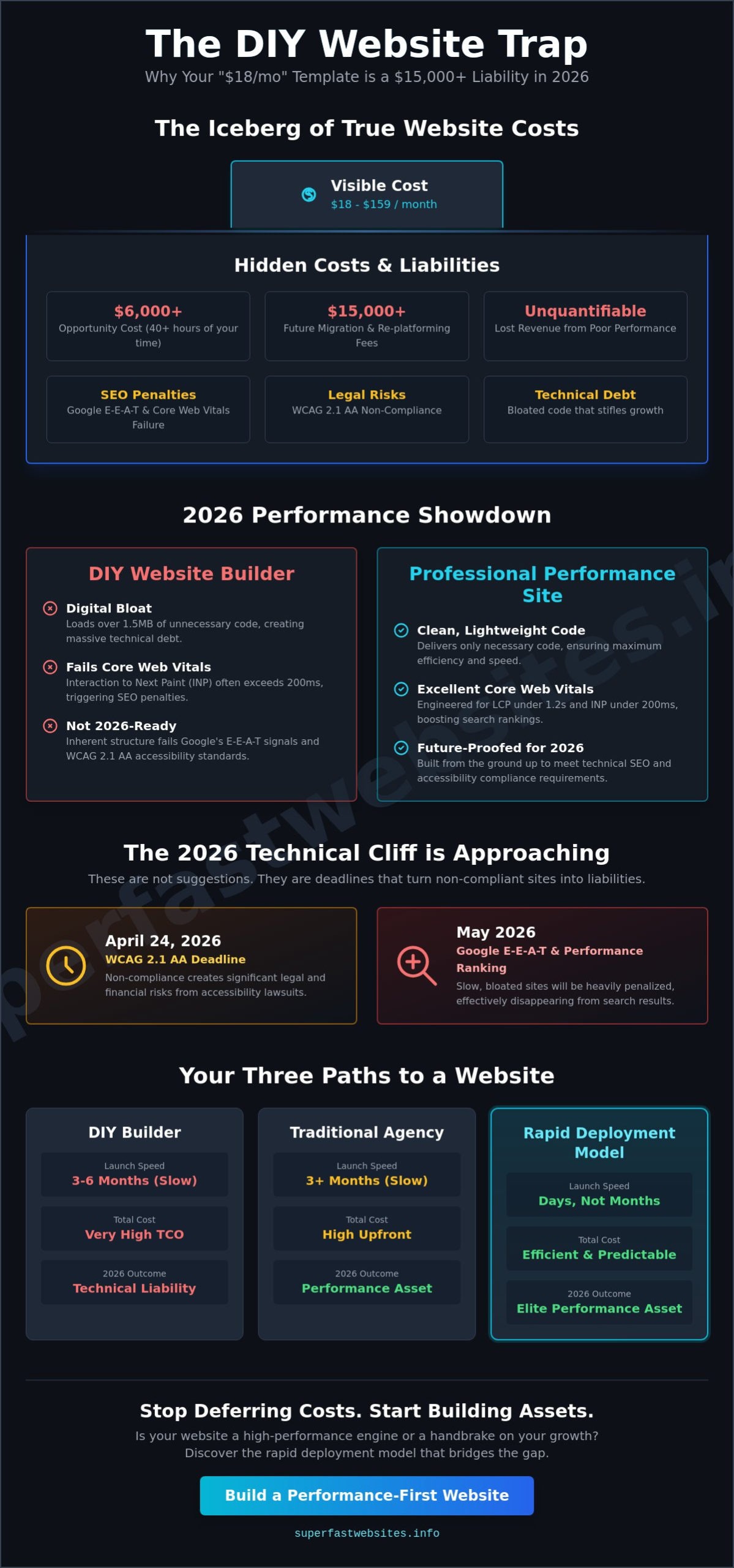
DIY vs. Traditional Agency vs. Rapid Deployment
The choice in the diy website vs professional designer debate used to be binary. You either spent 40 hours fighting a template or waited 12 weeks for an agency to deliver a custom build. This binary is obsolete. Traditional agencies charge between $5,000 and $15,000 for a basic 10-page site. They prioritize aesthetic customization over deployment speed. DIY builders offer a $29 entry point but trap you in a cycle of poor technical performance. Rapid deployment has emerged as the third path. It combines professional-grade engineering with a 7-day launch cycle.
Scalability is where the DIY model collapses. Industry data shows Wix users often hit a performance ceiling at $500,000 in annual revenue. Moving to a robust platform like Shopify can then cost between $15,000 and $50,000. It takes up to 12 weeks to migrate. When evaluating a diy website vs professional designer, you must consider these long-term migration costs. Choosing a professional build from day one eliminates this technical debt. You need a site that scales without a total rebuild. This ensures your infrastructure supports growth rather than hindering it.
The Cost-Performance Matrix
Upfront project fees tell only half the story. Agency-managed maintenance typically costs $500 to $3,000 per month. DIY maintenance is "free" but requires your constant attention to fix broken plugins or security patches. Your choice of an ecommerce website development company determines your long-term hosting reliability. A performance-first partner provides a fixed-fee structure. This eliminates the "agency quote" anxiety and ensures your server environment is optimized for conversion. Performance is the only metric that justifies the investment.
Launch Speed as a Competitive Advantage
Waiting is expensive. Every day your site is "under construction" is a day of zero revenue. A 3-month agency timeline is a massive opportunity cost. A standardized professional build delivers a high-performance "Minimum Viable Product" in just one week. This eliminates the "Design Purgatory" phase where projects stall due to endless revisions. Speed to market is your greatest competitive advantage in 2026. A site launched in seven days starts ranking and gathering data immediately. A site stuck in development is a stagnant expense. Rapid deployment prioritizes momentum over perfection, ensuring you capture market share before the competition even finishes their wireframes.
Decision Framework: When to Build and When to Hire
Choosing between a diy website vs professional designer is a calculation of risk, not just preference. If your website is a hobby or a side project with no revenue targets, a $17 monthly Wix Light plan is a sufficient starting point. However, if your site is a revenue-generating asset, DIY is a liability. You must audit your budget based on potential earnings. A professional build is an investment in infrastructure that supports scaling. A DIY site is often a temporary patch that requires a costly replacement as soon as your business gains momentum.
Assess your technical literacy honestly. Building a site in 2026 requires more than choosing a font. You must manage server environments, ensure SSL certificates are active, and meet the PHP 7.4 requirements for the WordPress 7.0 release. Amateur setups frequently fail at the server level, leading to high latency that destroys your search ranking. If you cannot troubleshoot a broken database or optimize a CSS delivery path, you shouldn't be your own lead developer. Professional designers handle the technical debt so you can handle your clients.
Evaluate your timeline against your hourly rate. A professional designer using a rapid deployment model can take you from zero to live in 7 days. A traditional agency often takes 70 days or more. Building it yourself might seem "free," but it consumes 40 to 60 hours of your time. If your time is worth $150 per hour, your DIY site actually costs $9,000 in lost opportunity. You could spend those hours closing deals instead of fighting a drag-and-drop editor.
The Professionalism Litmus Test
Amateur markers drive customers to your competitors. Generic templates, inconsistent spacing, and slow-loading images signal a lack of authority. Your site must look elite to command elite prices. This starts with high-performance copy for websites that converts visitors into leads. Even your domain name registration strategy impacts brand trust. A professional build ensures every element, from the favicon to the footer, reinforces your market position.
The ROI Calculation
The real cost of a diy website vs professional designer appears 12 months down the line. Migration costs from a DIY platform to a professional setup like Shopify typically range from $15,000 to $50,000. You'll spend more fixing a "cheap" site than you would have spent building a professional one from the start. A 1% increase in site speed can result in a measurable revenue lift. Investing in a performance-first site now eliminates future technical debt and maximizes your immediate conversion rates. Get a high-performance site launched in 7 days.
Superfast Websites: Professional Performance, Accelerated
The conflict in the diy website vs professional designer debate often forces a choice between low-quality speed and high-quality delay. Superfast Websites eliminates this trade-off. Our "Multi-Page Marvel" approach delivers a high-performance, professionally engineered site in exactly seven days. We've stripped away the "Agency Quote" anxiety by implementing a transparent, fixed-fee structure. You know the cost and the delivery date before we start. There are no hidden maintenance fees and no 3-month development cycles. We prioritize your time because we know it's your most valuable resource.
Our architecture is performance-first by design. Every millisecond of latency is a barrier to revenue. While DIY builders pile on digital bloat to support drag-and-drop features, we use lightweight, optimized code to ensure instantaneous loading. We handle the entire technical infrastructure, including high-speed hosting, SSL management, and security patches. This setup allows you to focus on business growth while we maintain the engine. Reliability isn't just a feature; it's our core philosophy. We ensure your site stays online and fast, regardless of traffic spikes or platform updates.
High-Performance Features as Standard
Every site we deploy is built to pass 2026 Core Web Vital tests with 95+ scores. Mobile-responsive design is the bare minimum requirement. We prioritize mobile-first interaction that ensures your site is accessible and fast on every device, meeting the strict WCAG 2.1 AA standards. Our frameworks are AI-ready, using clean code that search engine crawlers can index with maximum efficiency. We integrate foundational SEO from the first byte. This gives small businesses a technical head start that generic templates simply cannot match. Performance is the only lens through which we view every design choice.
The Turnkey Solution for UK Small Businesses
We bridge the gap between amateur tools and expensive, slow-moving agencies. By combining decades of experience with rapid-deployment efficiency, we offer a specialized b2b web development service that functions as a high-performance lead engine. This is the definitive answer for those stuck in the diy website vs professional designer dilemma. You get the technical authority of an elite agency with the agility of a startup.
The next step is simple. Stop losing revenue to slow loading times and technical debt. You can have a professional, high-performance site live by next week. We handle the migration, the optimization, and the ongoing support. Your business deserves a platform that matches your ambition. Choose the path of efficiency and launch your professional site today.
Stop Paying the Hidden Cost of Amateur Infrastructure
The choice in the diy website vs professional designer debate determines your business's trajectory for 2026. You've seen how a $17 monthly fee masks thousands in lost opportunity and technical debt. Digital bloat and 3-second lag times are no longer just inconveniences; they're revenue killers that trigger search engine penalties. You don't have to choose between a restrictive template and a 3-month agency delay. High-performance engineering is now accessible through a rapid deployment model that prioritizes your ROI.
We provide fixed-fee pricing with no hidden agency extras. Every site is mobile-responsive and SEO-optimized as standard. By leveraging decades of professional experience via VIA Creative, we ensure your technical metrics remain superior. Stop fighting with restrictive builders and start scaling with an asset that actually converts. Your business deserves an instantaneous, accessible platform that supports your ambition rather than hindering it.
Launch your high-performance website in 7 days with Superfast Websites. It's time to trade technical frustration for measurable growth.
Frequently Asked Questions
Is a DIY website really free?
No. While entry-level tiers seem cheap, the true cost is high. Subscription fees for plans like Wix Business Elite reach $159 per month. You also lose approximately 40 to 60 hours of your time. If your hourly rate is $150, you've spent $9,000 in opportunity cost before the site even launches. DIY is a deferment of expense, not a saving.
How long does it take to build a professional website in 2026?
Traditional agencies still require 8 to 12 weeks for a custom build. This delay costs you two months of potential revenue. A rapid deployment model from a performance-first specialist delivers a fully optimized site in 7 days. In 2026, speed to market is a critical metric for business growth. Don't let a slow development cycle stall your momentum.
Can I move my DIY website to a professional host later?
Migration is difficult and expensive. Moving from a platform like Wix to Shopify costs between $15,000 and $50,000. It typically takes 6 to 12 weeks to execute correctly. Most DIY platforms use proprietary code that doesn't export easily. It's more efficient to start on a scalable, professional foundation than to pay for a total rebuild in 12 months.
Do professional designers include SEO in their packages?
Elite designers include technical SEO as a core requirement. This involves optimizing site architecture, crawl budgets, and meeting the April 24, 2026, WCAG 2.1 AA accessibility standards. DIY builders often lack these deep technical layers. A professional build ensures your code is lean and your server environment is optimized for Google’s 2026 E-E-A-T requirements from day one.
What is the main advantage of a professional designer over Wix or Squarespace?
The primary advantage in the diy website vs professional designer debate is the elimination of digital bloat. Professional sites use lightweight code and server-side optimization to achieve instantaneous loading. DIY builders sacrifice this speed for drag-and-drop ease. Since Google prioritizes milliseconds, a professional build provides a permanent ranking advantage that amateur tools cannot replicate.
Is a one-page professional website better than a multi-page DIY site?
Yes. A high-performance, single-page site that converts is superior to a slow, 10-page DIY site that users abandon. Quality of engineering always beats quantity of content. A professional site focuses on user intent and fast interaction. In 2026, a site that loads in under 1.2 seconds will always outperform a bloated DIY framework, regardless of page count.
How much should a small business spend on a website in 2026?
A professional small business site of 5 to 10 pages typically costs between $5,000 and $15,000. This investment covers custom engineering, security, and the April 2026 accessibility compliance standards. While DIY monthly fees are lower, they don't include the $5,000 to $8,000 cost of professional copywriting. Investing in quality infrastructure now prevents expensive technical debt later.
Will a DIY website rank on the first page of Google?
It's unlikely for competitive keywords. Google's late 2025 and 2026 updates prioritize technical excellence and human-centric authority. DIY frameworks often struggle with Core Web Vital metrics due to redundant JavaScript and CSS. A diy website vs professional designer comparison shows that professionally optimized code is the only way to meet the strict performance standards required for top-tier search visibility.